ECB signals readiness to tighten policy further while geopolitical instability reshapes the region’s economic outlook

The euro area is facing mounting risks of slipping into what policymakers are increasingly describing as an “adverse scenario,” as persistent inflationary pressures and geopolitical tensions continue to cloud the economic horizon. In its latest communications, the European Central Bank has struck a more cautious tone, warning that the balance of risks is tilting toward slower growth, heightened volatility, and prolonged uncertainty.
At the heart of the concern lies a complex interplay between inflation dynamics and external shocks. While price growth has shown signs of moderating from previous peaks, it remains stubbornly above the ECB’s target. Officials have emphasized that underlying inflation, particularly in services and wage-sensitive sectors, continues to exhibit resilience. This persistence complicates the central bank’s path forward, especially as economic momentum shows signs of softening.
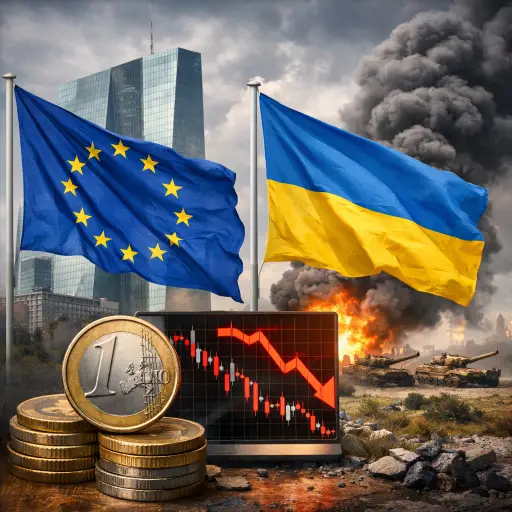
The shadow of war continues to loom large over the eurozone’s outlook. The ongoing conflict involving Ukraine has not only disrupted energy markets but has also reshaped trade flows and heightened uncertainty across the continent. Supply chain vulnerabilities, once thought to be easing, have resurfaced in new forms, contributing to cost pressures for businesses and households alike.
Energy remains a critical variable. Although prices have stabilized compared to previous spikes, the risk of renewed volatility cannot be dismissed. Market participants remain sensitive to geopolitical developments, particularly those that could affect energy infrastructure or supply routes. As a result, firms are maintaining precautionary pricing strategies, which in turn feeds into broader inflation persistence.
Against this backdrop, the ECB has made clear that interest rate hikes remain a viable option. While policymakers acknowledge the lagged effects of previous tightening measures, they have stopped short of declaring victory over inflation. Instead, they stress the need for flexibility, signaling that further action will depend on incoming data and evolving risks.
This stance reflects a delicate balancing act. On one hand, tightening monetary policy too aggressively could exacerbate economic weakness, particularly in countries already grappling with high debt levels and sluggish growth. On the other, easing prematurely risks entrenching inflation expectations, which could prove more costly to reverse in the long run.
Financial markets have responded with heightened sensitivity to central bank signals. Bond yields across the eurozone have shown increased volatility, while equity markets have struggled to find clear direction. Investors are attempting to reconcile the prospect of continued monetary tightening with a deteriorating growth outlook—a combination that underscores the fragility of current conditions.
Beyond monetary policy, structural factors are also shaping the eurozone’s trajectory. Demographic trends, productivity challenges, and uneven fiscal capacities among member states continue to weigh on long-term growth prospects. These underlying issues limit the region’s resilience to external shocks, making it more vulnerable in periods of heightened uncertainty.
Fiscal policy, meanwhile, is under renewed scrutiny. Governments face the dual challenge of supporting their economies while maintaining debt sustainability. Targeted support measures, particularly in response to energy costs, have helped cushion the impact on households. However, such interventions also risk complicating the disinflation process if not carefully calibrated.
The link between economic stability and geopolitical developments has rarely been more evident. Trade tensions, security concerns, and shifting alliances are increasingly influencing economic decision-making. Businesses are reassessing supply chains, diversifying sources, and, in some cases, relocating production closer to home. While these adjustments may enhance resilience over time, they also introduce short-term costs and inefficiencies.
For the eurozone, the path ahead is likely to remain uneven. The possibility of entering an adverse scenario does not imply an inevitable downturn, but it does highlight the narrowing margin for error. Policymakers must navigate a landscape where traditional economic indicators are intertwined with unpredictable geopolitical forces.
Ultimately, the coming period will test the eurozone’s ability to adapt. The ECB’s commitment to price stability remains central, but it operates within a broader context defined by uncertainty and rapid change. As inflation pressures persist and geopolitical risks evolve, the region finds itself at a critical juncture—one where economic outcomes will be shaped as much by events beyond its borders as by decisions made within them.