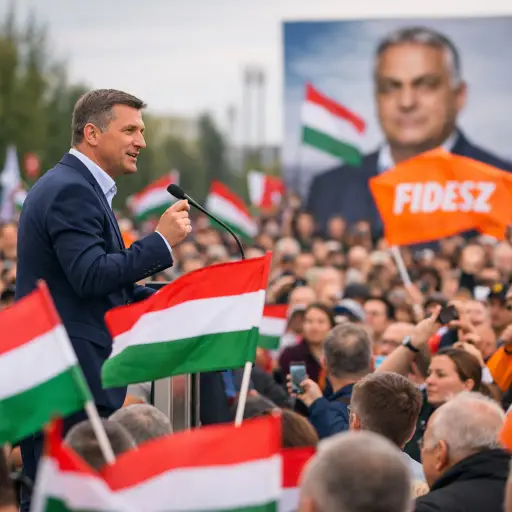
Rising support for Péter Magyar signals a potential political shift ahead of parliamentary elections, with many voters seeking change after years under Viktor Orbán

As Hungary approaches a pivotal parliamentary vote this weekend, the political landscape appears more uncertain than at any point in recent years. According to the latest polling data, the emerging political force led by Péter Magyar and his Tisza movement has taken a clear lead over the ruling Fidesz party, marking a dramatic shift in voter sentiment after more than a decade and a half of uninterrupted governance under Prime Minister Viktor Orbán.
The numbers reflect more than just a tightening race. A significant portion of the electorate, more than half of respondents, now openly expresses a desire to bring an end to Orbán’s long tenure in power. This sentiment underscores a growing appetite for political renewal in a country that has become synonymous with strong centralized leadership and a distinctive model of governance within the European Union.
The rise of Péter Magyar has been swift and, for many observers, unexpected. Once a relatively low-profile figure, he has capitalized on public frustration with entrenched political structures and positioned himself as a credible alternative to the ruling establishment. His message, centered on transparency, institutional reform, and a recalibration of Hungary’s relationship with its European partners, has resonated particularly among younger voters and urban populations.
Campaign rallies in recent days have drawn large crowds, reflecting both enthusiasm and a sense of urgency. Supporters describe the moment as a rare opportunity to reshape the country’s political trajectory. At the same time, the Tisza movement has worked to broaden its appeal beyond traditional opposition strongholds, targeting rural areas that have historically been loyal to Fidesz.
For Viktor Orbán and his party, the challenge is unprecedented. Since returning to power, Orbán has built a formidable political machine, underpinned by strong party discipline, a loyal voter base, and a narrative emphasizing national sovereignty and stability. His government has consistently framed itself as a defender of Hungarian interests against external pressures, particularly from Brussels.
Yet, critics argue that this model has come at the cost of democratic checks and balances, media pluralism, and institutional independence. These concerns have increasingly entered mainstream political discourse, contributing to the current momentum behind the opposition.
Despite trailing in recent polls, Fidesz remains a powerful contender. Its organizational strength, extensive grassroots networks, and experience in mobilizing voters could still prove decisive. Party officials have sought to reframe the election as a choice between continuity and uncertainty, warning that a change in leadership could jeopardize economic stability and national cohesion.
The broader European context also looms over the vote. Hungary’s relationship with the European Union has been marked by ongoing tensions over rule-of-law issues and funding disputes. A potential shift in leadership could signal a recalibration of these dynamics, with implications extending beyond national borders.
Political analysts caution, however, that polling trends, while indicative, are not definitive. Voter turnout, late campaign developments, and the distribution of support across constituencies will all play crucial roles in determining the final outcome. Hungary’s electoral system, which blends proportional representation with constituency-based seats, adds an additional layer of complexity to the race.
What is clear is that the upcoming vote represents a defining moment. For some, it is a chance to reaffirm a political model that has dominated the country’s recent history. For others, it is an opportunity to usher in a new era marked by different priorities and leadership styles.
As election day approaches, the atmosphere across Hungary is one of heightened anticipation. Conversations in public spaces, media debates, and online discourse all reflect a society deeply engaged with the choices ahead. Whether this engagement will translate into a historic shift or a reaffirmation of the status quo remains to be seen.
In the final hours before voters head to the polls, both camps are intensifying their efforts, aware that the outcome will shape Hungary’s direction for years to come. The question now is not only who will win, but what kind of future Hungarians ultimately choose for their country.