Bratislava meeting between Peter Pellegrini and Mikheil Kavelashvili highlights shifting diplomatic currents in Europe’s eastern neighborhood

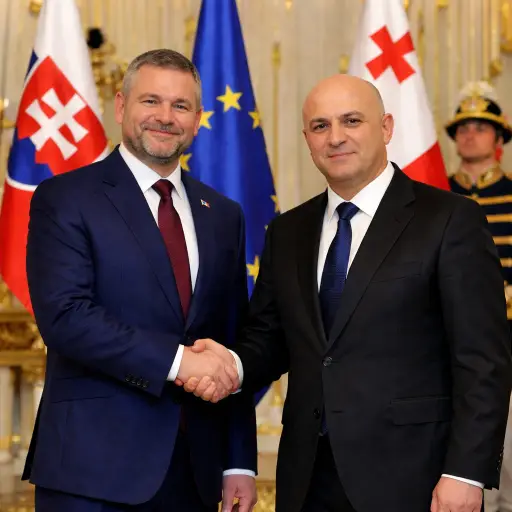
In a move that is already reverberating across European diplomatic circles, Slovak President Peter Pellegrini has officially received Georgian President Mikheil Kavelashvili in Bratislava, marking the first time a sitting head of state from a European Union member country has formally welcomed Georgia’s newly appointed leader. The meeting, conducted with full honors, underscores both symbolic and strategic dimensions at a time when geopolitical alignments in Eastern Europe and the South Caucasus remain fluid and contested.
The visit carries particular weight given the profile of Kavelashvili, a former professional footballer whose transition into politics has been accompanied by outspoken criticism of Western institutions and policies. His ascent to the presidency, facilitated by representatives of Georgia’s ruling Georgian Dream party, has drawn scrutiny from European observers concerned about the country’s long-term political direction and its relationship with Euro-Atlantic structures.
Against this backdrop, the decision by Slovakia to host Kavelashvili stands out as a notable diplomatic gesture. Analysts suggest it reflects Bratislava’s intention to maintain open channels of communication with Tbilisi, even as broader debates continue within the European Union regarding Georgia’s democratic trajectory and foreign policy orientation.
The meeting itself was framed by both sides as a platform for dialogue rather than endorsement. Slovak officials emphasized the importance of engagement, pointing to the need for continued cooperation on regional stability, economic ties, and energy security. In public remarks, Pellegrini highlighted Slovakia’s interest in maintaining constructive relations with countries along the EU’s eastern frontier, stressing that dialogue remains essential in a period marked by heightened geopolitical tensions.
For Kavelashvili, the visit represents an opportunity to demonstrate international legitimacy at a time when his presidency is still being assessed abroad. His critics have questioned whether his leadership signals a pivot away from Georgia’s longstanding aspirations toward European integration. Supporters, however, argue that his approach reflects a recalibration of national priorities, aimed at balancing external influences while preserving sovereignty.
The symbolism of the Bratislava reception was not lost on observers. As the first EU leader to officially host Kavelashvili, Pellegrini has positioned Slovakia at the center of an emerging conversation about how the European Union should engage with partners whose political trajectories may not fully align with Brussels’ expectations. The meeting may also indicate a willingness among some EU member states to pursue pragmatic diplomacy, even when ideological differences persist.
Regional experts note that Slovakia’s own geopolitical position—situated at the crossroads of Central and Eastern Europe—has often shaped its approach to foreign policy. Historically, Bratislava has sought to balance its commitments within the EU and NATO with the realities of its geographic proximity to regions marked by political volatility. In this context, engaging with Georgia’s leadership, regardless of its perceived orientation, can be seen as consistent with a broader strategy of maintaining influence through dialogue.
At the same time, the visit has sparked debate within European policy circles. Some commentators warn that extending high-level diplomatic recognition to figures associated with criticism of the West could send mixed signals about the EU’s commitment to its core values. Others counter that isolating such leaders risks pushing their countries further away from European engagement, potentially strengthening alternative alliances.
Beyond the political symbolism, the talks in Bratislava also touched on practical areas of cooperation. Economic relations between Slovakia and Georgia, while relatively modest, have shown potential for growth, particularly in sectors such as energy transit, infrastructure, and trade. Both sides expressed interest in exploring opportunities that could enhance connectivity between Europe and the South Caucasus, a region increasingly viewed as strategically important in the context of shifting global supply chains.
Security considerations also loomed large in the discussions. With ongoing instability in parts of Eastern Europe and the wider region, Slovakia and Georgia share concerns about maintaining stability and resilience. While their perspectives on certain international issues may differ, both countries face similar challenges related to energy dependence, regional conflicts, and the need for sustainable development.
The broader implications of the meeting remain to be seen. It is unclear whether other EU leaders will follow Slovakia’s example in formally engaging with Kavelashvili at the same level. Much will depend on how Georgia’s domestic and foreign policies evolve in the coming months, as well as on the internal dynamics within the European Union itself.
What is certain, however, is that the Bratislava meeting has introduced a new dynamic into EU–Georgia relations. By taking the initiative to host Kavelashvili, Slovakia has opened a diplomatic door that others may choose either to walk through or to keep at arm’s length.
As Europe continues to navigate an increasingly complex geopolitical landscape, such moments of engagement—however cautious or controversial—highlight the enduring importance of diplomacy in bridging divides. Whether this encounter marks the beginning of a broader shift or remains an isolated gesture will depend on decisions yet to unfold, both in Brussels and in Tbilisi.
For now, the image of the two presidents standing side by side in Bratislava serves as a reminder that even in times of uncertainty, dialogue remains a central instrument of international relations.