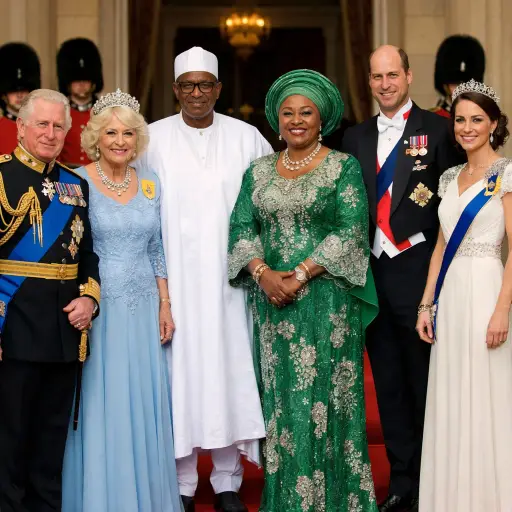
Ceremony, elegance and diplomacy converge as Britain’s royal family hosts distinguished guests in a moment of symbolic partnership

London has witnessed a moment of rare ceremonial grandeur as the Nigerian presidential couple arrived in the United Kingdom for an official visit marked by tradition, diplomacy and quiet political significance. The visit, unfolding in early spring, brought together senior members of the British royal family and one of Africa’s most influential political partnerships in a carefully choreographed display of mutual respect.
At the heart of the occasion stood King Charles III and Queen Camilla, who formally received the Nigerian president and his wife with full honors. The welcoming ceremony, steeped in centuries-old protocol, unfolded against the stately backdrop of royal architecture, where precision, pageantry and symbolism combined to set the tone for the visit.
Joining the monarch were the Prince of Wales, William, and Catherine, Princess of Wales, whose presence underscored the continuity of the monarchy and its evolving role in global engagement. Together, the royal family presented a united front—bridging tradition with a modern diplomatic outlook.
From the first moments of arrival, the visual impression was striking. Military bands, ceremonial guards and carefully arranged formations reflected the United Kingdom’s enduring commitment to state protocol. Yet it was the human dimension—the gestures, expressions and subtle exchanges—that gave the event its deeper resonance.
The Nigerian presidential couple appeared composed and confident, signaling the importance of the visit not only in formal terms but also as a reaffirmation of bilateral relations. Observers noted the ease with which both delegations interacted, suggesting a shared understanding of the broader geopolitical context.
As the day progressed, attention shifted from the ceremonial to the symbolic. The women of both delegations drew particular admiration for their refined and distinctive fashion choices, which blended cultural identity with diplomatic elegance. Queen Camilla opted for a timeless ensemble that reflected understated sophistication, while Catherine, Princess of Wales, once again demonstrated her ability to balance tradition with contemporary style.
Equally captivating was the Nigerian First Lady, whose attire paid tribute to her cultural heritage through rich fabrics and intricate design. Her presence brought a vibrant contrast to the British aesthetic, creating a visual dialogue that extended beyond words.
The interplay of styles was more than a matter of fashion; it became a subtle expression of cultural exchange. Each outfit told a story, contributing to the broader narrative of connection between two nations with deep historical ties and a shared interest in future cooperation.
The evening state banquet provided a further stage for diplomatic engagement. Held in an atmosphere of refined opulence, the event gathered political figures, dignitaries and representatives from various sectors, all under the vaulted ceilings of one of Britain’s most iconic venues.
During the banquet, speeches emphasized partnership, economic collaboration and mutual respect. While formal in tone, the remarks carried an undercurrent of pragmatism, reflecting current global challenges and the need for strengthened alliances.
King Charles III highlighted the importance of dialogue and cooperation, particularly in areas such as climate, trade and development. The Nigerian president, in turn, spoke of opportunity, growth and the enduring relationship between the two countries—one shaped by history but increasingly defined by shared ambition.
Behind the carefully chosen words lay a broader strategic reality. The visit comes at a time when both nations are navigating complex international landscapes, seeking stability and influence in a rapidly changing world. For the United Kingdom, engagement with key African partners remains a priority, while Nigeria continues to assert its role as a regional and continental leader.
Beyond policy and diplomacy, however, the visit also carried a human dimension that resonated with those observing both in person and from afar. The warmth of the interactions, the visible respect between hosts and guests, and the subtle gestures of courtesy all contributed to an atmosphere that felt both formal and genuinely cordial.
Public interest in the event extended well beyond political circles. Images from the ceremony and the banquet quickly captured attention, highlighting not only the grandeur of the occasion but also the personalities involved. In an era where visual storytelling shapes public perception, such moments carry significant weight.
For the British royal family, the visit offered an opportunity to reinforce its role as a diplomatic bridge—one that operates alongside, but distinct from, governmental channels. For Nigeria, it provided a platform to project confidence and partnership on an international stage.
As the visit continues, its immediate outcomes may remain largely within diplomatic channels, yet its symbolic impact is already evident. It serves as a reminder that in global relations, ceremony still matters—offering a language of its own, one that communicates respect, continuity and shared purpose.
In the end, the London welcome was more than a formal event. It was a carefully constructed moment of connection, where history, culture and diplomacy intersected. And in that intersection, both nations found an opportunity to reaffirm not only their relationship with each other, but also their place within a broader, interconnected world.