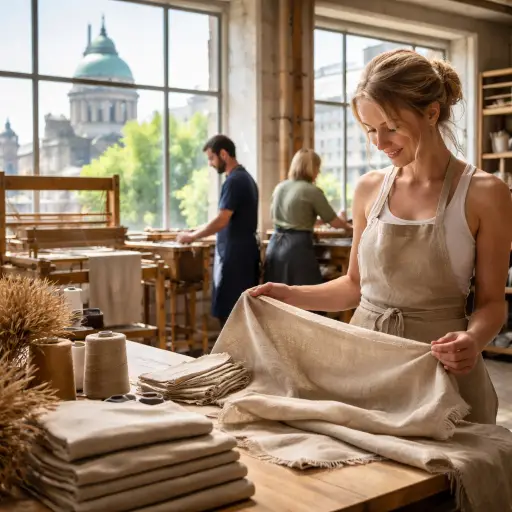
Once the fabric of empire, linen is returning to the heart of Northern Ireland’s capital, reshaping culture, fashion and rural life in a quiet but powerful revival

In Belfast, the past rarely stays buried. It lingers in shipyard cranes, in red-brick mills, in the stories passed between generations. But today, one of the city’s oldest industries is no longer just a memory. Linen, the fabric that once earned Belfast the name “Linenopolis,” is being rediscovered, reworked and reimagined as part of a broader cultural and economic renewal.
Across the city, from converted warehouses to contemporary design studios, linen is finding new relevance. Once mass-produced for global markets, it is now being crafted in smaller quantities, with an emphasis on sustainability, heritage and design integrity. What was once an industrial backbone is becoming a symbol of identity.
For many in Belfast, linen is not just a textile. It is a language of place.
In the nineteenth and early twentieth centuries, Belfast was one of the world’s leading linen producers. Powered by flax grown in surrounding counties and processed in vast mills, the industry employed tens of thousands and connected Northern Ireland to markets across Europe and beyond. The fabric was prized for its strength, breathability and understated elegance. Tablecloths, garments and fine linens made in Belfast were exported worldwide.
That dominance faded with the rise of cheaper synthetic fabrics and global competition. Mills closed, machinery fell silent, and a once-defining industry slipped into decline. For decades, linen survived mostly as a historical reference, preserved in museums and archives.
Now, however, a different story is unfolding.
The revival has not come through scale but through intention. Designers, craftspeople and entrepreneurs are returning to linen not as a commodity, but as a material with meaning. In Belfast’s growing creative quarters, linen is being used in fashion collections, homeware lines and experimental textiles. Its natural qualities align with a broader shift toward sustainable materials and slower production methods.
Young designers speak of linen as both a challenge and an opportunity. Its texture resists uniformity; it wrinkles, softens and evolves with use. Rather than seeing these traits as flaws, they embrace them as signs of authenticity. In a world saturated with synthetic perfection, linen offers something more human.
This renewed interest extends beyond the city. In rural areas, farmers are once again cultivating flax, the plant from which linen is made. Though still limited in scale, these efforts reflect a desire to reconnect with the land and with traditional agricultural practices. Heritage varieties of flax are being reintroduced, and knowledge once passed down through generations is being rediscovered.
The process is labor-intensive. From sowing and harvesting to retting and spinning, linen production requires time, skill and patience. Yet it is precisely this complexity that appeals to those seeking alternatives to fast fashion and industrial agriculture.
There is also a cultural dimension to the revival. Linen is increasingly featured in exhibitions, public art and educational initiatives. Workshops and community projects invite people to engage directly with the material, to understand its history and its potential. In doing so, linen becomes a bridge between past and present.
This resurgence has not gone unnoticed beyond Northern Ireland. International designers are incorporating Irish linen into their collections, drawn by its reputation for quality and its narrative of renewal. The fabric has also found its way into high-profile settings, embraced for its timeless aesthetic and environmental credentials.
For Belfast, this attention carries both opportunity and responsibility. There is a careful balance to be struck between growth and authenticity. Those leading the revival are keenly aware of the risks of over-commercialization. The aim is not to recreate the industrial scale of the past, but to build something more resilient and rooted.
In this sense, linen reflects a broader transformation within the city itself. Belfast has spent recent years redefining its identity, moving beyond the shadows of conflict toward a future shaped by creativity, innovation and cultural expression. The return of linen fits naturally within this narrative.
It is a quiet transformation, often unfolding behind studio doors or in small fields on the outskirts of town. Yet its impact is tangible. Linen is appearing in homes, in galleries, in the wardrobes of a new generation. It is being spoken about not as nostalgia, but as possibility.
Perhaps most importantly, the revival of linen is reconnecting people with a sense of continuity. In handling the fabric, in tracing its journey from seed to cloth, there is an awareness of the lives and labor that came before. This connection does not weigh the city down; rather, it gives it depth.
As Belfast continues to evolve, linen offers a thread that ties together history and modernity. It is not the dominant industry it once was, nor is it likely to become so again. But in its quieter, more deliberate resurgence, it carries a different kind of significance.
Linen is no longer just what Belfast made. It is part of how Belfast understands itself today.