Czech president pushes for Ankara attendance and meeting with Babiš amid government resistance over who should represent the country

President Petr Pavel is continuing to assert his intention to attend the upcoming NATO summit in Ankara, signaling both a commitment to maintaining the Czech Republic’s international profile and a growing tension within the country’s political leadership over who should represent Prague on the global stage.
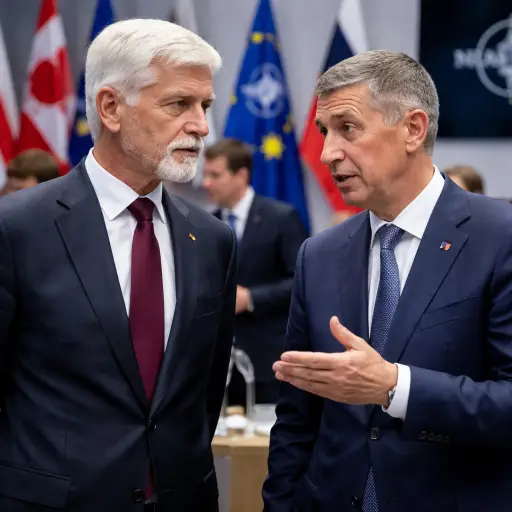
According to statements confirmed by the presidential office, Pavel expects to participate in the high-level gathering of allied leaders and is seeking a direct meeting with Prime Minister Andrej Babiš to clarify the Czech position ahead of the summit. The move comes at a time when differing views within the government and coalition partners have surfaced more openly, exposing a broader debate about foreign policy representation and political legitimacy.
Babiš had earlier indicated that he, alongside Foreign Minister Petr Macinka, should attend the summit, framing the issue as one of executive responsibility. His stance reflects a more traditional interpretation of government-led diplomacy, where the prime minister and cabinet ministers serve as the primary actors in international negotiations. However, Pavel’s insistence on attending underscores the evolving role of the presidency in Czech foreign policy, particularly in matters related to defense and transatlantic relations.
The disagreement has been sharpened by Macinka’s public remarks, in which he reiterated a long-held position that opposition figures should not be included in official delegations to major international forums such as NATO summits. While Pavel is not an opposition politician in the conventional sense, Macinka’s comments have been interpreted by some observers as a broader signal of resistance to expanding the circle of representation beyond the government.
This divergence highlights a deeper institutional ambiguity within the Czech political system. While the constitution provides for a division of powers between the president and the government, the practical boundaries—especially in foreign and security policy—have often depended on political context and personal relationships between key figures. In this case, the absence of a unified approach risks sending mixed signals to allies at a time when cohesion within NATO is widely regarded as essential.
Pavel’s background as a former senior NATO military official adds another layer to the discussion. His experience and connections within the alliance are seen by supporters as valuable assets that could enhance the Czech Republic’s influence during strategic deliberations. Critics, however, argue that institutional clarity should take precedence over individual qualifications, warning that overlapping mandates could weaken the country’s negotiating position.
The planned meeting between Pavel and Babiš is therefore being closely watched as a potential turning point. If the two leaders can reach a compromise, it could help present a united Czech front in Ankara. If not, the dispute may persist into the summit itself, raising questions about coordination and authority.
Beyond the immediate question of attendance, the situation reflects broader dynamics in Czech politics. The interplay between the presidency and the government has long been shaped by both formal rules and informal practices, and moments of friction are not uncommon. What makes the current episode notable is its timing, coinciding with heightened geopolitical tensions and the continued importance of NATO as a forum for collective decision-making.
As preparations for the summit continue, the Czech Republic finds itself navigating not only external challenges but also internal debates about representation and leadership. The outcome of these discussions will likely influence not just the country’s role in Ankara, but also the future balance of power in its foreign policy architecture.
In the meantime, Pavel’s determination to attend and his call for dialogue with Babiš suggest an effort to bridge differences rather than escalate them. Whether that effort succeeds will depend on the willingness of all parties involved to prioritize coherence over contention at a moment when unity carries particular weight.