As Moscow seeks technological sovereignty, Tencent’s WeChat and ByteDance’s Douyin emerge as blueprints for Russia’s next-generation super app

In a sign of shifting digital priorities, Russia is increasingly looking to China’s technology ecosystem as a model for its own domestic platforms. At the center of this strategy is Max, a messaging app developed by state-controlled internet company VK, which officials hope will evolve into a multifunctional “super app” capable of rivaling global competitors and consolidating services across daily life.
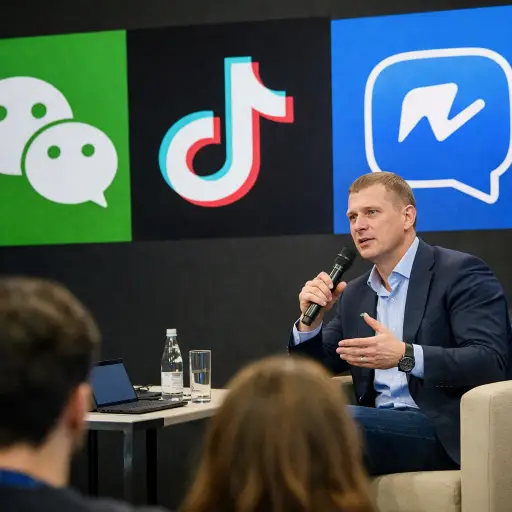
Speaking at a recent industry forum, VK’s chief executive, Vladimir Kiriyenko, pointed explicitly to Chinese platforms as reference points. He highlighted Tencent’s WeChat and ByteDance’s Douyin as examples of how messaging and content platforms can expand far beyond communication into payments, entertainment, e-commerce, and public services. For Russia, which has faced increasing isolation from Western technology ecosystems, these platforms represent not only success stories but also practical templates.
The ambition behind Max reflects a broader effort by Russian authorities to reduce reliance on foreign digital infrastructure. Over the past several years, access to global platforms has become more limited, either through regulatory measures or corporate withdrawals. This has created both a challenge and an opportunity for domestic firms like VK, which now find themselves tasked with filling gaps left by international services.
Yet building a super app from scratch is no small feat. WeChat’s dominance in China did not emerge overnight; it evolved over years of integration with financial systems, government services, and everyday consumer behavior. Douyin, meanwhile, has leveraged algorithm-driven content and seamless in-app commerce to become a cornerstone of China’s digital economy. Replicating these ecosystems requires not only technical capability but also deep coordination between private companies, regulators, and financial institutions.
Max, in its current form, remains a modest player. Originally positioned as a messaging service, it has struggled to differentiate itself in a crowded domestic market that includes established platforms like Telegram and VK’s own social network products. User adoption has been uneven, and engagement levels have yet to reach the critical mass needed to support a broader ecosystem of services.
Kiriyenko’s remarks suggest that VK is now rethinking its approach. Rather than competing solely on messaging features, the company appears to be pivoting toward a more integrated model, one that could combine communication with digital payments, media consumption, and potentially government services. This shift mirrors the trajectory of WeChat, which transformed from a simple chat app into an indispensable tool for daily life in China.
Analysts note that Russia may have certain structural advantages in pursuing this path. The country’s strong tradition of state involvement in key industries could facilitate the kind of integration required for a super app. Government backing could also accelerate partnerships with banks, telecom providers, and public institutions, enabling Max to embed itself in multiple aspects of users’ routines.
At the same time, there are significant hurdles. Consumer trust remains a critical issue, particularly when it comes to platforms closely associated with the state. While WeChat operates within a highly controlled environment, it has benefited from widespread adoption driven by convenience and network effects. In Russia, convincing users to consolidate their digital lives into a single app may prove more difficult, especially given concerns about privacy and data security.
Another challenge lies in innovation. Chinese tech companies have spent years refining user experience, personalization algorithms, and monetization strategies. Douyin’s success, for instance, is built on highly sophisticated recommendation systems that keep users engaged and drive commercial activity. For Max to compete, it will need to develop comparable capabilities, which requires significant investment in artificial intelligence and data analytics.
There is also the question of international reach. While WeChat and Douyin have primarily focused on the domestic Chinese market, they have also achieved varying degrees of global influence. Russia’s Max, by contrast, is likely to remain largely domestic in scope, at least in the near term. This could limit its growth potential but also allow it to tailor its features more closely to local needs.
Despite these challenges, the push behind Max reflects a clear strategic direction. Russia is not merely attempting to replicate Western platforms but is instead aligning itself with an alternative digital model, one that emphasizes integration, state collaboration, and self-reliance. In this context, Chinese apps offer a compelling vision of what a fully developed digital ecosystem can look like.
For VK, the stakes are high. Success could position the company as the backbone of Russia’s digital infrastructure, giving it a central role in everything from communication to commerce. Failure, on the other hand, would underscore the difficulties of building a super app in a fragmented and competitive environment.
As the global technology landscape continues to shift, the development of Max will be closely watched. It represents not only a corporate initiative but also a broader experiment in how countries can shape their own digital futures. Whether Russia can translate inspiration from China into a functioning, widely adopted platform remains an open question, but the direction is now unmistakably clear.