Concerns over potential long-range Ukrainian strikes cast uncertainty over one of Russia’s most symbolic military traditions

As preparations would normally intensify for one of Russia’s most important national ceremonies, officials in Moscow are reportedly considering an extraordinary step: canceling the annual Victory Day military parade on Red Square. The move, if confirmed, would mark a significant break with decades of tradition and underscore the growing security concerns surrounding the ongoing conflict in Ukraine.
According to recent reporting, Russian authorities are seriously evaluating the risks posed by potential long-range Ukrainian missile strikes targeting high-profile public events. The Victory Day parade, traditionally held each spring to commemorate the Soviet Union’s victory over Nazi Germany in World War II, is among the most symbolically and politically significant displays of military power in the country.
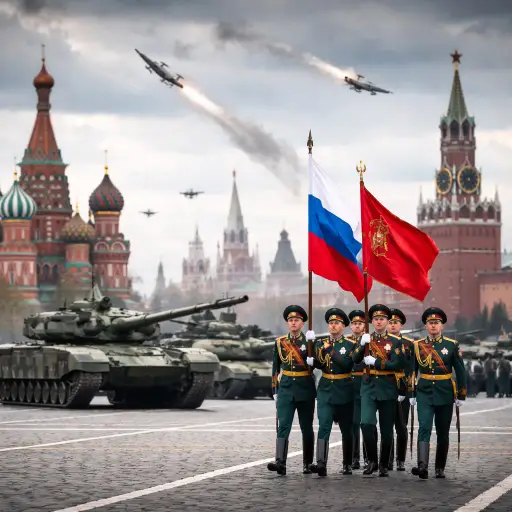
The event has long served as a showcase of Russia’s armed forces, featuring columns of soldiers, heavy military equipment, and aerial flyovers against the backdrop of the Kremlin’s historic walls. It is also a key moment for national unity and political messaging, often attended by top leadership and broadcast across the country.
However, the evolving nature of modern warfare—and the demonstrated reach of Ukrainian long-range capabilities—has introduced a new layer of vulnerability. Analysts note that large, centralized gatherings such as military parades could present attractive targets, both strategically and symbolically.
The concerns are not limited to the capital. Reports suggest that similar deliberations are underway regarding the parallel parade traditionally held in St. Petersburg. As Russia’s second-largest city and another important cultural and historical center, it too could face heightened security risks in the current climate.
The possibility of canceling or significantly scaling back these events reflects a broader shift in how the Russian state is balancing tradition with security realities. While smaller-scale commemorations or alternative formats remain possible, the absence of a full military parade on Red Square would be deeply symbolic.
Public reaction within Russia remains difficult to gauge. Victory Day holds deep emotional resonance for many citizens, tied to collective memory and national identity. Any decision to cancel or alter the celebrations could therefore carry political implications, potentially signaling a shift in the government’s messaging about strength and stability.
At the same time, officials may calculate that ensuring safety—particularly in an era of increasingly unpredictable threats—must take precedence over tradition. The visibility of senior leaders and the concentration of military assets in one location could pose unacceptable risks under current conditions.
International observers are also closely watching the situation. The parade has often served as a platform for demonstrating military capability to both domestic and global audiences. Its cancellation or modification could be interpreted as an acknowledgment of the changing dynamics of the conflict and the pressures it places on Russia internally.
As discussions continue behind closed doors, the final decision is expected to reflect a careful weighing of symbolism, security, and political calculation. Whether the parade proceeds, is scaled down, or is called off entirely, the outcome will offer a telling glimpse into how the conflict is reshaping even the most established rituals of the Russian state.
For now, uncertainty surrounds an event that has long been seen as a fixture of national life. What was once a predictable display of power has become, like much else in the current geopolitical landscape, subject to rapid and consequential change.