A deadly strike during a burial underscores escalating tensions despite fragile regional diplomacy

In a small village in southern Lebanon, grief had already settled heavily over one family before the sound of warplanes shattered what remained of their world. Relatives and neighbors had gathered inside a modest home to mourn a man recently killed in earlier violence. Among them was his one-year-old daughter, Talín, too young to understand the rituals unfolding around her, yet central to the fragile thread of continuity the family clung to.
Moments later, that thread was severed.
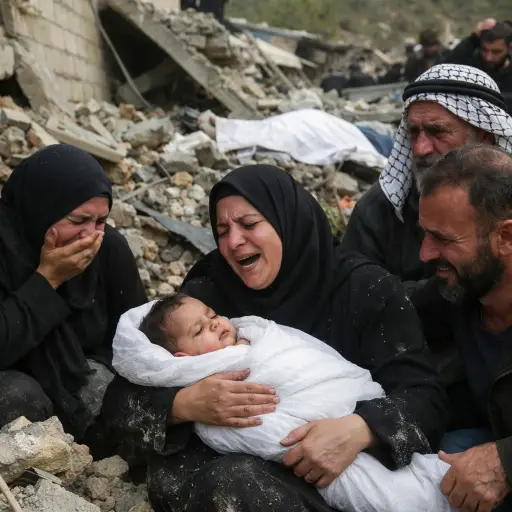
A powerful strike hit the house directly, collapsing walls and burying those inside. When the dust settled, five members of the same family were dead, including the infant whose life had only just begun. Survivors described a scene of chaos and disbelief, where mourning turned instantly into devastation. What had been a place of farewell became a site of mass death.
The attack was one of several carried out across southern Lebanon that day, marking one of the heaviest waves of strikes since the latest phase of cross-border hostilities began. The timing was especially striking. The escalation came shortly after a diplomatic breakthrough elsewhere in the region, where the United States and Iran had moved toward easing tensions, raising cautious hopes that violence might subside.
Instead, on the ground in Lebanon, the opposite appeared to unfold.
Residents in the affected areas reported sustained aerial activity, with multiple strikes targeting villages near the border. While military officials have stated that operations are aimed at militant infrastructure, the impact on civilians has once again come into sharp focus. In this case, the victims were not combatants but a family gathered for a funeral, a moment traditionally reserved for reflection and closure.
Witnesses described rescuers digging through rubble with bare hands, pulling out survivors and bodies alike. The image of Talín, wrapped in a white burial cloth meant for her father, quickly spread among those present, becoming a haunting symbol of the day’s events. For many in the village, the tragedy encapsulated the broader reality they have endured for months: the constant overlap of life, death, and violence.
Local officials condemned the strike, calling it a violation of basic humanitarian principles. They pointed to the circumstances of the gathering, emphasizing that it was a civilian event with no apparent military significance. The destruction of the home, they added, has left extended relatives displaced, compounding the immediate loss with longer-term hardship.
The broader situation along the Israel-Lebanon border remains volatile. Exchanges of fire, drone surveillance, and targeted strikes have become a near-daily occurrence, with each side accusing the other of provocation. The fragile equilibrium has repeatedly been tested, and efforts to contain the conflict have so far failed to produce lasting calm.
Analysts note that while high-level diplomacy may shift strategic calculations, it often has little immediate effect on localized conflicts, where entrenched dynamics and mistrust prevail. The recent ceasefire developments involving major powers may reduce the risk of wider regional escalation, but they have not translated into relief for communities caught in ongoing confrontations.
For families like Talín’s, such distinctions offer little comfort.
In the aftermath of the strike, mourning resumed, this time for multiple lives lost in a single moment. The village, already accustomed to loss, now faces another chapter of grief. Funerals, once singular events, have become collective rituals of survival.
As night fell, the rubble remained, a stark reminder of how quickly moments of remembrance can turn into scenes of tragedy. In the quiet that followed the day’s violence, the absence of those lost was felt as deeply as the echo of the strike itself.