Record early turnout fuels speculation over the future of Viktor Orbán’s long-standing rule

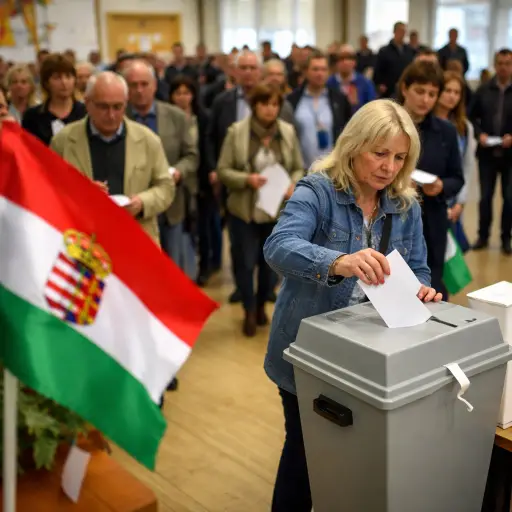
A wave of voters streamed into polling stations across Hungary on Sunday morning, delivering an unprecedented surge in early turnout that could mark a decisive moment in the country’s political trajectory. By early afternoon, more than half of registered voters had already cast their ballots, according to official figures, setting a new benchmark for participation in the modern electoral era.
The scale and speed of voter mobilization have drawn immediate attention both domestically and internationally, as the election is widely viewed as a critical test of Prime Minister Viktor Orbán’s grip on power after more than a decade and a half in office. Long a dominant figure in Hungarian politics, Orbán now faces a political landscape that appears more energized—and potentially more unpredictable—than at any point in recent memory.
Across cities, towns, and rural communities, polling stations reported long queues forming from the early hours. Election officials described the turnout as “extraordinary,” noting that participation levels had already significantly surpassed those recorded at the same stage in previous parliamentary contests. The steady flow of voters continued throughout the day, suggesting that final turnout could reach historic levels.
For many Hungarians, the election represents more than a routine democratic exercise. Interviews with voters outside polling stations revealed a sense of urgency and heightened civic responsibility. Some spoke of a desire for continuity and stability, while others emphasized the need for political renewal and institutional change. The diversity of motivations underscores the broader national conversation about Hungary’s direction in the years ahead.
Analysts suggest that such high early turnout often reflects a deeply engaged electorate, though it does not necessarily predict the outcome. In Hungary’s case, however, the figures are being closely scrutinized as a potential indicator of shifting public sentiment. The contrast with previous elections—where early participation was markedly lower—has only intensified speculation about whether the political balance could be tilting.
Orbán’s tenure has been defined by a mix of economic policies, national identity narratives, and a centralization of political authority that has drawn both strong support and sustained criticism. Supporters credit his leadership with maintaining stability and asserting Hungary’s sovereignty, while critics argue that democratic institutions and media independence have eroded under his rule.
This election, therefore, is widely perceived as a referendum not only on the government’s record but also on the broader trajectory of the country’s democratic framework. The unusually high turnout may reflect a convergence of factors, including increased political polarization, mobilization efforts by opposition groups, and a growing sense among voters that the stakes are particularly high.
International observers are also watching closely, viewing the election as a bellwether for political trends within the region. Hungary has often been cited in discussions about democratic backsliding and the rise of populist governance in Europe, making the outcome of this vote significant beyond its national borders.
As the day progresses, attention will turn to whether the early momentum in turnout is sustained through the final hours of voting. Election authorities have emphasized that the process has so far proceeded smoothly, with no major disruptions reported. Final results are expected to be closely contested, and the high level of participation could complicate projections until late into the counting process.
Regardless of the outcome, the early surge in voter turnout has already sent a clear signal: Hungarian citizens are deeply engaged in shaping their political future. Whether this engagement translates into continuity or change will become evident only once the ballots are fully counted, but the scale of participation alone marks a significant moment in the country’s democratic life.