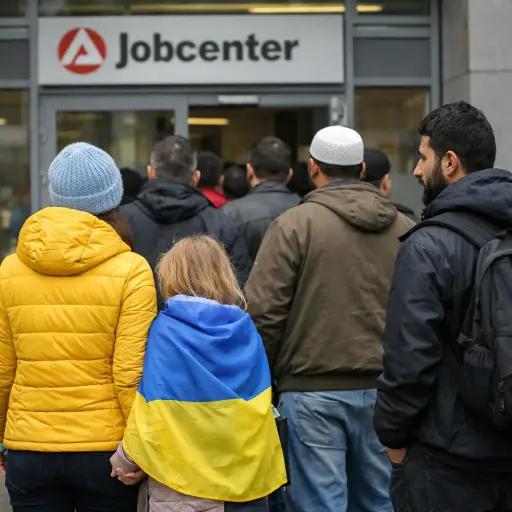
Rising reliance on social benefits among both citizens and migrants fuels political tension, economic questions, and calls for reform

Germany is facing a renewed and increasingly heated debate over its social welfare system, as new figures highlight the scale and composition of benefit recipients across the country. Recent data show that approximately 5.2 million German citizens received social assistance over the past year. Of these, around 2.4 million were foreign nationals, representing roughly 47 percent of all beneficiaries.
The figures have sharpened an already polarizing national conversation about migration, integration, and the sustainability of Europe’s largest economy. While Germany has long positioned itself as a country committed to humanitarian responsibility and social stability, the near parity between domestic and foreign recipients is prompting deeper scrutiny from policymakers, economists, and the public alike.
Among foreign nationals receiving support, individuals from Ukraine, Syria, and Afghanistan form the largest groups. Their presence reflects both recent geopolitical crises and Germany’s role as a primary destination for those fleeing conflict and instability. The arrival of Ukrainians, in particular, surged following Russia’s full-scale invasion, while Syrians and Afghans represent longer-term refugee populations that continue to navigate integration into German society.
Supporters of the current system argue that these figures are not surprising given the circumstances under which many migrants arrive. Language barriers, credential recognition challenges, and the time required to integrate into the labor market often delay employment. Welfare support, they say, serves as a necessary bridge, preventing poverty and social fragmentation while newcomers establish themselves.
Critics, however, view the data as evidence of structural strain. They question whether the system is adequately incentivizing workforce participation and warn that the growing number of recipients could place increasing pressure on public finances. Some political voices have called for stricter eligibility criteria or faster pathways into employment, arguing that prolonged reliance on benefits risks undermining public trust.
Economists remain divided. Some point out that Germany’s aging population and labor shortages mean that successful integration of migrants into the workforce is not just desirable but essential. Others caution that without significant reforms in education, training, and bureaucratic processes, the transition from welfare to employment may remain too slow to offset the costs.
The issue is further complicated by regional disparities. Urban centers, particularly in western Germany, tend to host larger migrant populations and therefore carry a greater share of welfare distribution. This has led to uneven political pressures at the local level, with municipalities seeking more federal support to manage housing, education, and social services.
Public opinion reflects this complexity. While many Germans continue to support humanitarian policies, concerns about fairness and long-term sustainability are becoming more pronounced. The debate is no longer confined to political fringes but has moved firmly into mainstream discourse, influencing electoral dynamics and policy agendas.
Government officials have acknowledged the challenges but emphasize that the figures must be understood in context. They highlight ongoing efforts to streamline job placement programs, expand language training, and reduce administrative barriers that prevent faster integration into the labor market.
As Germany navigates this delicate balance, the conversation is likely to intensify. The country stands at a crossroads where economic necessity, social cohesion, and political realities intersect. How it responds may not only shape its own future but also serve as a reference point for other European nations facing similar pressures.
What remains clear is that the numbers, while striking, tell only part of the story. Behind them are millions of individual journeys—of displacement, adaptation, and aspiration—woven into the broader fabric of a society grappling with change.