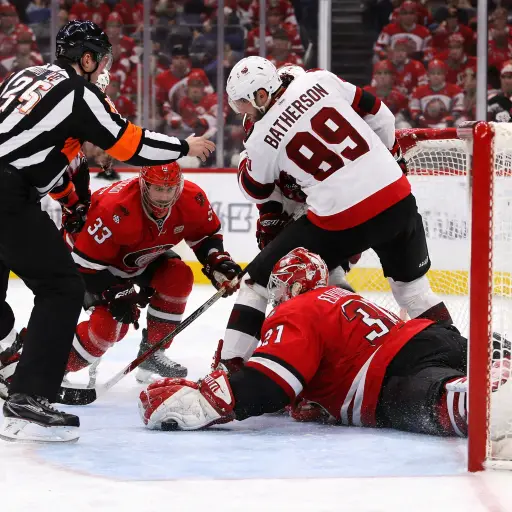
Ottawa’s apparent equalizer overturned after inconclusive video review, igniting fresh scrutiny of officiating standards in playoff hockey

The opening clash of the Stanley Cup playoffs between the Carolina Hurricanes and the Ottawa Senators delivered exactly what postseason hockey promises: intensity, physicality, and, inevitably, controversy. What was meant to be a showcase of elite competition quickly turned into a debate over officiating consistency after a pivotal moment late in the game left players, coaches, and fans divided.
Midway through a tightly contested battle, Ottawa believed it had drawn level. A chaotic scramble unfolded in front of the Carolina net, bodies converging in a blur of sticks, skates, and desperation. The puck disappeared beneath the glove of the Hurricanes’ goaltender, prompting a brief hesitation before Senators players began celebrating what they assumed was the tying goal.
On the ice, however, uncertainty reigned. The officials signaled for a video review, triggering a tense pause inside the arena. Replays were examined from every available angle, but none provided definitive evidence that the puck had fully crossed the goal line before being secured. After several minutes, the decision came: no goal.
The ruling preserved Carolina’s lead and ultimately shaped the outcome of the game, but it also opened the door to immediate criticism. Ottawa’s bench reacted with visible frustration, arguing that the lack of conclusive footage should not negate what they believed was a legitimate scoring play. Carolina, for its part, defended the decision, emphasizing that the burden of proof lies in clear visual confirmation.
Under the rules governing the National Hockey League, a goal can only be awarded if there is indisputable evidence that the puck has completely crossed the line. In this case, the absence of that clarity proved decisive. Yet, as is often the case in playoff hockey, the technical correctness of the call did little to quell the emotional response.
Players from both sides acknowledged the fine margins that define postseason games. For Ottawa, the disallowed goal represented more than just a missed opportunity; it was a momentum shift at a critical juncture. Instead of building on the surge of a potential equalizer, the team was forced to regroup, chasing the game in its closing stages.
Carolina, meanwhile, capitalized on the reprieve. The Hurricanes tightened their defensive structure, leaning on disciplined positioning and timely goaltending to maintain control. The incident seemed to galvanize their effort, reinforcing the importance of composure under pressure.
Beyond the immediate impact on the scoreboard, the episode has reignited broader discussions about the role of video review in modern hockey. While technology has undoubtedly improved the accuracy of officiating, moments like this highlight its limitations. Camera angles, obstruction, and the speed of play can still leave room for ambiguity, even in high-definition scrutiny.
Analysts have pointed out that such situations place officials in an unenviable position. The expectation for precision is absolute, yet the tools available do not always provide definitive answers. In these cases, the default reliance on “conclusive evidence” can feel unsatisfying to those on the wrong side of the decision.
For fans, the controversy adds another layer to an already compelling series. Playoff narratives are often shaped by singular moments, and this incident has the potential to linger as a defining storyline. Whether it fuels Ottawa’s determination or reinforces Carolina’s confidence remains to be seen.
What is certain is that the tone has been set. The first game of this Stanley Cup Playoffs series has delivered both drama and debate, a reminder that in hockey’s most intense stage, every inch of ice—and every fraction of a second—can carry enormous weight.
As the series continues, attention will not only focus on tactics and execution but also on how both teams respond to adversity. In the unforgiving environment of playoff hockey, resilience is as crucial as skill. And after a night marked by controversy, both Carolina and Ottawa know that the margins for error are razor-thin.