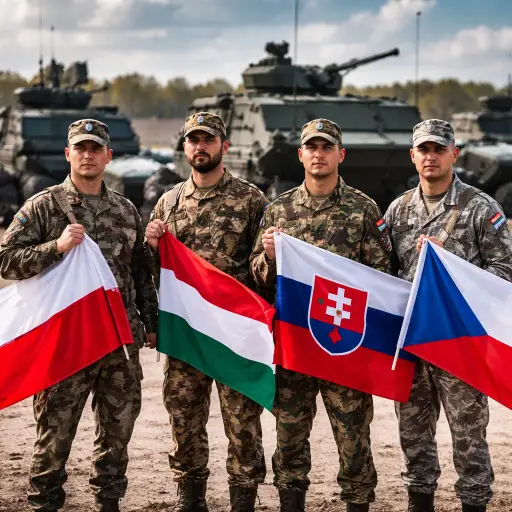
As security priorities split the Visegrád Four, Poland’s military surge reshapes both regional strategy and economic direction

The once-cohesive bloc of Central European nations known as the Visegrád Four is undergoing a profound transformation. Comprising the Czech Republic, Slovakia, Poland, and Hungary, the group has long been seen as a platform for regional coordination within the European Union and NATO. Yet in recent years, particularly following the escalation of tensions in Eastern Europe, the alliance has fractured along political, military, and economic lines.
At the heart of this divergence lies a fundamental disagreement over Russia and Ukraine. While Poland has positioned itself as one of the most assertive supporters of Ukraine, advocating strong military assistance and deterrence measures against Russia, Hungary has taken a markedly different approach, emphasizing diplomatic engagement and maintaining closer economic ties with Moscow. The Czech Republic and Slovakia, though broadly aligned with Western policy, have navigated more nuanced positions influenced by domestic political shifts and economic considerations.
This split has not only reshaped the political dynamics within the group but has also had tangible consequences for defense strategies. Poland, in particular, has emerged as a standout actor. Its rapid and expansive military modernization program reflects a sense of urgency unmatched by its regional partners. Investments in advanced weaponry, increased troop numbers, and expanded defense infrastructure have positioned Poland as a central pillar of NATO’s eastern flank.
The implications extend beyond security. Poland’s defense buildup has become a powerful driver of economic activity. Increased military spending has stimulated domestic industries, from manufacturing to technology, and attracted foreign investment. Defense contracts have created jobs and fostered innovation, particularly in sectors linked to cybersecurity, logistics, and advanced engineering. In this sense, national security priorities are directly fueling economic growth, reinforcing Poland’s rising influence within the European economy.
By contrast, Hungary’s more restrained military posture reflects a different set of economic calculations. Its government has prioritized energy security and industrial stability, maintaining economic links that some Western partners view with skepticism. This approach has allowed Hungary to avoid some of the fiscal pressures associated with large-scale defense spending, but it has also raised questions about long-term strategic alignment and resilience.
The Czech Republic and Slovakia occupy a middle ground. Both countries have increased defense budgets and supported collective security measures, yet they face internal debates over the scale and direction of military investment. Economic constraints, political transitions, and public opinion all play a role in shaping their policies. As a result, their defense trajectories appear more cautious and incremental compared to Poland’s assertive expansion.
A recent study by the security think tank Globsec highlights these diverging paths, emphasizing how differing threat perceptions have translated into uneven military capabilities across the region. The report underscores that while cooperation within the Visegrád framework has not disappeared, it is increasingly overshadowed by bilateral and multilateral initiatives that better reflect each country’s strategic priorities.
This fragmentation carries broader economic consequences for Central Europe. Defense spending, once relatively uniform across the group, is now a key differentiator influencing fiscal policy, industrial development, and foreign investment patterns. Countries that prioritize military expansion are channeling significant resources into defense-related sectors, potentially boosting long-term competitiveness but also increasing budgetary pressures. Those that adopt a more cautious approach may preserve short-term economic stability but risk lagging in strategic capabilities and technological advancement.
The shifting landscape also affects the region’s role within the European Union. As Poland strengthens its position as a security leader, it gains greater leverage in shaping EU defense initiatives and budget allocations. Meanwhile, internal divisions within the Visegrád Four weaken their collective bargaining power, reducing their ability to act as a unified bloc on broader economic and political issues.
What emerges is a picture of a region in transition. The Visegrád Four, once defined by shared post-communist trajectories and common integration goals, are now charting increasingly distinct paths. Defense policy has become a central axis around which these differences revolve, with far-reaching implications for economic development, political alignment, and regional influence.
As Central Europe navigates an uncertain security environment, the choices made today will resonate well beyond the military sphere. The intersection of defense and economics is redefining not only national strategies but also the balance of power within the region. In this evolving context, unity may prove more difficult to sustain, but the stakes—both strategic and economic—have never been higher.