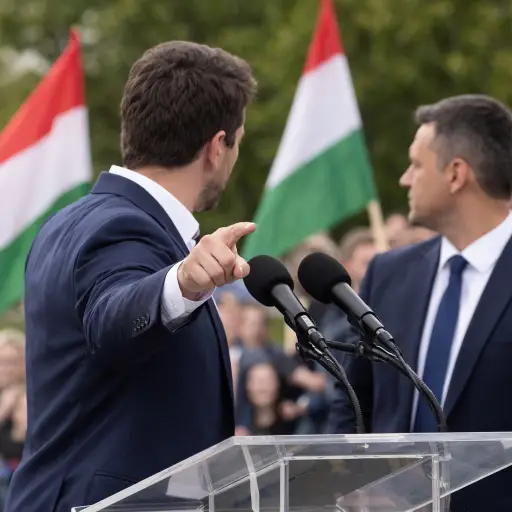
Péter Magyar challenges Fidesz candidate Péter Ágh to relinquish mandate as tensions rise over disputed constituency result

Hungary’s political landscape has been thrust into renewed uncertainty as Péter Magyar, the leader of the victorious Tisza party and the country’s incoming prime minister, publicly urged Péter Ágh of the ruling Fidesz party not to take up his parliamentary mandate. The call follows allegations of electoral misconduct in a key constituency in Vas County, where Magyar is demanding that authorities organize a new vote.
Speaking before supporters and national media, Magyar framed the dispute as a defining test for Hungary’s democratic integrity. He accused Ágh of benefiting from what he described as “systematic irregularities” during the election process in the district, arguing that the legitimacy of the result cannot stand under scrutiny.
“This is not about one seat,” Magyar said. “This is about whether citizens can trust that their vote is counted fairly and without interference.”
The contested constituency, located in western Hungary near the Austrian border, has quickly become a focal point in the aftermath of parliamentary elections that reshaped the country’s political balance. While Magyar’s Tisza party secured a decisive national victory, the narrow outcome in the Vas district has raised questions about local procedures and oversight.
Magyar stopped short of presenting detailed evidence during his initial statement but indicated that his party had gathered testimonies and documentation suggesting irregularities at multiple polling stations. He called on independent authorities to conduct a thorough investigation and urged Ágh to step aside voluntarily to allow a fresh vote.
Ágh, a long-time member of Fidesz and a familiar figure in Hungarian politics, has rejected the accusations, describing them as politically motivated. In a brief response, he stated that the election was conducted in accordance with the law and overseen by official bodies, and he expressed readiness to defend the result through legal channels if necessary.
The Fidesz party has echoed this stance, warning against what it characterizes as attempts to undermine the electoral system following a significant defeat at the national level. Party representatives have emphasized that Hungary’s election framework includes safeguards and review mechanisms, and they have called for restraint in public statements.
Despite these assurances, the controversy has intensified political tensions at a sensitive moment. Magyar’s rise to power has already marked a departure from years of Fidesz dominance, and his latest move signals a willingness to confront the previous governing party directly, even before formally taking office.
Observers note that disputes over individual constituencies are not uncommon in closely contested elections, but the tone and visibility of this confrontation are unusual. By personally calling on Ágh to decline his mandate, Magyar has elevated the issue from a legal matter to a broader political and symbolic challenge.
Analysts suggest that Magyar’s strategy may be aimed at reinforcing his campaign narrative of transparency and institutional reform. Throughout the election period, he positioned himself as a candidate committed to restoring public trust and addressing concerns about governance standards.
At the same time, critics warn that escalating the dispute could deepen polarization, particularly if the matter becomes prolonged or entangled in legal proceedings. The coming days are expected to be crucial, as electoral authorities review any formal complaints and determine whether conditions warrant further action.
International attention is also beginning to focus on the situation, with European observers closely watching how Hungary handles the allegations. The outcome may carry implications not only for domestic politics but also for the country’s standing within broader democratic frameworks.
For voters in the disputed district, the uncertainty remains immediate and tangible. Some residents have expressed frustration, saying they want clarity and closure, while others have welcomed the scrutiny as necessary to ensure fairness.
Whether a repeat vote will ultimately take place remains unclear. The decision will depend on legal assessments and the findings of any investigations. However, Magyar’s intervention has already ensured that the issue will remain at the forefront of Hungary’s political agenda.
As the country prepares for a transition of power, the dispute underscores the fragile balance between electoral victory and institutional legitimacy. For Magyar, the challenge will be to navigate this moment in a way that strengthens confidence in democratic processes while avoiding further division.
For Ágh and Fidesz, the stakes are equally high. Defending the integrity of the contested result has become a matter of political credibility, even as they move into opposition at the national level.
In the days ahead, Hungary will be watching closely to see whether this confrontation leads to resolution, escalation, or a test of the country’s electoral institutions. Whatever the outcome, the episode has already become one of the defining early moments of a new political era.