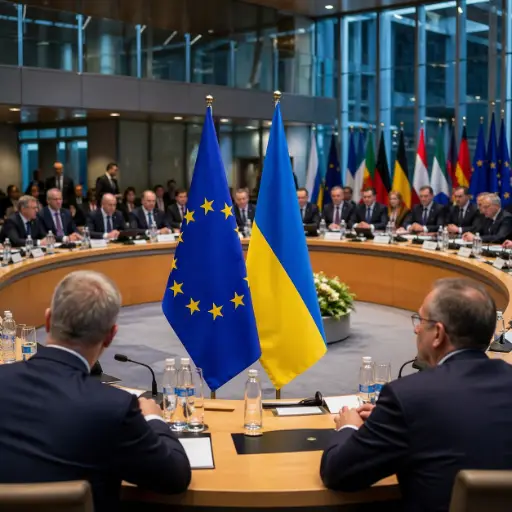
After weeks of tense negotiations and growing uncertainty over the European Union’s long-term commitment to Kyiv, representatives of EU member states have backed a landmark financial package worth 90 billion euros for Ukraine, marking one of the bloc’s most ambitious collective support measures since the start of the war.

The decision came after Hungary withdrew its objections, clearing the way for unanimous approval among member states. Slovakia, which had also expressed reservations during the negotiations, ultimately joined the consensus and supported both the aid package and a new round of sanctions targeting Russia.
The agreement is being viewed in Brussels as a critical political breakthrough at a moment when European unity has repeatedly been tested by economic pressure, electoral shifts, and growing fatigue over the prolonged conflict in Eastern Europe. Diplomats described the negotiations as difficult until the final hours, with several governments demanding additional guarantees on oversight, spending transparency, and the long-term burden on EU taxpayers.
The approved package is expected to provide Ukraine with a combination of reconstruction financing, budgetary assistance, infrastructure support, and military-related funding aimed at stabilizing the country’s economy and public institutions. European officials argue that continued financial backing is essential not only for Ukraine’s survival, but also for maintaining broader regional security.
Senior EU representatives emphasized that the package sends a message beyond Europe’s borders. According to diplomats involved in the talks, the agreement demonstrates that despite internal disagreements, the bloc remains capable of acting collectively on major geopolitical issues.
The shift in Hungary’s position attracted particular attention among European observers. Budapest had previously delayed several initiatives linked to Ukraine, arguing that sanctions against Moscow were damaging European economies and placing additional pressure on energy markets. Hungarian officials had also demanded concessions related to frozen EU funds and national economic protections.
In recent days, however, negotiations intensified behind closed doors, with senior European leaders seeking a compromise that could preserve unity without reopening broader institutional disputes inside the bloc. Sources familiar with the discussions described the final agreement as the result of “high-level political balancing” rather than a sudden policy reversal.
Slovakia’s support was also closely watched. The government in Bratislava has increasingly called for a more cautious approach toward military escalation and sanctions policy, reflecting divisions within parts of Central Europe over the long-term direction of EU strategy toward Russia.
Despite those concerns, the final vote illustrated that support for Ukraine remains the dominant position among member states, particularly as fears continue to grow over Russian military pressure and instability along the EU’s eastern frontier.
Alongside the financial package, EU representatives approved a fresh set of sanctions targeting Russian individuals, companies, and sectors linked to military production and sanctions evasion networks. European officials say the measures are designed to limit Moscow’s access to strategic technologies, industrial components, and international financing channels.
Analysts say the simultaneous approval of both financial assistance and sanctions was politically significant. While the aid package demonstrates Europe’s willingness to sustain Ukraine economically, the sanctions underline continued pressure on the Kremlin despite growing concerns about the impact on European industries and consumers.
The latest measures also arrive at a sensitive moment for transatlantic relations. European governments have faced increasing pressure to assume a larger share of responsibility for Ukraine’s financing and defense needs amid uncertainty surrounding future international commitments. Several EU capitals have argued that Europe can no longer rely exclusively on outside support and must strengthen its own strategic autonomy.
Financial markets reacted cautiously but positively to the announcement, with investors interpreting the agreement as a sign of political stability inside the EU. Energy markets remained relatively calm, although some analysts warned that additional sanctions could still create volatility in trade and supply chains over the coming months.
Inside Ukraine, officials welcomed the decision as a crucial signal of continued European backing. Ukrainian authorities have repeatedly warned that delays in international funding risk weakening public services, slowing reconstruction efforts, and undermining economic resilience during wartime conditions.
For many European leaders, the agreement carries symbolic weight beyond its financial scale. It reflects an effort to preserve the credibility of the European project itself at a time when nationalist movements, economic uncertainty, and geopolitical tensions continue to challenge cohesion inside the union.
Diplomats in Brussels acknowledged that divisions among member states are unlikely to disappear. Questions over defense spending, energy dependency, inflation, and enlargement policy continue to create friction between governments with differing political priorities.
Yet despite those tensions, the latest agreement suggests that when confronted with major strategic decisions, the European Union remains capable of compromise — even after prolonged confrontation behind closed doors.
As the conflict continues with no immediate diplomatic resolution in sight, European policymakers increasingly view support for Ukraine not as a temporary emergency measure, but as a long-term strategic commitment likely to shape the future direction of the continent for years to come.