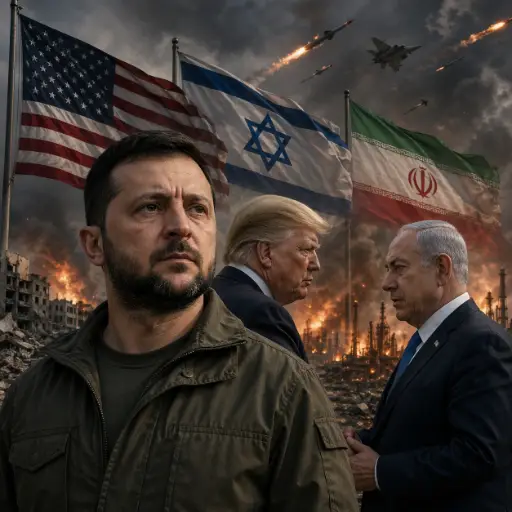
Ukrainian President Volodymyr Zelenskyy has issued one of his sharpest warnings yet about the consequences of the escalating American-Israeli confrontation with Iran. According to Kyiv, the conflict is no longer a regional crisis confined to the Middle East. Instead, it is becoming a geopolitical turning point capable of destabilizing security far beyond the region while strengthening Russia’s strategic position on the world stage.

The Ukrainian leader believes that the widening confrontation is gradually diverting the attention, resources and political focus of the United States and its allies away from Eastern Europe. For Ukraine, which continues to depend heavily on Western military and financial assistance in its defense against Russian aggression, the timing could hardly be worse.
Speaking to European media and diplomatic partners, Zelenskyy argued that Moscow has a direct interest in seeing the Middle East remain unstable for as long as possible. In his view, every new escalation between Israel, Iran and American forces creates additional pressure on Washington and weakens the unity of Western governments already struggling with internal political divisions and economic fatigue.
Analysts across Europe increasingly share concerns that the conflict is entering a dangerous phase. Military exchanges between Israel and Iranian-backed groups have intensified, while Tehran continues to project influence through regional allies stretching from Lebanon to the Red Sea. The United States has reinforced its military presence in the area, insisting that it seeks deterrence rather than a broader war. Yet diplomatic channels remain fragile and unpredictable.
For Ukraine, the issue is not only political but also deeply practical. Western arms production remains limited, and military aid packages require long negotiations in both the United States and Europe. Ukrainian officials fear that a prolonged Middle Eastern crisis could redirect weapons systems, air defense capabilities and intelligence resources toward Israel and American operations in the Gulf region.
Several European diplomats privately acknowledge that strategic priorities inside NATO are becoming increasingly complicated. While support for Ukraine officially remains firm, governments are now balancing multiple crises simultaneously: the war in Eastern Europe, instability in the Middle East, maritime security threats, cyberattacks and growing tensions in the Indo-Pacific.
Russia, meanwhile, appears eager to exploit the shifting geopolitical landscape. Moscow has strengthened its economic and military cooperation with Tehran over recent years, particularly in the fields of drone technology, energy coordination and sanctions evasion. Western intelligence agencies have repeatedly warned that the partnership between Russia and Iran has evolved into a broader anti-Western alignment designed to challenge American influence across several regions at once.
According to security experts, the Kremlin benefits whenever international attention fragments. A divided West makes coordinated sanctions more difficult, slows military decision-making and increases political pressure inside democratic governments already facing inflation, migration debates and election campaigns.
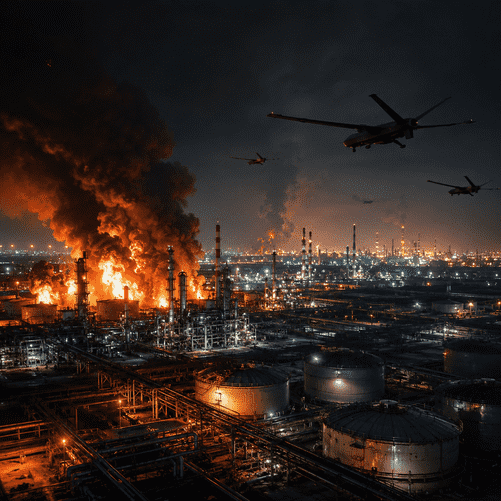
Energy markets have also reacted nervously to the rising instability. Investors fear that any disruption to maritime routes or oil infrastructure in the Gulf could trigger another wave of global inflation. European economies, still recovering from previous energy shocks linked to the war in Ukraine, remain particularly vulnerable to sudden increases in fuel prices.
The conflict is also fueling fears of broader aggression outside the Middle East. Intelligence officials in several European capitals worry that authoritarian states may interpret Washington’s strategic overstretch as an opportunity to test Western resolve elsewhere. This includes cyber operations, disinformation campaigns, sabotage activities and renewed military pressure in contested regions.
Zelenskyy’s message is therefore aimed not only at defending Ukraine’s interests but also at warning allies against strategic distraction. Ukrainian officials insist that global security crises are becoming increasingly interconnected and that authoritarian governments cooperate more closely than many Western policymakers previously believed.
Some observers compare the current moment to previous periods of geopolitical fragmentation in which simultaneous conflicts gradually eroded international stability. The concern in European capitals is not necessarily the outbreak of a world war in the traditional sense, but rather the emergence of multiple overlapping confrontations capable of exhausting alliances and weakening global institutions.
Despite mounting tensions, diplomatic efforts continue behind closed doors. European governments are attempting to maintain communication with both Washington and regional actors in hopes of preventing further escalation. However, mutual distrust remains high, and each new military incident risks triggering a wider chain reaction.
Inside Ukraine, the developments are watched with growing anxiety. Civilians and soldiers alike understand that international attention can shift rapidly. For many Ukrainians, the fear is not only that support may slow, but that the world could gradually become accustomed to permanent instability across several fronts at once.
As the geopolitical balance continues to evolve, one conclusion is becoming increasingly difficult to ignore: conflicts that once appeared regional now carry global consequences. Whether in Eastern Europe or the Middle East, today’s wars are no longer isolated crises. They are interconnected struggles shaping the future of international power, alliances and security.