How The Devil Wears Prada 2 captures the collapse of editorial power and the rise of luxury brands, influencers and algorithm-driven fashion culture

Fashion once revolved around a small circle of editors who decided what mattered. A cover placement in Vogue, a front-row invitation arranged by a magazine, or the approval of a powerful editor could launch a designer, define a trend and shape the entire luxury market for a season. The upcoming sequel to The Devil Wears Prada arrives in a completely different industry — one where the traditional gatekeepers are no longer fully in control.
The original film became iconic because it dramatized the authority of fashion media at its peak. Miranda Priestly, inspired by the legendary figures who dominated glossy magazines in the early 2000s, represented a system built on scarcity, hierarchy and editorial judgment. Designers feared editors. Publicists chased magazine covers. Retail buyers waited for editorial approval before committing to collections. Fashion journalism itself was part of the luxury machinery.
The sequel reportedly shifts this balance entirely. Early details surrounding The Devil Wears Prada 2 suggest a world where magazines are financially weakened, digital platforms dominate attention and luxury brands increasingly communicate directly with consumers. The transformation is not simply technological. It is cultural, economic and generational.
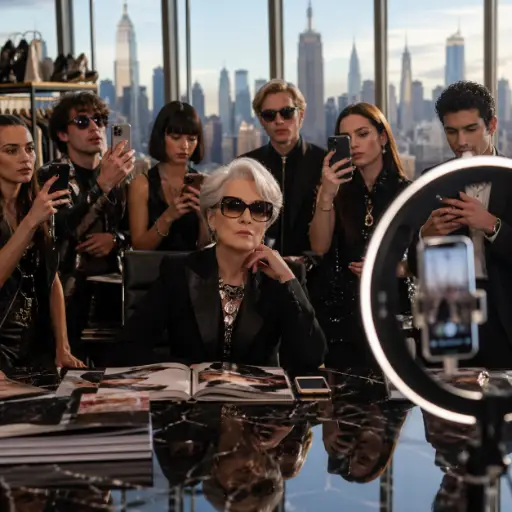
The most important change is that fashion authority has fragmented. Today, a viral TikTok creator can influence sales faster than a legacy publication. Luxury houses no longer depend exclusively on editors to curate trends because they own their own communication channels. Brands produce documentaries, podcasts, livestreamed runway shows and cinematic campaigns designed for social platforms. They speak directly to audiences in real time, bypassing the old editorial filters.
This evolution has deeply altered the relationship between fashion media and luxury conglomerates. In the past, magazines could pressure brands through criticism or exclusion. That leverage has weakened. Advertising budgets have shifted toward influencers, celebrities and digital campaigns controlled by the brands themselves. Editors who once decided cultural relevance now often compete for access and partnerships.
The sequel arrives at a moment when the fashion industry is confronting another uncomfortable reality: consumers increasingly trust personalities more than institutions. The rise of influencer culture has transformed fashion communication into a constant stream of personal recommendations, behind-the-scenes videos and algorithm-driven trends. The polished authority of traditional magazines feels distant compared to the immediacy of social media creators who appear accessible and authentic.
This does not mean fashion journalism has disappeared. Instead, its role has changed. Critics, writers and editors still shape conversations, but they no longer operate as untouchable cultural arbiters. Influence is now dispersed among creators, stylists, celebrities, data analysts and even recommendation algorithms. Luxury companies monitor engagement metrics with the same intensity that they once monitored magazine reviews.
The irony is that luxury brands themselves helped create this new ecosystem. In their race for global visibility, fashion houses embraced digital platforms aggressively. They partnered with influencers, invested heavily in social media storytelling and turned fashion shows into online spectacles designed for viral circulation. In doing so, they reduced their dependence on traditional publications.
The Devil Wears Prada 2 appears ready to explore the emotional consequences of this transformation. Characters who once wielded enormous influence must now navigate an environment where authority is unstable and relevance can disappear overnight. The anxiety at the center of the new film is no longer about pleasing a powerful editor. It is about surviving a system where trends move faster than institutions can control them.
That tension reflects the wider uncertainty inside the luxury industry itself. Brands now operate in a hyper-competitive digital economy where visibility is constant but attention spans are shrinking. The modern fashion cycle never pauses. Collections are dissected online within minutes. Campaigns are instantly memed, praised or attacked. Designers are expected to produce content as much as clothing.
The sequel’s timing is especially significant because fashion is entering another transition period. The industry is balancing exclusivity with mass exposure, craftsmanship with virality and heritage with internet culture. Younger consumers admire luxury brands but engage with them differently. They discover fashion through short videos, celebrity collaborations and online personalities rather than through editorial spreads alone.
In this environment, the figure represented by Miranda Priestly becomes almost historical — not irrelevant, but symbolic of a disappearing era. The gatekeeper has not vanished entirely, but the gate itself has collapsed. Access to fashion is now radically democratized, even if power and wealth remain concentrated behind the scenes.
That is why The Devil Wears Prada 2 may resonate beyond nostalgia. The sequel is not only revisiting beloved characters. It is documenting the end of a cultural system that once defined modern fashion. The film reflects a broader truth about media in the digital age: institutions that once controlled public taste are increasingly being replaced by networks, algorithms and direct-to-consumer influence.
The fashion world portrayed today is louder, faster and less predictable than the one audiences saw decades ago. Yet it is also more transparent about the commercial machinery underneath the glamour. Consumers now understand that luxury is shaped not only by creativity, but by data, branding strategy and digital attention economies.
In many ways, the new film captures the central paradox of contemporary fashion. The industry still sells aspiration, exclusivity and authority, but it now operates inside a culture that rewards accessibility, speed and constant exposure. The editor-in-chief who once dictated trends from behind a polished desk must now compete with millions of screens refreshing endlessly across the world.
The death of the gatekeeper is therefore not simply the story of magazines losing power. It is the story of fashion itself becoming decentralized. The sequel to The Devil Wears Prada appears poised to show that transformation with unusual clarity — revealing an industry where influence no longer belongs to a single office, publication or personality, but to a chaotic digital ecosystem that reinvents itself every day.