As the luxury industry searches for fresh relevance in a changing global landscape, this year’s finalists reveal a generation of designers more interested in identity, craft and longevity than spectacle alone.

The announcement of the finalists for the 2026 LVMH Prize arrives at a moment of recalibration for the global fashion industry. After years dominated by celebrity-driven marketing, social-media acceleration and logo-heavy maximalism, the emerging generation of designers appears to be moving in another direction entirely: one rooted in precision, narrative depth and a renewed respect for craftsmanship.
After unveiling 20 semi-finalists earlier this season, the LVMH Prize has now narrowed the competition to nine finalists who will compete for one of fashion’s most influential awards. The final selection reflects one of the most geographically diverse lineups in the history of the prize, underlining the increasingly global nature of contemporary luxury fashion.
The nine finalists for the 2026 LVMH Prize are Colleen Allen from the United States for womenswear; De Pino by Gabriel Figueiredo of France for womenswear; Institution by Galib Gassanoff of Georgia for womenswear, menswear and genderless collections; Julie Kegels of Belgium for womenswear; LII by Zane Li of China for womenswear and menswear; Petra Fagerström of Sweden for womenswear; Ponte by Harry Pontefract of the United Kingdom for womenswear and menswear; The Vxlley by Daniel del Valle Fernandez of Spain for genderless collections; and Yoshita 1967 by Anil Padia of Kenya for womenswear.
Long regarded as fashion’s most prestigious incubator for emerging talent, the LVMH Prize has evolved into far more than a financial award. It now functions as a global indicator of where fashion is heading creatively, culturally and commercially. Previous winners and finalists have gone on to redefine modern luxury, shaping both independent fashion and the creative direction of major houses.
This year’s finalists point toward a broader transformation already underway inside the industry. Rather than relying on spectacle or overt trend-making, many of the selected designers are focused on developing highly personal visual languages grounded in craftsmanship, cultural storytelling and technical precision.
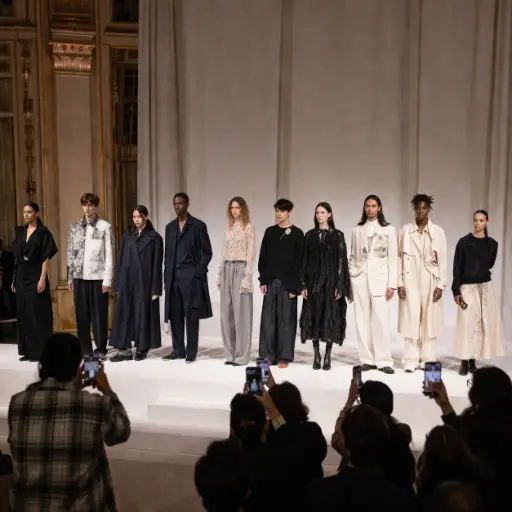
One of the strongest themes emerging from the finalists’ collections is restraint. Tailoring is sharper, silhouettes more architectural and materials more tactile. Neutral palettes, sculptural outerwear and elongated proportions appeared repeatedly throughout presentations, suggesting a shift away from the loud visual codes that dominated fashion during the post-pandemic rebound years.
At the same time, innovation remains central to the new generation’s identity. Several finalists presented sophisticated textile experimentation and advanced sustainable production methods, incorporating recycled fabrics, deadstock sourcing and artisanal construction techniques into collections that still feel unmistakably luxurious. Sustainability is no longer treated as a separate category within fashion but as an integrated creative principle.
Gender fluidity also continues to define the contemporary luxury conversation. Many of the shortlisted collections resisted traditional menswear and womenswear distinctions, favoring adaptable garments designed around movement, personality and styling freedom. The result is a more flexible approach to luxury dressing that reflects evolving consumer attitudes, particularly among younger audiences.
Industry insiders have also emphasized the increasingly interdisciplinary nature of emerging fashion talent. Several finalists work across multiple creative fields, drawing inspiration from architecture, visual art, cinema and performance. Fashion today is no longer confined to clothing alone; it is becoming part of a larger cultural ecosystem in which storytelling and emotional connection carry equal weight to commercial success.
The commercial significance of the LVMH Prize remains substantial. Beyond the visibility associated with the competition, finalists receive access to mentorship from executives across the LVMH group in areas including production, communication, merchandising and international growth. At a time when independent brands face mounting economic pressure and rising operational costs, that support can prove transformative.
Yet the prize’s greatest influence may be symbolic. The LVMH Prize frequently identifies aesthetic and cultural shifts long before they become dominant within the broader industry. Buyers, editors and creative directors follow the competition closely because its finalists often forecast the direction of luxury fashion several years ahead.
This year’s lineup suggests a growing appetite for authenticity over immediacy. The collections generating the strongest reactions are not necessarily the most theatrical but those with the clearest creative identities. Many feel deeply rooted in personal histories, local traditions and cultural specificity rather than designed purely for digital virality.
The diversity of the finalists also reflects the continued decentralization of fashion itself. Creative innovation is no longer concentrated exclusively in Paris, Milan or London. Designers from Georgia, Kenya, China and elsewhere are increasingly shaping the global luxury conversation on equal footing, bringing new perspectives and narratives into an industry historically dominated by Western capitals.
As the competition moves toward its final stage, the 2026 LVMH Prize already appears to capture a broader shift in fashion culture. The industry is entering a more reflective period—one in which craftsmanship, precision and emotional intelligence matter as much as visibility and hype.
For a business often driven by acceleration and constant reinvention, the new generation of LVMH Prize finalists offers a surprisingly measured vision of the future: one built not on excess, but on clarity, cultural depth and lasting creative identity.