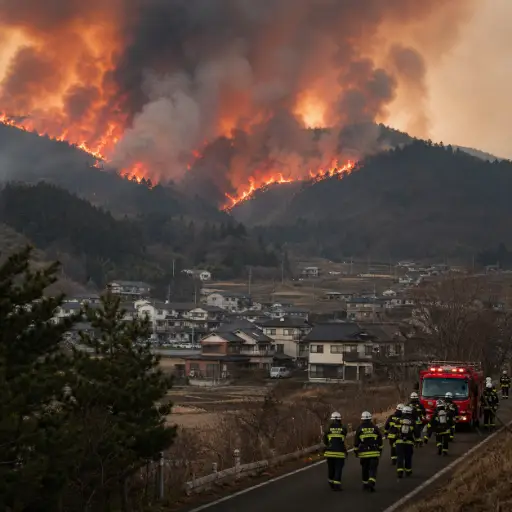
Mass evacuations, exhausted firefighters and growing fears over climate-driven disasters mark one of the country’s largest wildfire emergencies in modern history.

More than a thousand firefighters in northern Japan continue to battle two massive wildfires that have been burning for several days, forcing thousands of residents to evacuate as flames edge dangerously close to populated areas. Authorities say the combined area affected has already become the third-largest wildfire disaster ever recorded in the country, raising alarm over the increasing intensity of natural disasters across Japan.
The fires, fueled by strong winds, dry vegetation and unusually warm spring conditions, have spread rapidly across forested mountain regions, sending thick columns of smoke into the sky and turning nearby communities into emergency zones. Helicopters have been deployed alongside ground crews, while emergency responders work around the clock to prevent the flames from reaching additional residential districts.
Local authorities ordered the evacuation of more than 3,000 residents after the fires began moving toward towns situated near the affected forests. Many families left their homes carrying only essential belongings, taking refuge in temporary shelters established in schools, sports centers and municipal buildings. Officials warned that shifting winds could quickly change the direction and speed of the fires, making the situation highly unpredictable.
Firefighters from multiple prefectures have joined the operation, one of the largest coordinated emergency responses seen in the region in recent years. Exhausted crews have been working in difficult terrain, where steep hills and dense forest make access challenging. In several locations, firefighters were forced to create emergency firebreaks to slow the advance of the flames.
Residents described scenes of fear and uncertainty as smoke covered roads and ash fell across neighborhoods. Some evacuees said they could see glowing flames from their windows during the night before authorities ordered them to leave. Others expressed concern about elderly relatives and isolated rural communities that may require additional assistance if conditions worsen.
Officials have not yet confirmed the exact cause of the fires, though investigations are expected to continue once the situation is brought under control. Weather experts noted that the affected areas have experienced lower-than-average rainfall in recent weeks, creating dry conditions favorable for rapid fire spread. Strong seasonal winds have further complicated containment efforts.
Japan is not traditionally associated with large-scale wildfires on the level seen in parts of North America or Australia, but experts say the country has become increasingly vulnerable to extreme weather patterns linked to climate change. Rising temperatures and longer dry periods are believed to be contributing to more intense fire seasons, particularly in heavily forested regions.
Environmental specialists warn that such disasters could become more common unless broader prevention measures are implemented. Forest management, emergency preparedness and early detection systems are expected to become central topics in future national discussions on disaster resilience.
For now, authorities remain focused on protecting lives and containing the advancing flames. Emergency teams continue to monitor weather conditions closely, hoping for calmer winds and possible rainfall that could help slow the fires naturally.a
As smoke continues to rise above northern Japan, the crisis has become a stark reminder of how rapidly natural disasters can escalate and how vulnerable even well-prepared communities remain in the face of increasingly extreme environmental conditions.