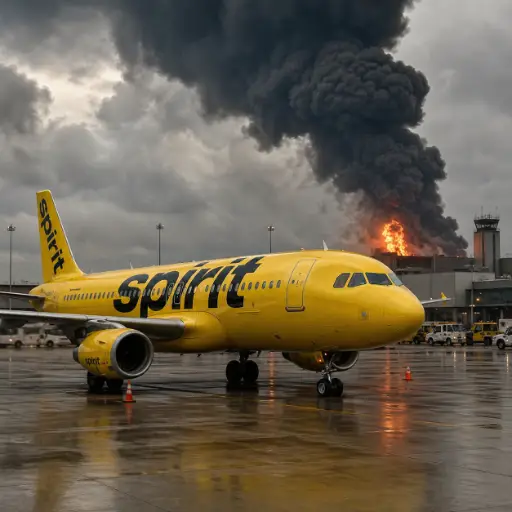
A deepening Middle East crisis, rising fuel costs and years of financial instability have pushed the low-cost carrier closer to collapse, reviving a fierce debate over state intervention in the airline industry.

Spirit Airlines, once celebrated as the symbol of ultra-cheap air travel in the United States, is now fighting for survival. The Florida-based carrier has entered one of the most difficult periods in its history as geopolitical tensions in the Middle East continue to shake global energy markets and drive jet fuel prices sharply higher. Combined with heavy debt accumulated during the pandemic years and weakening consumer demand, the crisis has placed the airline under enormous pressure and intensified fears of bankruptcy.
The situation has become so serious that officials in Washington are reportedly considering a rescue package that would involve public funding in exchange for an ownership stake in the company. The proposal immediately reignited political and legal debates over whether governments should intervene to save struggling airlines in times of economic and geopolitical instability.
Spirit’s problems did not begin with the latest international crisis. The carrier has been under financial strain since the collapse of global air travel during the Covid-19 pandemic. Although passenger numbers recovered in the years that followed, Spirit never fully regained financial stability. The airline’s business model, built on extremely low fares and additional service fees, became increasingly vulnerable as operating costs rose across the industry.
Unlike larger competitors with diversified international networks and premium business-class revenues, Spirit remained heavily dependent on price-sensitive travelers. Inflation in the United States and slowing consumer spending weakened demand for low-cost leisure travel, while maintenance expenses and labor costs climbed steadily. Analysts say the renewed instability in the Middle East has only accelerated problems that had already been building for years.
Higher oil prices have become one of the most immediate threats. Airlines worldwide are facing increased fuel expenses after renewed regional tensions disrupted global markets and raised concerns about long-term supply stability. For a budget carrier operating on narrow profit margins, even moderate increases in fuel prices can quickly become devastating.
Industry observers note that Spirit also faces growing competitive pressure from larger American airlines that expanded aggressively after the pandemic. Major carriers strengthened loyalty programs, added routes and attracted travelers willing to pay more for reliability and additional comfort. Spirit, meanwhile, struggled with operational disruptions, aircraft delivery delays and weaker investor confidence.
The possibility of direct government intervention has divided the aviation sector. Supporters argue that Spirit plays an important role in the American market by providing affordable travel options and increasing competition on domestic routes. A collapse of the airline, they warn, could reduce consumer choice and lead to higher ticket prices, particularly on routes serving lower-income travelers.
Critics, however, argue that rescuing a private airline with taxpayer money would distort competition and reward years of risky management decisions. Rival airlines have already signaled strong opposition to any state-backed deal and are preparing legal challenges should Washington move forward with the plan.
The debate has drawn comparisons with Germany’s controversial intervention in Lufthansa during the pandemic period. Berlin provided billions of euros in support to stabilize the airline in exchange for an ownership position. Although German officials defended the move as necessary to protect jobs and strategic infrastructure, competitors argued that the rescue gave Lufthansa an unfair advantage in the European market.
Those objections eventually reached European courts, where challengers succeeded in overturning parts of the original approval process. The legal outcome continues to influence discussions in both Europe and the United States about the limits of state support for private carriers.
In Washington, policymakers now face a difficult balancing act. On one hand, allowing Spirit Airlines to fail could trigger layoffs, disrupt regional travel networks and further reduce competition in an industry already dominated by a small group of powerful companies. On the other hand, approving a rescue package risks opening the door to future demands for government assistance from other struggling corporations.
Economists say the case reflects a broader shift in how Western governments respond to crises affecting strategically important industries. In recent years, authorities in both Europe and the United States have shown a greater willingness to intervene in sectors considered essential for economic stability and national infrastructure. Airlines, because of their role in transportation and commerce, increasingly fall into that category.
For passengers, the uncertainty surrounding Spirit Airlines creates immediate concerns about future flights, ticket reliability and possible route cancellations. Travel agencies and consumer groups are closely monitoring the situation, while investors remain cautious about the airline’s long-term viability.
Whether Spirit ultimately survives may depend not only on political decisions in Washington, but also on the direction of the global economy and the evolution of tensions in the Middle East. For now, the airline stands at the center of a wider debate about globalization, market competition and the growing role of governments in protecting critical industries during periods of international instability.