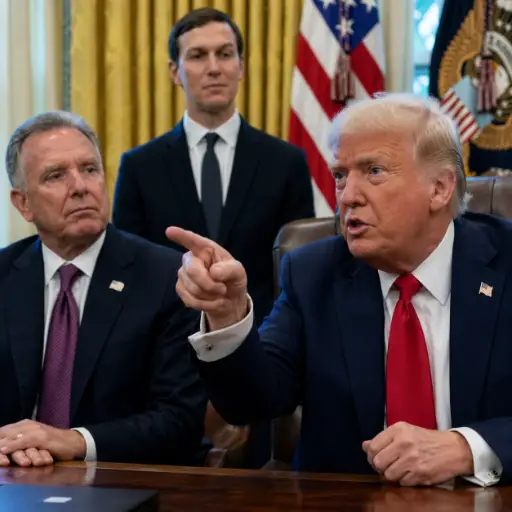
White House signals confidence and strategic dominance after Donald Trump calls off planned diplomatic trip by Steve Witkoff and Jared Kushner

The White House has abruptly canceled a planned diplomatic mission to Pakistan involving American negotiator Steve Witkoff and presidential adviser Jared Kushner, signaling a sharper and more uncompromising approach by the United States toward the ongoing conflict involving Iran.
According to reports broadcast by Fox News, President Donald Trump personally decided to halt the trip after concluding that Washington already possesses sufficient leverage in the broader regional standoff. Speaking to the network’s White House correspondent, Trump reportedly stated that the United States “has all the cards,” making further talks unnecessary at this stage.
The canceled visit had been expected to focus on possible diplomatic channels aimed at easing tensions surrounding Iran and reducing the risk of wider instability across the Middle East and South Asia. Pakistan, which maintains sensitive relations with both Tehran and Washington, had quietly emerged as a potential intermediary capable of facilitating indirect communication between competing regional interests.
The decision, however, reflects a growing confidence inside the Trump administration that economic pressure, military deterrence and strategic alliances are currently working in America’s favor. Senior officials close to the administration have increasingly argued that direct concessions or additional negotiations could weaken Washington’s negotiating position at a critical moment.
Steve Witkoff, who has become one of Trump’s most trusted envoys on sensitive international matters, was expected to hold meetings with senior Pakistani officials behind closed doors. Jared Kushner, Trump’s son-in-law and longtime adviser on Middle Eastern affairs, was also scheduled to participate in discussions that analysts believed could open informal pathways toward de-escalation.
Instead, the sudden cancellation has reinforced perceptions that the administration is shifting toward a more unilateral strategy, preferring pressure over diplomacy while projecting strength ahead of possible future negotiations.
Diplomatic observers in Islamabad reacted cautiously to the news. Pakistani officials had reportedly prepared for discreet consultations intended to explore whether regional actors could help prevent further escalation between Iran and its adversaries. Islamabad has long attempted to balance its strategic partnership with the United States while maintaining workable ties with neighboring Iran, a relationship shaped by energy interests, border security concerns and regional stability.
Political analysts say the cancellation may also reflect divisions inside Washington over the usefulness of backchannel diplomacy at a time when the administration believes Iran is facing growing economic and political strain. Supporters of Trump’s decision argue that maintaining maximum pressure increases the likelihood of forcing Tehran into future concessions without granting symbolic victories through additional talks.
Critics, however, warn that abandoning diplomatic openings could deepen instability across an already fragile region. Former diplomats and security experts have repeatedly emphasized that even limited communication channels can reduce the risk of misunderstandings during periods of heightened military and political tension.
The development comes as international concern continues to grow over the possibility of wider confrontation involving Iran and several regional powers. Energy markets, security analysts and foreign governments are closely monitoring every signal emerging from Washington, Tehran and neighboring capitals.
Within the Trump administration, the message appears increasingly clear: the United States believes it currently occupies a position of strategic advantage and sees little reason to engage in talks that could dilute that leverage.
For Pakistan, the cancellation represents a reminder of the difficult diplomatic balancing act it continues to perform between global and regional powers. While Islamabad remains eager to position itself as a stabilizing actor capable of facilitating dialogue, the latest decision from Washington demonstrates how quickly geopolitical calculations can shift.
Whether the move ultimately strengthens America’s hand or closes off valuable diplomatic opportunities remains uncertain. What is clear is that the cancellation of the Witkoff-Kushner mission has added another layer of tension to an already volatile geopolitical landscape, at a moment when every decision carries consequences far beyond the negotiating table.