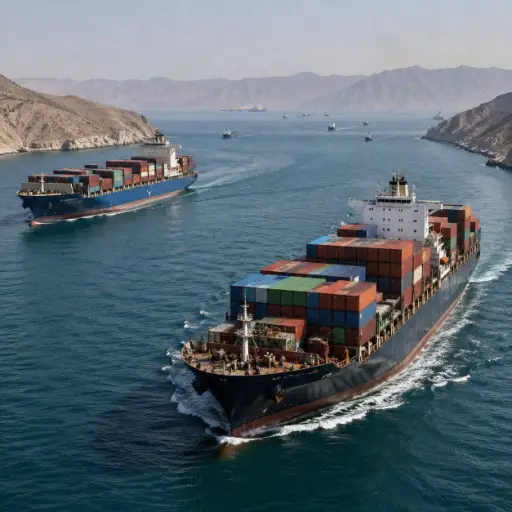
As Chinese and Indian carriers regain strategic ground in Gulf trade routes, European shipping companies face mounting economic pressure from sanctions, security fears, and political caution.

The Strait of Hormuz has once again become the focal point of global maritime trade, but the latest developments reveal more than a regional security issue. They expose a growing divide between Asia’s increasingly assertive shipping industry and Europe’s more cautious commercial approach. As tensions in the Gulf fluctuate and maritime insurers continue to raise premiums, several major Asian shipping companies have begun restoring transit operations through Hormuz far more rapidly than their Western European competitors.
The implications extend far beyond the shipping sector. Analysts warn that if Asian carriers maintain their current momentum, Europe could face a worsening competitive imbalance in trade, logistics, manufacturing, and energy supply chains. What initially appeared to be a temporary reaction to geopolitical instability may evolve into a structural economic disadvantage for the continent.
For months, maritime traffic through the narrow but crucial waterway had slowed under the weight of regional tensions, attacks on commercial vessels, and fears of broader military escalation. European shipping groups responded conservatively. Many redirected vessels around Africa, accepted longer delivery times, or reduced exposure to Gulf-related routes altogether. The decisions were largely driven by insurance liabilities, shareholder pressure, and compliance concerns linked to international sanctions regimes.
Asian operators, however, especially from China and India, adopted a markedly different strategy.
Several carriers resumed passages through Hormuz soon after security conditions showed signs of stabilization. Industry observers note that Asian companies often operate with stronger state backing, greater tolerance for geopolitical risk, and a more aggressive focus on maintaining supply continuity. For them, withdrawing from key maritime corridors carries its own strategic danger: losing market share during a period when global trade networks are already being reorganized.
The result is increasingly visible across major ports and freight markets. Asian shipping firms are regaining delivery speed advantages while preserving direct access to Gulf energy exports and regional manufacturing hubs. European importers, meanwhile, continue facing higher transportation costs and prolonged shipping times. In sectors dependent on just-in-time logistics, such delays can quickly ripple through entire industrial chains.
Energy remains at the center of the equation. The Strait of Hormuz handles a substantial portion of global oil and liquefied natural gas shipments. While Europe has spent recent years attempting to diversify energy sources and reduce strategic dependencies, the continent still relies heavily on maritime energy imports. Any logistical disadvantage in accessing Gulf exports risks feeding inflationary pressures already affecting industry and consumers alike.
The situation is particularly sensitive for Germany, Italy, and other export-oriented European economies. Manufacturers dependent on petrochemicals, industrial inputs, or Asian intermediate goods are now confronting a widening transportation gap compared with competitors in Asia. Shipping costs alone are becoming a competitive factor capable of influencing factory output, pricing, and investment decisions.
European shipowners argue that their caution is not irrational. Insurance costs for vessels operating near conflict zones remain elevated, and legal uncertainty surrounding sanctions compliance continues to complicate decision-making. Executives also point to political expectations within the European Union, where companies face far greater scrutiny over security exposure and reputational risk than many of their Asian counterparts.
Yet critics increasingly warn that excessive caution may itself become economically damaging.
Some maritime analysts describe the current moment as a turning point in global commercial geography. According to this view, Asian shipping companies are no longer simply reacting faster to crises; they are actively reshaping trade architecture in their favor. By preserving operational presence in contested regions while European firms retreat, they strengthen long-term relationships with Gulf exporters, secure priority access to logistics infrastructure, and deepen influence over strategic maritime corridors.
China’s broader geopolitical ambitions also play a role. Beijing has spent years investing in ports, shipping capacity, and overseas infrastructure under various trade connectivity initiatives. The willingness of Chinese carriers to maintain activity in sensitive waters reflects not only commercial calculation but also a strategic effort to expand influence over global supply chains. India, meanwhile, is increasingly seeking to position itself as a maritime and industrial power capable of balancing both East and West while protecting its own energy interests.
For Europe, the challenge is becoming difficult to ignore. The continent already faces sluggish industrial growth, weaker export performance, and intensifying competition from Asian manufacturers. If European shipping companies continue losing ground on key global routes, the effects could spread well beyond logistics firms and into the broader economy.
Some policymakers in Brussels are now discussing whether Europe needs a more coordinated maritime security framework capable of reassuring commercial operators and reducing dependence on external naval protection. Others argue that the European Union must reconsider aspects of its sanctions policy if those measures indirectly weaken the competitiveness of European companies while rivals continue operating under different standards.
Behind the debate lies a broader question about the future balance of economic power.
Global trade increasingly rewards flexibility, speed, and tolerance for uncertainty. Asian shipping groups appear more willing to navigate volatile environments in exchange for strategic advantage. European firms, constrained by regulation, political caution, and financial exposure, are moving far more slowly.
As commercial traffic gradually returns to the Gulf, the race is no longer simply about who can pass safely through the Strait of Hormuz. It is about who will dominate the trade routes of the next decade.
And for Europe, the cost of hesitation may prove far greater than the risks it sought to avoid.