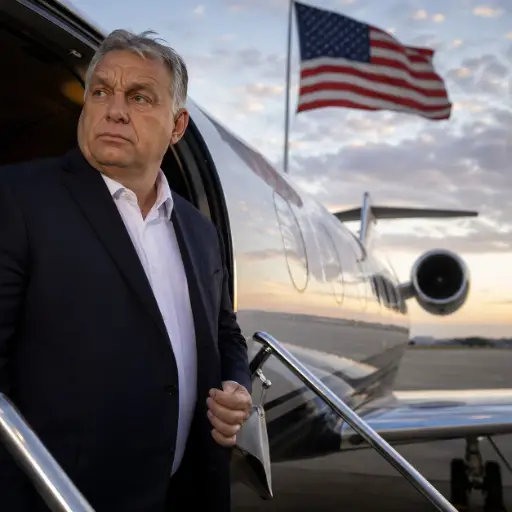
Hungary’s longtime nationalist leader declines his parliamentary seat after election setback, fueling debate about his political legacy and future abroad

Viktor Orbán, the dominant figure of Hungarian politics for more than a decade and a half, has announced that he will not take up the parliamentary mandate won by his party in the recent national elections, a decision that immediately triggered intense speculation about his future and the future direction of Hungary itself.
The outgoing prime minister made the announcement on Saturday in a brief but carefully worded statement that avoided direct references to retirement or political withdrawal. Yet within hours, political observers, opposition figures and several Hungarian media outlets began circulating reports suggesting that Orbán may be preparing to relocate to the United States, where his eldest daughter has been living with her family for some time.
The development marks one of the most dramatic political turning points in Hungary since the fall of communism. For years, Orbán was regarded not only as the country’s most influential political actor, but also as one of the defining nationalist voices in Europe. His departure from frontline politics now raises questions about the future of the conservative movement he built, the cohesion of his Fidesz party and Hungary’s relationship with both Brussels and Washington.
Although Orbán did not explicitly confirm any plans to move abroad, his decision to refuse the parliamentary seat has been interpreted by many analysts as a symbolic closing chapter in a political career that reshaped Hungary’s institutions, media landscape and foreign policy orientation.
In Budapest, reactions were immediate and deeply divided. Supporters described the decision as a dignified exit by a leader who had spent decades defending Hungarian sovereignty against external pressure. Critics, however, argued that the move reflects the growing isolation of a politician who once appeared politically untouchable but who increasingly faced economic discontent, diplomatic tensions and mounting domestic fatigue.
Several figures close to the governing party attempted to calm speculation by insisting that Orbán would continue to play an advisory role in Hungarian public life. Nonetheless, sources within conservative political circles acknowledged that discussions about a longer stay in the United States had intensified in recent months, particularly after the elections.
The possibility of Orbán settling in America carries undeniable political symbolism. Throughout much of his leadership, the Hungarian prime minister cultivated an image as a defender of traditional European nationalism and a critic of liberal Western institutions. His frequent clashes with European Union officials over migration, judicial reforms, media laws and civil society policies made him one of the continent’s most controversial leaders.
At the same time, Orbán maintained strong relationships with segments of the American conservative movement. His speeches at international conservative gatherings and his repeated emphasis on “illiberal democracy” earned admiration from some right-wing commentators in the United States, even as they alarmed many European leaders.
For political historians, the irony is difficult to ignore. A politician who built much of his domestic narrative around resistance to foreign influence may now be considering a future outside Hungary at the very moment his political era appears to be ending.
In central Budapest, the atmosphere over the weekend reflected both uncertainty and exhaustion after years of deeply polarized politics. Some residents expressed relief at the prospect of political change, while others worried that Orbán’s departure could destabilize the conservative camp and create a prolonged period of internal struggle within Fidesz.
“There is a sense that an entire era is ending,” said one political analyst interviewed by local television. “Whether people admired him or opposed him, Orbán defined Hungarian politics for years. It is difficult to imagine the country without him at the center of power.”
International reactions were similarly cautious. European officials largely avoided direct commentary on the reports surrounding Orbán’s possible relocation, though diplomats privately acknowledged that his departure could open the door to a reset in Hungary’s strained relationship with several European institutions.
Financial markets also reacted carefully, with investors watching for signs of political instability or leadership disputes inside the ruling party. While no immediate crisis is expected, analysts note that Fidesz has long been closely identified with Orbán personally, making any succession process particularly delicate.
The former prime minister’s inner circle remains largely silent regarding his personal plans. Neither members of his family nor senior party officials have publicly addressed reports about a possible move to the United States. Observers note, however, that Orbán has increasingly spent time outside the public spotlight in recent months, fueling rumors that he had already begun preparing for a transition away from active politics.
For many Hungarians, the announcement carries emotional as well as political weight. Orbán first rose to prominence as a young anti-communist reformer before transforming himself into the architect of a nationalist political system that profoundly influenced modern Hungary. Admirers credit him with defending national identity and resisting external political pressure. Opponents accuse him of weakening democratic institutions and deepening divisions within society.
Now, with his parliamentary mandate declined and uncertainty surrounding his future, Hungary enters a new and unpredictable chapter.
Whether Viktor Orbán ultimately settles in the United States or remains an influential figure behind the scenes in Hungary, his decision signals the beginning of a post-Orbán political landscape — a prospect that, until recently, many in the country believed impossible.