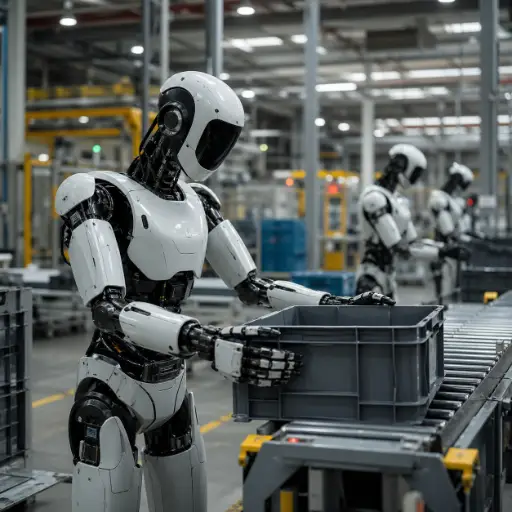
While the United States focuses on futuristic ambitions, China is already deploying humanoid machines into real industrial operations.

The global technology race has entered a new phase — quieter than the rise of smartphones or artificial intelligence, yet potentially just as transformative. Humanoid robots, once confined to research laboratories and science-fiction demonstrations, are now stepping directly into factories, warehouses, logistics centers, and service industries. What was recently considered experimental technology is beginning to take on real operational roles, particularly in China, where companies are accelerating commercial deployment at a pace that is attracting worldwide attention.
According to reporting highlighted by CNBC, Chinese technology firms are rapidly integrating humanoid robots into industrial workflows, aiming to address labor shortages, increase productivity, and strengthen the country’s manufacturing dominance. Unlike many Western projects that still emphasize long-term vision and conceptual innovation, China’s strategy appears increasingly practical: build robots that can work now, even if they are not yet perfect.
This shift marks a significant turning point for the robotics industry. For years, humanoid robots were largely viewed as technological showcases — impressive machines capable of dancing, running, or mimicking human gestures, but rarely delivering meaningful economic value. The challenge was not only engineering sophisticated movement, but also making robots reliable, affordable, and useful in unpredictable real-world environments.
That balance is now beginning to change.
Several Chinese companies have introduced humanoid machines designed specifically for repetitive industrial tasks such as sorting packages, transporting materials, inspecting equipment, and assisting workers on assembly lines. Advances in artificial intelligence, computer vision, and battery efficiency have dramatically improved the robots’ ability to navigate dynamic workplaces and adapt to changing conditions.
The rapid expansion of generative AI has also accelerated robotics development. Modern humanoid systems are no longer programmed only for fixed routines. Instead, they are increasingly capable of understanding verbal instructions, recognizing objects, and learning tasks through observation. This convergence between AI and robotics is creating machines that can operate with a degree of flexibility previously impossible in automated systems.
For China, the timing is strategic. The country faces mounting demographic pressures, including an aging population and slowing workforce growth. Automation is becoming not simply an economic advantage, but a necessity. Humanoid robots offer an appealing solution because they can operate within environments already designed for humans, reducing the need for expensive infrastructure redesigns.
At the same time, Chinese authorities continue to support robotics through national industrial policies and investment programs. State-backed initiatives encourage companies to develop domestic supply chains for advanced components, including sensors, semiconductors, and AI processors. The objective is clear: reduce dependence on foreign technologies while securing leadership in next-generation manufacturing.
The United States, meanwhile, remains highly influential in robotics innovation, particularly through companies developing advanced AI models and high-end robotic systems. American firms continue to dominate many areas of software, machine learning, and chip design. Yet industry observers increasingly note a growing contrast between American experimentation and China’s large-scale implementation.
In Silicon Valley and other U.S. innovation centers, humanoid robots are frequently presented as part of a future vision — assistants for households, healthcare, or even space exploration. In China, however, the emphasis is shifting toward immediate commercial utility. The question is no longer whether humanoid robots can exist, but whether they can lower costs and increase efficiency today.
This difference reflects broader economic philosophies. American technology culture often prioritizes disruptive breakthroughs and long-term scalability, while Chinese industrial policy tends to focus on rapid deployment, manufacturing integration, and operational testing in live environments. As a result, Chinese companies may gain valuable real-world data and experience faster than many of their international competitors.
Still, important obstacles remain. Humanoid robots are expensive to produce, energy-intensive, and technically complex. Many systems still struggle with delicate tasks, uneven terrain, or long periods of autonomous work. Safety regulations and workforce concerns also continue to shape adoption rates across industries.
There are also social implications that cannot be ignored. Labor experts warn that increasing automation could transform employment patterns in manufacturing and logistics. While robotics may help address labor shortages in some regions, it may also displace certain categories of workers. Governments and businesses are therefore under growing pressure to prepare employees for a more automated economy through retraining and education initiatives.
Despite these concerns, investment momentum continues to build. Analysts increasingly view humanoid robotics as one of the most important emerging sectors in global technology. Major manufacturers, venture capital firms, and AI developers are all competing to secure positions in what could become a multitrillion-dollar industry over the coming decades.
The race is no longer theoretical. Humanoid robots are already entering the workforce, moving beyond controlled demonstrations and into daily operations. Whether they ultimately become as common as industrial machines or remain specialized tools will depend on technological progress, economic viability, and public acceptance.
What is already clear, however, is that the era of humanoid labor is no longer a distant concept. The machines are leaving the laboratory — and in parts of the world, they have already started their first shifts.