After redefining modern science fiction and dystopian cinema, the filmmaker behind 28 Days Later, Ex Machina and Civil War is preparing one of the most ambitious video game adaptations in recent memory.

Alex Garland has never been a predictable filmmaker. Across a career shaped by unsettling visions of the future, psychological tension and social collapse, the British writer-director has consistently chosen projects that challenge both audiences and studios. Now, after years of collaborating with acclaimed independent powerhouse A24, Garland is stepping into the world of epic fantasy with a cinematic adaptation of Elden Ring, one of the most celebrated video games of the decade.
The announcement has immediately ignited excitement across both the film and gaming industries. Elden Ring is not simply another fantasy property. Developed by Japanese studio FromSoftware in collaboration with novelist George R. R. Martin, the game became a global phenomenon thanks to its vast mythological universe, cryptic storytelling and haunting artistic design. Since its release, fans and critics alike have speculated about the possibility of a film adaptation, though many doubted whether its complex world could ever translate effectively to cinema.
Garland’s involvement has changed that conversation almost overnight.
The director’s reputation for cerebral storytelling and visually immersive filmmaking makes him an unusually compelling choice for the project. Unlike many modern fantasy productions that rely heavily on exposition and spectacle, Garland has built his career on atmosphere, ambiguity and emotional tension. Those qualities align remarkably well with the tone of Elden Ring, a universe defined less by straightforward narrative and more by fragments of history, decaying kingdoms and mysterious characters wandering through a dying world.
Industry insiders suggest that A24 sees the adaptation as a major strategic move. The studio, once known primarily for intimate independent dramas and unconventional horror films, has expanded aggressively into larger-scale productions in recent years. Garland’s previous collaborations with the company, particularly Civil War, demonstrated that A24 is increasingly willing to finance ambitious projects with mainstream potential while preserving artistic identity. Elden Ring could become the studio’s boldest crossover yet: a prestige fantasy epic aimed simultaneously at hardcore gamers and general audiences.
Perhaps the most intriguing aspect of the production is the rumored cast assembling around the film. While official confirmations remain limited, reports point toward an ensemble featuring several internationally recognized actors, blending established dramatic talent with younger performers rising rapidly in Hollywood. According to early speculation circulating through entertainment media, the studio is pursuing performers capable of balancing emotional intensity with the mythic weight demanded by the source material.
That challenge is significant. Elden Ring does not revolve around conventional heroes in the traditional fantasy mold. Its world is populated by broken warriors, fallen rulers and morally ambiguous figures struggling through cycles of ruin and rebirth. Translating that atmosphere to the screen requires actors capable of communicating vulnerability and menace simultaneously, something Garland has often drawn from his casts in previous films.
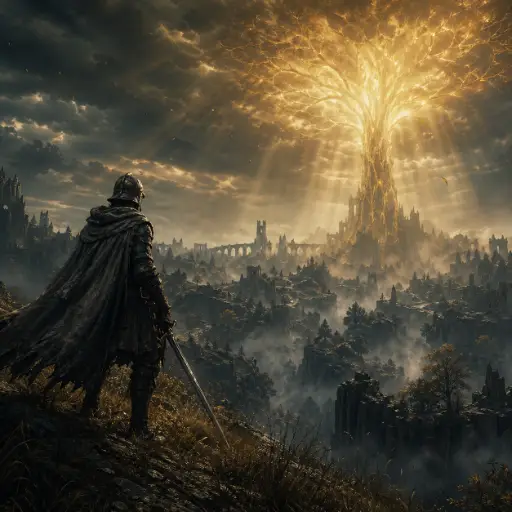
Visually, the project also represents a major opportunity. The game’s landscapes — colossal golden trees, abandoned castles, underground cities and monstrous demigods — possess an operatic grandeur that naturally invites cinematic interpretation. Yet observers familiar with Garland’s style expect the adaptation to avoid becoming a purely digital spectacle. Instead, many anticipate a grounded visual approach emphasizing realism, texture and psychological unease over excessive fantasy ornamentation.
The timing of the project is particularly notable. Hollywood’s relationship with video game adaptations has transformed dramatically in recent years. For decades, studios struggled to convert successful games into critically respected films. More recently, however, productions such as The Last of Us and Fallout demonstrated that audiences are willing to embrace mature, emotionally layered adaptations that remain faithful to the spirit of their source material.
A24 appears determined to position Elden Ring within that new generation of prestige adaptations rather than alongside traditional blockbuster fantasy franchises. Garland’s presence reinforces that intention. Even his most visually expansive films maintain an intimate, often philosophical core, exploring themes of identity, power, violence and societal collapse. Those themes already exist within Elden Ring’s mythology, making the partnership feel unusually organic compared with many corporate franchise adaptations.
There is also growing curiosity surrounding George R. R. Martin’s indirect connection to the film. Although the author contributed to the game’s world-building rather than its screenplay, his involvement helped shape the lore and dynastic conflicts underlying the story. Fans are eager to see whether the adaptation will expand on those elements or maintain the game’s famously fragmented narrative structure.
For Garland himself, the film may represent a creative evolution. Following years spent exploring dystopian politics, artificial intelligence and human self-destruction, fantasy offers him an entirely different canvas while preserving the existential themes that define his work. In many ways, Elden Ring’s decaying universe mirrors the emotional landscapes Garland has always gravitated toward: civilizations collapsing under the weight of ambition, characters searching for meaning inside violent systems and humanity confronting forces beyond comprehension.
Production is expected to begin once casting and script development are finalized. Even at this early stage, anticipation surrounding the project has become enormous, fueled by the combination of Garland’s auteur reputation, A24’s growing influence and the passionate global fanbase surrounding the game itself.
Whether the film ultimately becomes an awards-season fantasy epic or a darker, more experimental interpretation remains unknown. What is clear, however, is that the adaptation already stands apart from the majority of Hollywood franchise announcements. In an era saturated with recycled universes and formulaic blockbusters, the prospect of Alex Garland bringing Elden Ring to life feels genuinely unpredictable — and that may be exactly why audiences are paying such close attention.