Russian Commentary Portrays the U.S. President as a Weakened Leader Dragged Into Strategic Failure and Domestic Decline

The latest escalation between Washington and Tehran has reignited fierce political debate far beyond the borders of the United States. While American media remain divided over the long-term consequences of military operations linked to Iran, some of the harshest criticism has emerged from Moscow, where the influential daily Moskovskij Komsomolec published a strikingly blunt assessment of President Donald Trump’s political future.
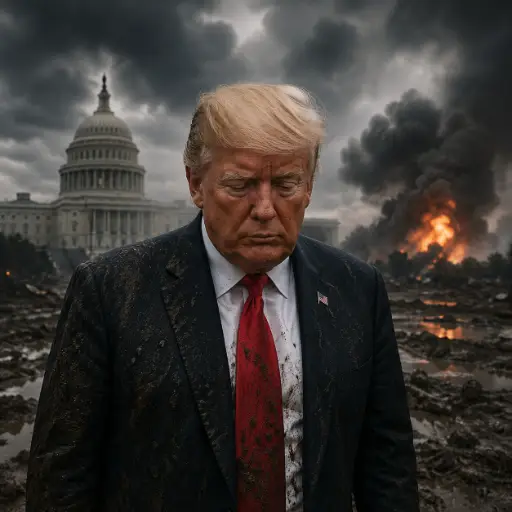
According to commentator Mikhail Rostovsky, the confrontation with Iran has not strengthened Trump’s authority but instead exposed the limits of his leadership at a critical moment in American politics. The article argues that the conflict has trapped the president in what it describes as “political mud,” undermining the carefully cultivated image of a strong and decisive outsider capable of controlling global crises while protecting domestic stability.
The Russian newspaper’s analysis arrives at a particularly delicate stage for the White House. Political tensions inside the United States are intensifying, divisions within the Republican Party are becoming more visible, and concerns over economic uncertainty continue to dominate voter sentiment. Against this backdrop, the Iran conflict has become more than a foreign policy issue; it has evolved into a test of credibility for an administration already facing growing fatigue among portions of the electorate.
Rostovsky’s commentary paints Trump as an “outgoing politician with weakening influence,” suggesting that his once-dominant political presence no longer carries the same force either internationally or at home. The article further predicts a painful electoral setback for Republicans in the coming autumn, arguing that the administration’s aggressive foreign policy may alienate moderate voters while failing to energize an increasingly fragmented conservative base.
Although Russian political commentary is often viewed through the lens of geopolitical rivalry, the article reflects a broader international perception that Trump’s political capital has eroded significantly during recent months. European observers have also expressed concern that Washington’s increasingly confrontational approach in the Middle East risks destabilizing global energy markets while further isolating the United States diplomatically.
Inside America, reactions remain deeply polarized. Trump’s supporters continue to defend the administration’s hard-line posture toward Iran, arguing that military pressure demonstrates strength and deters regional threats. Conservative allies insist that any sign of hesitation would embolden adversaries and damage U.S. credibility abroad.
Critics, however, see the situation very differently. Opponents accuse the administration of escalating tensions without presenting a coherent long-term strategy, while warning that another prolonged confrontation in the Middle East could drain political attention from urgent domestic challenges including inflation, immigration, and economic insecurity.
What makes the current moment especially dangerous for Trump politically is the contrast between his original political identity and the realities now confronting his administration. During his rise to power, Trump frequently criticized American military interventions overseas, presenting himself as a leader focused on ending “endless wars” and prioritizing domestic renewal over foreign entanglements. The Iran crisis, according to many analysts, risks undermining that narrative by associating his presidency with precisely the kind of geopolitical conflict he once condemned.
The symbolism of this shift has not gone unnoticed internationally. Russian commentators argue that Trump, who once portrayed himself as unpredictable but effective, now appears increasingly reactive, forced to respond to crises rather than shaping events on his own terms. Rostovsky’s article suggests that this perception of weakened control could become politically devastating as the electoral season intensifies.
At the same time, Republican strategists face mounting anxiety over voter enthusiasm. Several recent opinion trends indicate growing frustration among independents and suburban conservatives, groups considered essential for maintaining Republican competitiveness nationwide. While Trump remains highly influential within the party’s core base, analysts increasingly question whether that support alone is sufficient to secure broader electoral momentum.
The administration’s opponents are already using the Iran conflict as evidence of strategic inconsistency. Democratic figures argue that Washington has become trapped in an escalating cycle of confrontation without clear diplomatic objectives. Some former military officials have also publicly warned that prolonged instability in the region could produce unpredictable consequences extending far beyond the Middle East.
Yet Trump’s political resilience should not be underestimated. Throughout his career, predictions of collapse have repeatedly failed to materialize. The president has often transformed controversy into political energy, mobilizing supporters through narratives of resistance against both domestic institutions and foreign criticism. For many loyal voters, attacks from Russian media or international commentators may even reinforce the perception that Trump remains a disruptive figure challenging established global structures.
Still, the tone of the Moskovskij Komsomolec article reflects a noticeable shift in how foreign observers evaluate the American president. Rather than depicting Trump as a dominant and destabilizing force capable of reshaping international politics, the commentary portrays him as increasingly constrained by events, weakened by political exhaustion, and vulnerable to electoral backlash.
As tensions surrounding Iran continue to unfold, the broader political consequences remain uncertain. What is already clear, however, is that the international debate over Trump’s leadership has entered a new phase. The question is no longer whether his presidency changed the political landscape, but whether the weight of mounting crises is beginning to diminish the force that once made him appear politically untouchable.