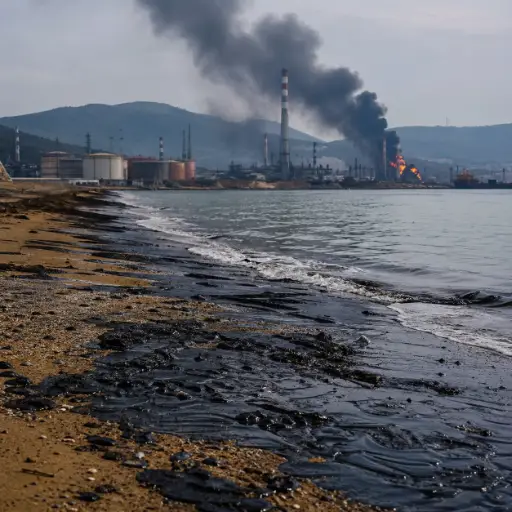
A week after a Ukrainian drone strike ignited a massive fire at a Russian oil refinery on the Black Sea coast, the port city is facing a growing environmental crisis as toxic smoke lingers in the air and oil contamination spreads toward nearby resorts.

The smoke no longer rises in thick black columns above the refinery in Tuapse, but the consequences of the attack continue to drift across the Russian Black Sea coast. More than a week after Ukrainian drones struck one of southern Russia’s strategic oil-processing facilities, local authorities are still struggling to contain the environmental fallout from a disaster that has exposed both the vulnerability of Russia’s energy infrastructure and the fragility of the surrounding coastline.
The fire, which burned for nearly five days before emergency crews managed to fully extinguish it, left behind scorched industrial structures, polluted air and growing public anxiety. Residents in Tuapse describe a persistent chemical odor hanging over the city long after the flames disappeared. Fine soot still coats cars, balconies and sidewalks in several districts near the industrial zone, while independent environmental observers warn that air quality may remain hazardous for weeks.
The refinery, located near the harbor on the northeastern coast of the Black Sea, plays a critical role in exporting petroleum products through southern Russia. Ukrainian strikes against such facilities have intensified over the past year as Kyiv seeks to disrupt Russian fuel logistics far from the front line. Moscow has repeatedly condemned the attacks as terrorism, while Ukraine argues that oil infrastructure directly supports Russia’s military operations.
But beyond the strategic calculations of war, Tuapse is now confronting a different battle — one against contamination spreading through its sea, beaches and tourist areas.
In the days immediately after the strike, local officials attempted to reassure the population that the environmental impact remained under control. Cleanup crews were deployed along sections of the waterfront where oil residue had washed ashore, and municipal workers used heavy equipment to remove dark patches of polluted sand. Yet recent rainfall has complicated those efforts dramatically.
According to environmental activists monitoring the coastline, rainwater flowing through drainage systems and streams has carried traces of petroleum deeper into the coastal ecosystem. Small slicks have reportedly begun appearing farther south along beaches traditionally visited by tourists during the warmer months. While authorities insist the situation is manageable, residents in nearby resort communities say the contamination is becoming increasingly visible.
Along several stretches of coastline, volunteers wearing rubber gloves and protective masks have been gathering tar-like clumps from the sand and shallow water. Some complain they were given little official guidance and fear the pollution could spread even farther if storms intensify.
The environmental concerns are particularly sensitive because the Black Sea coast remains one of Russia’s most important domestic tourism regions. As international travel options for many Russians have narrowed in recent years, resorts along the Krasnodar coastline have become increasingly crowded during spring and summer seasons. Local business owners now worry that images of polluted beaches and smoke-filled skies could discourage visitors at the very moment hotels and restaurants are preparing for peak tourist traffic.
“There is fear that this season could be damaged before it even begins,” said one local café owner near the coast, speaking anonymously because of concerns about discussing the situation publicly. “People see videos online of black water and smoke over the port. Tourists do not want to spend holidays near an environmental disaster.”
Medical concerns are also growing. Although Russian authorities have not declared a public health emergency, some residents report headaches, respiratory irritation and nausea following days of exposure to smoke from the refinery fire. Doctors in the region have advised vulnerable groups, particularly children and the elderly, to avoid prolonged outdoor activity when the smell of fuel becomes especially strong.
Environmental experts note that refinery fires release a dangerous mix of pollutants, including sulfur compounds, benzene and microscopic particles capable of penetrating deep into the lungs. Even after flames are extinguished, toxins can remain suspended in the environment or settle into soil and water systems.
Satellite imagery analyzed by independent monitoring groups appears to show extensive burn damage around parts of the refinery complex. Several fuel storage installations were reportedly hit during the attack, intensifying the blaze and complicating firefighting operations. Videos circulating on Russian social media showed towering flames visible from residential districts during the height of the fire.
The strike has also renewed questions about the effectiveness of Russian air defenses protecting critical infrastructure far from the battlefield. Tuapse lies hundreds of kilometers from the active combat zone, yet energy facilities across southern Russia have increasingly become targets for long-range drone operations.
Military analysts believe Ukraine’s strategy is designed not only to reduce Russian refining capacity but also to force Moscow to divert defensive resources away from the front. Energy installations, ports and fuel depots have become symbols of a new phase in the conflict where economic pressure and infrastructure disruption carry growing strategic importance.
For residents of Tuapse, however, geopolitics now feels secondary to immediate daily realities. Beaches once associated with summer tourism are instead lined with cleanup crews and contaminated debris. Fishing activity has slowed in some coastal areas, and concerns are mounting about possible long-term damage to marine life.
Marine biologists warn that oil contamination in semi-enclosed waters like the Black Sea can persist longer than many expect. Toxic substances may settle beneath the surface, affecting fish populations, seabirds and coastal vegetation long after visible traces disappear. Rain and changing currents can also spread contamination unpredictably along the shoreline.
Despite official efforts to project control, frustration is quietly growing among some residents who feel information about environmental risks remains incomplete. Independent reporting inside Russia on incidents connected to military operations has become increasingly limited, leaving many citizens dependent on social media footage and local word-of-mouth accounts.
As cleanup operations continue, the atmosphere in Tuapse remains tense and uncertain. Smoke has faded from the skyline, but the city is still living with the aftermath of a strike that transformed a strategic military target into an unfolding environmental crisis.
For now, the Black Sea waves continue carrying traces of oil farther along the coast, while crews race to contain a disaster whose consequences may outlast the fire itself.