Former Rivals Unite in an Attempt to Challenge Benjamin Netanyahu’s Long Political Dominance as Analysts Draw Comparisons with Hungary’s Opposition Coalition Against Viktor Orbán

Israeli politics entered a new and potentially decisive phase this week after former prime ministers Naftali Bennett and Yair Lapid announced the merger of their political parties ahead of the autumn parliamentary elections. The alliance between Bennett’s right-leaning Bennett 2026 movement and Lapid’s centrist Yesh Atid immediately transformed the electoral landscape and intensified speculation over whether Prime Minister Benjamin Netanyahu may finally face the most serious challenge to his long rule in years.
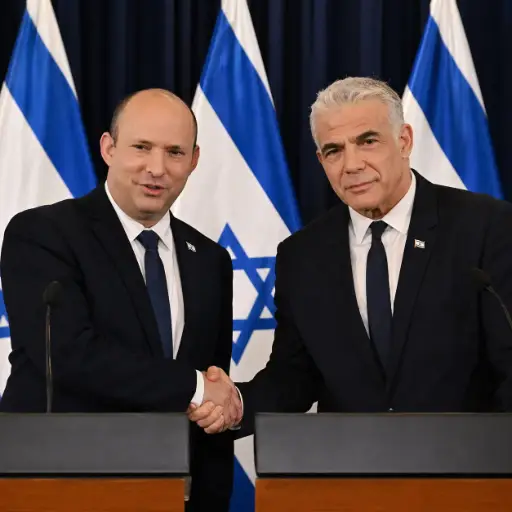
The announcement came during a joint appearance in Tel Aviv, where the two longtime political rivals presented what they described as a “national emergency partnership” designed to restore political stability, rebuild public trust in institutions and unite Israelis exhausted by years of polarization, corruption scandals and deep divisions over the war in Gaza and the country’s democratic future.
The agreement marks one of the most surprising political reconciliations in modern Israeli history. Bennett and Lapid once led a fragile coalition government that removed Netanyahu from office for a brief period before collapsing amid ideological tensions and defections. Since then, both men have pursued separate political strategies while criticizing each other’s leadership styles and electoral calculations. Their decision to reunite reflects growing concern among opposition figures that fragmented anti-Netanyahu forces could once again fail to convert public frustration into electoral victory.
“We understand the magnitude of this moment,” Lapid declared during the announcement. “Israel cannot afford another cycle of paralysis, hatred and institutional erosion. We are putting personal ambitions aside for the future of the country.”
Bennett, who has attempted to reposition himself as a pragmatic conservative alternative to Netanyahu, emphasized security and economic recovery while accusing the current government of deepening internal divisions. “This is not about left versus right anymore,” he said. “This is about saving Israel’s democratic character and restoring confidence in leadership.”
The merger immediately sparked comparisons with the united opposition movement that emerged in Hungary against Prime Minister Viktor Orbán. Political analysts across Europe and the Middle East noted similarities between the Israeli coalition strategy and the Hungarian attempt to combine ideologically diverse parties under a single electoral platform aimed at defeating a dominant nationalist leader accused by critics of weakening democratic institutions.
Although the Hungarian opposition ultimately failed to remove Orbán from power, observers say the Israeli case differs in several important ways. Netanyahu’s coalition has faced mounting criticism over judicial reforms, the management of the Gaza conflict, tensions with international allies and growing public dissatisfaction over economic pressures and military conscription debates. Polling trends in recent months have suggested a noticeable decline in trust toward the governing bloc, particularly among centrist and younger voters.
At the same time, Netanyahu remains one of the most resilient political figures in modern Israeli history. His supporters continue to view him as the country’s most experienced leader on national security and diplomacy. Members of his Likud party dismissed the Bennett–Lapid alliance as an opportunistic arrangement lacking ideological coherence.
“This is a coalition built only on personal hatred of Netanyahu,” one senior Likud official said after the announcement. “The Israeli public remembers how unstable their previous government was.”
Yet even some conservative commentators acknowledged that the merger changes the electoral equation. Bennett’s appeal among moderate right-wing voters combined with Lapid’s strong support in urban and secular constituencies could create a broader political base than previous opposition efforts. Several smaller parties are now reportedly considering cooperation agreements or tactical alliances to avoid wasting votes below the electoral threshold.
The timing of the announcement is also significant. Israeli society remains deeply traumatized by the security crisis and the continuing regional tensions that followed Hamas attacks and the subsequent military operations in Gaza. Public debates over hostage negotiations, military strategy and relations with Washington have intensified pressure on the government while exposing fractures within Netanyahu’s coalition itself.
International reaction to the alliance was cautious but attentive. Diplomats in Europe and the United States privately acknowledged that a unified opposition may stabilize Israel’s increasingly fragmented political system and potentially improve strained relations with Western partners concerned about democratic backsliding and regional escalation.
Financial markets reacted moderately positively to the news, with analysts interpreting the alliance as a possible sign of future political stability after years of repeated elections and coalition collapses. Investors have expressed concern that prolonged uncertainty could damage Israel’s economic resilience at a time of heightened geopolitical risk.
Despite the excitement surrounding the merger, major obstacles remain. Bennett and Lapid still represent different ideological traditions and voter expectations. Bennett appeals to religious and nationalist conservatives who remain skeptical of centrist politics, while Lapid’s support base includes secular liberals strongly opposed to hardline nationalist policies. Maintaining unity during a heated election campaign will require careful negotiation over policy priorities, cabinet roles and campaign messaging.
Questions also remain about leadership. Although the alliance announcement emphasized partnership and unity, neither politician clearly indicated who would serve as prime minister if the bloc wins enough seats to form a government. Analysts expect that issue to become increasingly sensitive as campaigning intensifies.
Nevertheless, the political symbolism of the merger is already undeniable. After years of division, two of Netanyahu’s most prominent rivals have concluded that only a united front offers a realistic path to power. Whether that strategy succeeds will depend not only on electoral arithmetic but also on whether Israeli voters are prepared to embrace another experiment in political compromise after one of the most turbulent periods in the country’s history.
For now, the Bennett–Lapid alliance has injected new uncertainty into an already volatile political environment. As campaigning accelerates toward the autumn vote, Israel appears headed for a defining political battle — one that could reshape the country’s leadership, its democratic institutions and its position on the global stage for years to come.