Veteran Trophy Hunter Killed by Elephant Herd While Tracking Rare Antelope in Central Africa

The death of American millionaire and renowned big-game hunter Ernie Dosia deep inside the African jungle has reignited fierce debate over trophy hunting, conservation ethics, and the growing dangers posed by increasingly unpredictable wildlife encounters across remote regions of the continent.
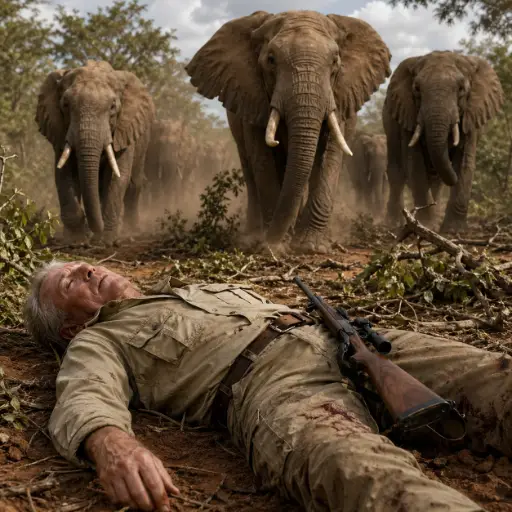
Dosia, a wealthy California businessman whose private collection of mounted trophies was known among elite hunting circles around the world, died after being trampled by a herd of elephants while pursuing a rare species of antelope through dense rainforest terrain. Local guides accompanying the expedition reportedly survived by fleeing into thick vegetation moments before the attack unfolded.
According to regional wildlife authorities and members of the safari team, the seventy-five-year-old hunter had been tracking the elusive bongo antelope in a heavily forested conservation zone known for both its difficult terrain and substantial elephant population. Witnesses described the incident as sudden and violent.
The group had reportedly spent several days moving through humid jungle corridors where visibility was limited to only a few meters. Fresh elephant tracks had been identified earlier in the morning, but the hunting party continued deeper into the forest after spotting signs believed to belong to the antelope they had been pursuing.
Survivors later told investigators that the herd emerged almost silently from dense foliage before charging without warning. In the chaos that followed, Dosia became separated from the rest of the group. Rangers arriving hours later discovered extensive signs of trampling near a narrow game trail surrounded by crushed vegetation and broken saplings.
Authorities stated that the elephants involved appeared to include several females and juveniles, suggesting the herd may have reacted defensively after perceiving the hunters as a threat. Wildlife experts say such encounters are becoming increasingly dangerous as human activity pushes deeper into remote habitats already stressed by climate shifts, poaching pressure, and expanding tourism operations.
Dosia had long cultivated the image of an old-world adventurer. Friends and critics alike described him as one of the last representatives of a fading era of luxury big-game hunting. His sprawling estate in California reportedly housed dozens of rare trophies collected over decades from multiple continents, including lions, buffalo, rhinoceroses, and exotic antelope species.
Photographs circulating in hunting magazines and private collectors’ forums frequently showed Dosia posing beside mounted animals in richly decorated trophy halls lined with ivory carvings and antique firearms. Supporters praised him as a passionate conservation donor whose hunting fees contributed to wildlife preservation programs. Opponents viewed him as a symbol of a controversial industry built around the killing of endangered animals for prestige and entertainment.
News of his death spread rapidly across social media and international news outlets, triggering sharply divided reactions. Some conservation advocates described the tragedy as a grim irony, while others urged restraint, emphasizing the unpredictability of wildlife encounters regardless of personal views on hunting.
“This was still a human life lost in a brutal accident,” said one African wildlife researcher familiar with the region. “But the story also reflects a larger collision between wealth, tourism, conservation, and the realities of wild ecosystems that do not operate according to human expectations.”
Local officials confirmed that no elephants would be culled following the incident. Authorities stressed that the animals were behaving naturally within their habitat and that there was no indication of abnormal aggression beyond a defensive herd response.
The tragedy has also renewed scrutiny of high-end hunting expeditions operating in fragile ecosystems across Africa. While regulated trophy hunting remains legal in several countries and generates significant revenue in some rural areas, critics argue that wealthy foreign hunters often underestimate the environmental and physical risks involved in pursuing dangerous animals deep inside unstable wilderness regions.
In recent years, safari operators have reported a rise in close-range encounters involving elephants, particularly in areas where shrinking migration corridors have increased stress among herds. Experts note that forest elephants, unlike their savanna counterparts, can be especially difficult to detect in dense jungle conditions and may react aggressively when startled.
Dosia’s body was eventually transported out of the remote reserve by helicopter after recovery teams struggled for hours against muddy terrain and heavy rainfall. Officials indicated that an investigation into safety procedures surrounding the expedition would continue in cooperation with local authorities and international hunting organizations.
Back in California, tributes from fellow hunters described Dosia as fearless, charismatic, and deeply committed to the traditions of expeditionary hunting. Yet beyond those circles, his death has become part of a broader global conversation about humanity’s increasingly uneasy relationship with the natural world.
In the depths of the African jungle where visibility disappears behind walls of vines and towering trees, nature ultimately remains indifferent to wealth, reputation, and experience. For Ernie Dosia, a man who spent decades pursuing the world’s rarest animals, the final encounter came not with the antelope he sought, but with a force of the wild far more powerful than any hunter could control.