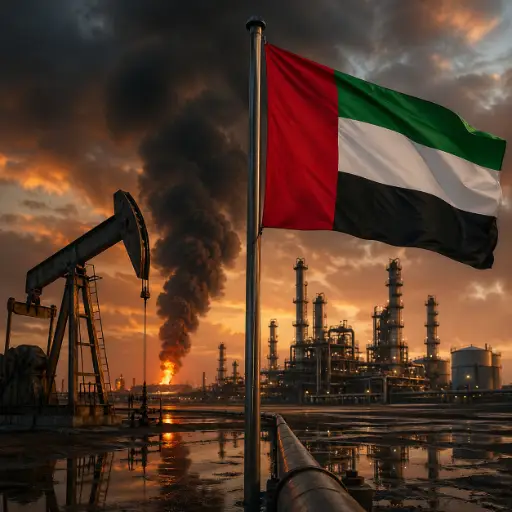
United Arab Emirates Breaks with OPEC and OPEC+ Amid Global Energy Turmoil Triggered by the Iran Conflict

The decision by the United Arab Emirates to leave both OPEC and the wider OPEC+ alliance marks one of the most dramatic turning points in the modern history of the global oil market. Announced through the state news agency WAM, the move sends shockwaves through energy markets already destabilized by the ongoing conflict involving Iran, a crisis that has triggered one of the most severe energy disruptions in decades and intensified fears of a prolonged global economic slowdown.
For years, the UAE had been considered one of the most influential and strategically important members of the oil-producing bloc led by Saudi Arabia. While disagreements inside OPEC were not uncommon, few analysts expected Abu Dhabi to make such a definitive break at a moment when producer unity was seen as critical to stabilizing prices and reassuring international markets.
The departure represents far more than an internal dispute over production quotas. It is increasingly viewed as a direct challenge to Saudi Arabia’s leadership over the global oil-exporting alliance and a sign that national economic priorities are beginning to outweigh collective discipline among major producers.
Markets reacted immediately to the announcement. Oil prices swung sharply as traders attempted to assess whether the split could trigger a new production battle between Gulf exporters at a time when supplies are already under extraordinary pressure due to geopolitical instability across the Middle East. Concerns have intensified over the security of maritime routes, infrastructure vulnerability, and the possibility of wider regional escalation affecting global energy flows.
The UAE has spent years expanding its production capacity and investing heavily in downstream industries, renewable energy, and international logistics. Officials in Abu Dhabi have repeatedly signaled frustration with production limits imposed by OPEC+, arguing that the country’s long-term economic strategy requires greater flexibility and freedom to monetize its growing output potential.
In recent years, tensions between the UAE and Saudi Arabia had become increasingly visible behind closed doors. Although both countries remain close political and security partners, differences emerged over energy policy, regional influence, foreign investment competition, and the future direction of Gulf economic diversification. The oil alliance often masked those rivalries, but the latest decision has brought them into the open.
The timing of the announcement could hardly be more sensitive. The war involving Iran has already shaken global confidence, disrupted shipping corridors, and forced governments across Europe and Asia to revisit emergency energy strategies. Several economies remain vulnerable to rising fuel prices and supply instability, while central banks fear a renewed inflationary spiral linked to energy costs.
Western governments are now watching developments in the Gulf with growing concern. Diplomats fear that the fragmentation of OPEC+ could weaken the ability of major producers to coordinate responses during periods of crisis. Others, however, believe the move could eventually increase oil supply and ease upward pressure on prices if the UAE chooses to raise production independently.
Energy analysts remain divided over what comes next. Some predict the beginning of a prolonged restructuring of the global oil market, with countries increasingly pursuing unilateral strategies rather than collective agreements. Others believe Saudi Arabia will attempt to preserve the alliance by renegotiating production arrangements and offering concessions to key regional partners.
For Saudi Arabia, the symbolic impact may be as serious as the economic consequences. OPEC has long served as a pillar of the kingdom’s geopolitical influence, allowing Riyadh to shape international energy policy and maintain leverage over both allies and rivals. A public break by one of its closest Gulf partners risks undermining the perception of cohesion that has sustained the organization for decades.
The UAE, meanwhile, appears determined to present the decision as a strategic economic necessity rather than a political rupture. Emirati officials insist the country remains committed to market stability and international cooperation, even outside formal cartel structures. Yet few observers doubt that the move fundamentally alters the balance of power inside the global energy system.
The broader implications may extend well beyond oil markets. Investors are now reassessing risk across the Middle East, while governments dependent on Gulf energy exports face increasing uncertainty over future pricing and supply coordination. The decision could also accelerate international efforts to diversify away from fossil fuels, as consuming nations seek greater protection from geopolitical shocks.
As the world enters a period of heightened instability, the collapse of unity inside the oil-producing alliance marks a defining moment for global energy politics. What was once considered an unshakable bloc now faces an uncertain future, just as the world confronts one of its most dangerous economic and geopolitical crises in recent memory.