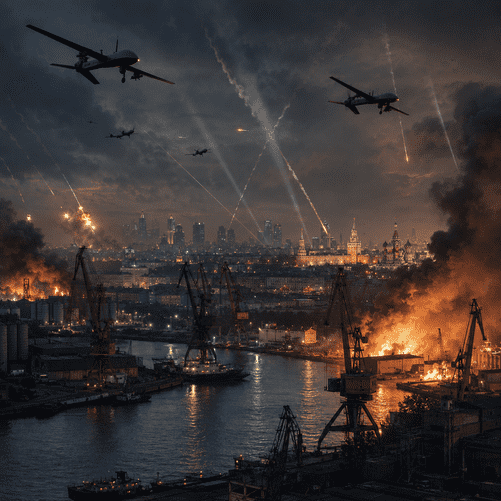
Russian attacks hit Ukraine’s Danube port infrastructure while Kyiv’s drones push deeper into Russian territory, underscoring how the war is expanding beyond the front line.

KYIV — Russia and Ukraine exchanged a new wave of long-range drone attacks on Tuesday, intensifying the air war even as diplomatic efforts to slow the conflict remain stalled.
Russian forces struck the Ukrainian Danube port city of Izmail in the Odesa region, damaging port infrastructure but causing no reported casualties or major destruction, according to Ukrainian officials. Izmail has become one of Ukraine’s most important logistics hubs since Russia’s invasion, serving as a key route for trade and supplies through the Danube corridor.
At the same time, Russian authorities said they intercepted four Ukrainian drones heading toward Moscow. Other drone attacks were reported in the Kursk, Rostov and Yaroslavl regions, where officials described casualties and industrial damage. Ukraine has increasingly targeted Russian energy and industrial infrastructure, arguing that such strikes are intended to reduce Moscow’s capacity to sustain the war.
The latest attacks followed a weekend of heavy strikes on both sides. Russian drones also hit Kharkiv, where people were reportedly trapped under debris, as well as the Dnipropetrovsk, Mykolaiv and Zaporizhzhia regions. Moscow and Kyiv both deny deliberately targeting civilians, but the widening use of drones has made the conflict more unpredictable and brought the war closer to population centers far from the battlefield.
The escalation comes after a U.S.-backed ceasefire attempt earlier this month failed to produce a durable pause in fighting. Ukraine and Russia traded accusations of violating the temporary truce almost immediately, while broader peace efforts have shown little sign of progress.
For Ukraine, attacks on Russian territory are part of a strategy to offset Moscow’s advantage in manpower and artillery. Kyiv says strikes on refineries, depots and military-linked facilities can weaken Russia’s war machine without requiring a breakthrough at the front. President Volodymyr Zelenskiy has argued that Russia’s resources are not unlimited, even if the Kremlin continues to rely on reserves and state spending to sustain the campaign.
For Russia, the growing reach of Ukrainian drones presents a political problem as well as a military one. Strikes near Moscow and in industrial regions undermine the Kremlin’s effort to portray the war as distant from everyday Russian life.
The result is a conflict increasingly fought in three layers: trenches and artillery along the front, missiles and drones over Ukrainian cities, and long-range strikes deep inside Russia. With negotiations frozen and both sides expanding their target lists, the latest exchange suggests the war is not narrowing toward settlement, but widening into a more dangerous campaign of attrition.