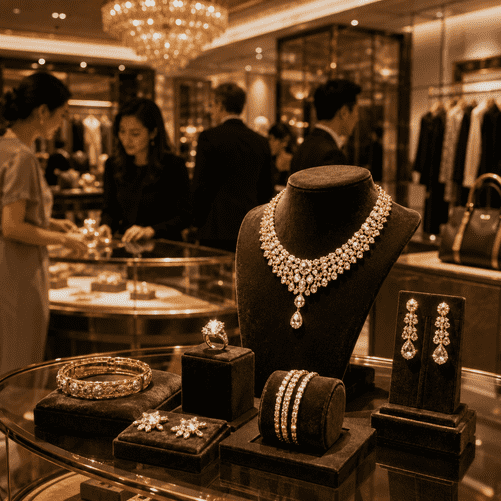
Strong sales in the United States and Asia show how high-end jewellery is becoming the safest corner of a fragile luxury market

Richemont, the Swiss luxury group behind Cartier, Van Cleef & Arpels and Buccellati, has delivered one of the strongest signals yet that the global luxury market is splitting into winners and losers. While many fashion houses continue to struggle with weaker aspirational demand, Richemont reported stronger-than-expected quarterly sales, powered by resilient demand for high-end jewellery.
The group’s sales rose 13% at constant exchange rates to €5.4 billion, beating analyst expectations. Jewellery was the clear engine of growth, with sales up 14%, far ahead of the company’s watch division, which grew only 1%. The performance underlines a wider shift in luxury spending: wealthy consumers are still buying, but they are increasingly favoring timeless, investment-like categories over trend-driven fashion.
Richemont’s strength was especially visible in the United States and Asia, where demand for Cartier and Van Cleef & Arpels remained robust. Chairman Johann Rupert pointed to continued resilience in the U.S. economy and signs of recovery among high-end consumers in China and Hong Kong, two markets closely watched by the luxury industry.
The result stands in contrast with the pressure facing several major European luxury groups. LVMH and Kering have both been affected by weaker demand from aspirational shoppers, particularly after years of steep price increases across handbags, ready-to-wear and accessories. Jewellery, by comparison, has retained stronger appeal because it is associated with durability, craftsmanship and long-term value.
Still, Richemont’s outlook is not without risk. The company’s operating margin declined to 20%, partly because of higher raw-material costs, including gold. The group also faced regional weakness in the Middle East, where sales fell amid reduced tourism linked to geopolitical instability.
The broader luxury sector is entering 2026 with cautious optimism but limited visibility. Bain has forecast a modest rebound in China’s personal luxury market this year, after a difficult period in which domestic demand weakened and consumers became more selective. The recovery, however, is expected to be uneven, benefiting brands with strong identity, pricing power and cultural relevance.
Richemont’s latest performance suggests that the luxury customer has not disappeared. Instead, spending is becoming more disciplined. Consumers at the top end of the market are still willing to pay for heritage, scarcity and perceived value, while mid-tier and aspirational buyers are more resistant to aggressive pricing.
For the fashion and luxury industry, the message is clear: the era of easy growth is over. Brands can no longer rely only on price increases or logo visibility. In a more selective market, jewellery’s success shows that luxury houses will need to justify their prices with craftsmanship, emotional value and long-term desirability.