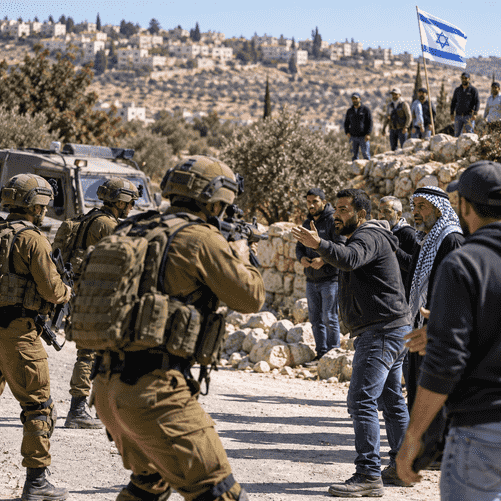
An Israeli soldier was filmed shooting a Palestinian man in the leg during a confrontation involving settlers and villagers, adding to mounting questions over military conduct and the authorities’ ability to curb escalating violence in the occupied West Bank.

A video showing an Israeli soldier shooting a Palestinian man in the leg during a confrontation between settlers and residents of a West Bank village has triggered renewed scrutiny of Israel’s handling of settler violence and the conduct of troops deployed to protect communities in the occupied territory.
The incident took place in Faqqua, where tensions reportedly began after Israeli settlers brought livestock onto land claimed by Palestinian residents. Villagers confronted the settlers, and Israeli soldiers subsequently intervened.
Footage from the scene shows a soldier firing at Qassem Hussam, a Palestinian man who was wounded in the leg. The Israel Defense Forces confirmed that one of its soldiers had opened fire and said the circumstances surrounding the shooting were being investigated.
The episode comes during a period of sharply heightened tension across the West Bank, where attacks by settlers, clashes with Palestinian residents and Israeli military operations have all intensified.
Although the exact sequence of events in Faqqua remains under investigation, the footage has drawn particular attention because it appears to show Israeli troops operating in the middle of a confrontation that began between civilians.
For critics of Israeli policy in the West Bank, it is another example of what they describe as a persistent failure to protect Palestinians from settler violence. Israeli officials, meanwhile, argue that troops frequently face volatile situations in which stones, firearms and other threats can emerge rapidly and require immediate intervention.
A Wider Surge in Violence
The shooting did not occur in isolation.
Only days earlier, violence in the northern West Bank left two Palestinians dead and an Israeli settler critically wounded in separate incidents.
In the village of Hajja, residents told Reuters that armed settlers entered the community from a nearby outpost, prompting Palestinians to gather in response. Israeli troops later arrived, and the confrontation escalated. The military said Palestinians threw stones toward soldiers, who responded with arrest procedures that included warning shots and live fire toward what it called key instigators. One Palestinian was killed and several others were wounded.
In another incident, a Palestinian entered a settler outpost near Qusra and stabbed an Israeli man before being killed by Israeli troops.
The pattern illustrates the increasingly dangerous cycle of violence across the territory: settler incursions and attacks provoke Palestinian resistance, Israeli forces intervene, and confrontations can quickly become lethal.
Reuters has also documented the rapid expansion of unauthorised settler outposts, including several linked to activists who openly advocate extending Israeli control over Palestinian land. Some of those outposts have been associated with the displacement of Palestinian families and repeated confrontations with nearby villages.
Growing Pressure on the Israeli Government
International pressure on Israel to address settler violence has intensified.
Earlier this month, Prime Minister Benjamin Netanyahu ordered the dismantling of a number of unauthorised West Bank outposts following growing pressure from Washington. Israel has approximately 146 officially recognised settlements and hundreds of additional unauthorised outposts, according to Israeli monitoring group Peace Now.
The United States has also adopted unusually strong language.
U.S. Ambassador to Israel Mike Huckabee recently described violent settlers responsible for attacks on Palestinian communities as “terrorists” and called for stronger action against them after visiting areas affected by repeated violence.
Such remarks are significant because Washington has traditionally been one of Israel’s closest diplomatic and military partners.
The criticism reflects growing concern that settler violence is no longer a marginal security issue but a potential catalyst for broader instability.
Questions Over the Role of Israeli Forces
The most sensitive aspect of the latest incident is the role of the military itself.
Israeli soldiers frequently operate alongside or close to settlers in the West Bank, particularly near isolated settlements and unauthorised outposts. Troops are tasked with protecting Israeli citizens while also maintaining order among Palestinian communities living under military occupation.
That dual role has repeatedly generated accusations of unequal enforcement.
Palestinian residents and human-rights organisations argue that troops often intervene aggressively against Palestinians while failing to arrest or restrain settlers accused of attacking people, damaging property or seizing land.
Reuters has documented cases in which Israeli forces were present during demolitions or settler activity that displaced Palestinian families, while Israeli authorities have said military deployments were intended to enforce security or administrative orders.
Israeli officials reject claims that the military systematically enables settler violence, and the IDF regularly says individual incidents are investigated when there are suspicions that soldiers have acted outside operational rules.
The investigation into the Faqqua shooting will therefore be closely watched.
If investigators conclude that the soldier violated regulations governing the use of live ammunition, the case could add further pressure on the military to demonstrate that troops are held accountable for misconduct.
Settlements at the Heart of the Conflict
The broader dispute cannot be separated from the rapid expansion of Israeli settlements.
More than half a million Israeli settlers now live in the occupied West Bank, alongside roughly three million Palestinians. Most of the international community regards the settlements as illegal under international law, a position Israel disputes.
The International Court of Justice concluded in 2024 that Israel’s continued occupation and settlement policies violated international law and called for the occupation to end as rapidly as possible.
Settlement expansion has nevertheless continued.
Recent years have also seen a sharp increase in small agricultural and residential outposts established without formal Israeli government approval. These settlements can consist initially of only a handful of caravans or farm structures but may gradually expand and receive infrastructure, security protection and eventual legal recognition.
Critics describe that process as a form of incremental annexation.
Supporters of the settlement movement argue that Jews have historical and religious rights to the territory and reject international claims that the settlements are illegitimate.
Violence Risks Becoming Self-Sustaining
The growing number of confrontations is raising fears that violence in the West Bank could develop into a self-reinforcing cycle.
Settler attacks can trigger Palestinian retaliation. Palestinian attacks then prompt expanded Israeli military operations, checkpoints and raids. Those measures generate further resentment and can create the conditions for additional attacks.
That pattern has become increasingly visible since the Hamas-led assault on Israel on 7 October 2023 and the subsequent Gaza war.
According to UN figures cited in recent reporting, more than 1,100 Palestinians, including hundreds of minors, have been killed in the West Bank since October 2023 amid Israeli military operations, settler violence and armed confrontations. Israelis have also been killed in Palestinian attacks during the same period.
The escalation has increasingly drawn foreign governments into the dispute.
Britain, France and Canada recently introduced measures targeting goods and companies associated with Israeli settlements, while Israel responded by ordering the closure of the British consulate in East Jerusalem and imposing additional diplomatic restrictions.
The dispute demonstrates how violence on individual hillsides and village roads is increasingly affecting Israel’s broader diplomatic relationships.
A Test of Accountability
The shooting in Faqqua is unlikely by itself to alter the trajectory of the West Bank conflict.
Its significance lies instead in what it represents.
A confrontation over access to land escalated into a military shooting, captured on video and rapidly circulated beyond the village where it occurred. The incident now joins a growing collection of documented clashes that have placed Israeli security forces, settlers and Palestinian communities under increasingly intense international scrutiny.
For Israel, the central question is whether its institutions can demonstrate that the same legal constraints apply when Israeli settlers are accused of violence as when Palestinians are suspected of attacking Israelis.
For Palestinian communities, the concern is more immediate: whether soldiers deployed during confrontations will protect them from violence or become another source of danger.
As settlement expansion continues and the number of flashpoints increases, incidents such as the Faqqua shooting are becoming more than isolated security episodes.
They are becoming part of a broader struggle over land, authority and accountability in a territory where the distinction between civilian confrontation, military intervention and political conflict is becoming increasingly difficult to separate.


