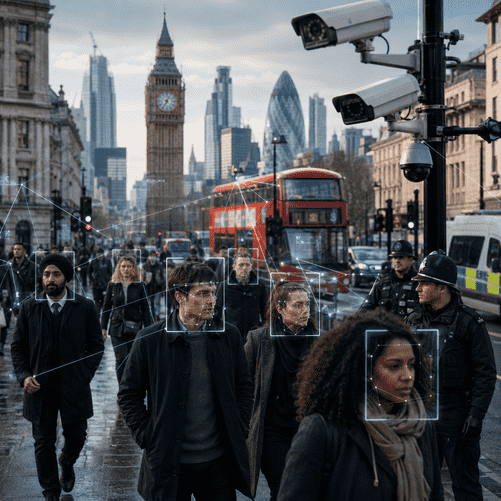
Police say live biometric scanning is helping identify wanted suspects, while civil liberties groups warn of a shift toward mass surveillance

London has become one of Europe’s most visible testing grounds for live facial recognition, as police expand the use of biometric cameras in public spaces while privacy groups warn that the technology risks turning ordinary streets into surveillance zones.
During a recent Metropolitan Police operation in central London, cameras scanned the faces of pedestrians and compared them with a watchlist of wanted individuals. Reuters reported that the system was deployed in areas including Victoria and Tottenham, where officers used temporary cameras, police vans and warning signs to notify the public that live facial recognition was in operation.
Police officials argue the technology is already changing law enforcement in the capital. According to the Met, live facial recognition has helped officers arrest around 2,500 wanted people since the start of 2024, including suspects linked to violent and sexual offences. The force says the system compares biometric templates briefly and deletes data when there is no match.
The technology works by converting a person’s face into biometric data and checking it against a watchlist. In London, that list includes roughly 17,000 people, largely drawn from custody images. The Met says the system scanned more than 3 million faces in the 12 months to last September and generated 10 false alerts, none of which led to an arrest.
Supporters describe live facial recognition as a practical response to crime in a city already covered by extensive CCTV networks. For police, the appeal is speed: officers can identify suspects in crowded areas in real time, rather than relying only on later investigations and manual review of video footage.
But civil liberties groups say the issue is not only accuracy. They argue that live facial recognition changes the relationship between the state and the public by scanning large numbers of people who are not suspected of any crime. Big Brother Watch has warned that the technology risks normalising mass biometric checks in public spaces and undermining privacy, free speech and freedom of association.
The controversy intensified after the technology was used at a protest for the first time on May 16. Police said the deployment was based on intelligence about a potential public safety threat, while critics argued that biometric surveillance at demonstrations could discourage people from exercising democratic rights.
The legal and political battle is still developing. A High Court judge dismissed a challenge to the technology last month, allowing police to continue using it, while the British government is working on a new legal framework. That means London may become a model — or a warning — for other European cities considering similar systems.
For Europe, the debate goes beyond policing. It cuts to the heart of how democratic societies should regulate artificial intelligence, biometric data and public security. As the technology becomes faster and more accurate, the central question is no longer whether facial recognition can work, but how much surveillance citizens are willing to accept in the name of safety.