Why More Artists Are Fighting Artificial Intelligence — and Why the Music Industry Is Entering a New Cultural Battle

As artificial intelligence becomes more powerful and increasingly integrated into the entertainment industry, a growing number of artists are pushing back against technologies they believe threaten not only their income, but also the future of human creativity itself. What once seemed like a distant technological debate has rapidly evolved into a cultural and economic conflict involving musicians, actors, writers, and visual artists around the world.
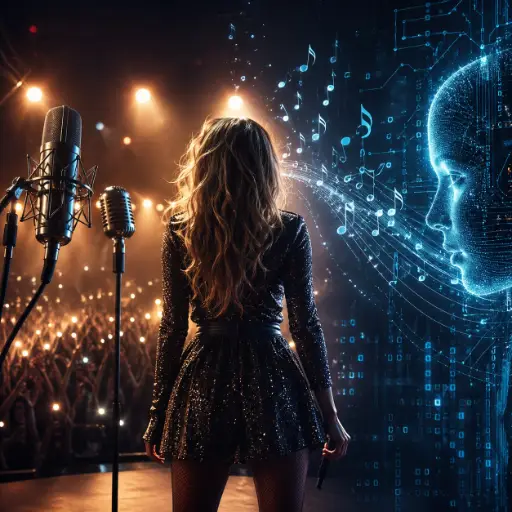
One of the latest and most influential figures to enter the debate is Taylor Swift, whose enormous cultural influence has once again drawn worldwide attention to the uneasy relationship between art and artificial intelligence. Although concerns over AI-generated music and digital imitation have been growing for several years, the involvement of major artists with global audiences has intensified pressure on record labels, streaming platforms, and technology companies.
At the center of the controversy lies a simple issue: many artists fear that artificial intelligence systems are being trained on their work without permission, compensation, or transparency. AI tools are now capable of generating songs, lyrics, voices, images, and videos that imitate the style of real creators with increasingly convincing accuracy. For musicians, the possibility that software could reproduce recognizable vocal styles or musical identities raises serious legal and ethical concerns.
The music industry has already witnessed several viral incidents involving AI-generated songs that sounded remarkably similar to famous performers. In some cases, listeners struggled to distinguish between genuine recordings and computer-generated imitations. While technology companies often describe these systems as creative tools, critics argue that they risk turning human artistry into raw material for algorithms designed primarily for profit.
Taylor Swift’s growing involvement in the debate reflects broader frustrations shared throughout the entertainment industry. According to analysts and music lawyers, artists are becoming increasingly concerned that AI-generated content could flood digital platforms, reduce the value of original work, and weaken protections surrounding intellectual property. For performers whose careers depend on uniqueness and emotional connection, imitation by machines represents more than a technical issue — it challenges the very meaning of artistic identity.
The conflict is also unfolding at a moment when streaming economics are already under pressure. Many musicians have spent years criticizing low royalty payments from digital platforms, arguing that artists receive only a small fraction of the profits generated by online consumption. The rise of AI-generated music threatens to intensify these tensions by increasing competition and saturating the market with inexpensive synthetic content.
Industry observers note that younger audiences often consume music through short-form social media clips rather than traditional albums, making it easier for AI-generated tracks to spread rapidly online. In such an environment, authenticity can become harder to verify, especially when artificial intelligence can replicate production styles, melodies, or vocal characteristics within seconds.
At the same time, supporters of AI technology argue that artificial intelligence should not automatically be viewed as an enemy of creativity. Some producers and independent musicians already use AI-assisted tools for sound engineering, composition support, translation, or visual production. They insist that technology can expand artistic possibilities rather than replace human creators entirely.
Yet even among artists who accept technological innovation, many insist that stronger rules are urgently needed. Calls for new legislation have intensified in both Europe and the United States, where lawmakers are increasingly examining how copyright law should apply to AI-generated material. Legal experts say the current system was not designed for technologies capable of learning from massive collections of human-created works and reproducing stylistic patterns at industrial scale.
The debate has also exposed deeper philosophical questions about culture itself. Can a machine truly create art, or does genuine creativity require human experience, emotion, and vulnerability? For many musicians, the answer remains clear. Songs are not merely combinations of sounds or mathematical patterns; they are reflections of memory, heartbreak, ambition, fear, and personal history. Critics of AI-generated music argue that algorithms may imitate style, but they cannot replicate lived experience.
Public reaction remains divided. Some listeners are fascinated by the speed and sophistication of AI-generated music, while others express discomfort at the idea of machines reproducing human voices and artistic identities. Surveys conducted by entertainment analysts suggest that audiences still place greater emotional trust in authentic performers, but the rapid evolution of the technology is forcing consumers to reconsider how they define originality.
For Taylor Swift and other artists entering the debate, the stakes extend far beyond individual careers. The current struggle over artificial intelligence may ultimately determine how creative ownership is protected in the digital age. As governments, technology companies, and entertainment giants negotiate new boundaries, artists are increasingly determined to ensure that human creativity does not become an afterthought in an automated future.
What began as a technological experiment has evolved into one of the most important cultural battles of the modern entertainment era. And as artificial intelligence continues to advance at extraordinary speed, the music industry may soon face a defining question: in a world where machines can imitate almost anything, how much value will society continue to place on the human voice behind the art?