At least nine killed in renewed strikes as President Aoun condemns violations and diplomatic talks stall.

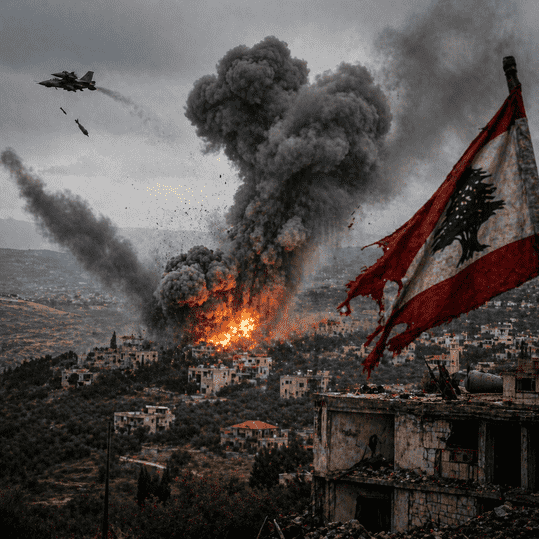
A fragile US-mediated ceasefire between Israel and Lebanon, intended to halt weeks of devastating conflict, is unraveling as violence spikes in southern Lebanon. Despite the truce taking effect on April 17, Israeli airstrikes and artillery shelling have intensified over the past 24 hours, killing at least 28 people, including civilians, Lebanese soldiers, and rescue workers, according to the Lebanese National News Agency. The death toll brings the total number of fatalities in Lebanon since the conflict escalated on March 3 to at least 2,586, with over 8,020 wounded.
The latest wave of violence includes targeted strikes on residential areas and critical infrastructure. In the municipality of Jebchit, a residential building was destroyed, killing four people and wounding nine others. Similar attacks in Toul, Harouf, and Qana claimed the lives of at least 10 more individuals, including members of a single family. In Kfar Rumman, an Israeli air raid targeted a home occupied by a Lebanese soldier and his family, resulting in multiple deaths. Additionally, a drone strike near a cemetery in Zebdine killed six people, underscoring the peril faced by civilians even in locations not typically associated with active combat.
Israel’s military has issued evacuation warnings for 15 villages in southern Lebanon, many situated outside the designated “Yellow Line,” a 10km buffer zone where Israel asserts its right to operate against threats. The Israeli Defense Forces stated that these operations are direct responses to alleged violations by Hezbollah, the Iran-backed militia that, while not a signatory to the ceasefire, had pledged to abide by its terms if Israel reciprocated.
Hezbollah’s Tactical Evolution: The Rise of Drone Warfare
In response to Israeli operations, Hezbollah has shifted its strategy from heavy artillery fire to near-daily precision drone strikes against Israeli troops. This evolution marks a transition to “strategic attrition,” utilizing cost-effective, fiber-optic-guided drones that evade traditional electronic countermeasures and radar systems. These unmanned aerial vehicles, often referred to by Hezbollah as “new martyrdom squads,” are designed to inflict casualties on infantry while minimizing the group’s own resource expenditure.
On Thursday, Hezbollah claimed responsibility for drone attacks on Israeli positions in Bint Jbeil and Qantara, resulting in the death of one Israeli soldier and injuries to at least 15 others. The IDF confirmed the soldier’s death, attributing it to an explosive-laden rocket attack, and described the incident as a “violation of the ceasefire understandings.” Military analysts note that this tactic allows Hezbollah to maintain pressure on Israeli forces despite the depletion of its missile stockpiles over the last two years.
The ongoing violence has exposed deepening political divisions within Lebanon’s leadership. President Joseph Aoun has strongly condemned the “continuing Israeli violations,” calling for international pressure to ensure compliance with the truce. “Pressure must be exerted on Israel to ensure it respects international laws and conventions and ceases targeting civilians, paramedics, civil defence, and humanitarian health and relief organisations,” Aoun stated. He has advocated for direct, face-to-face negotiations to transform the temporary ceasefire into a permanent security arrangement, though he insists Israel must first fully implement the current terms.
Conversely, Parliament Speaker Nabih Berri, a key ally of Hezbollah, has opposed direct talks, warning of the risks involved and calling for an international fact-finding committee to investigate Israeli actions. The US has attempted to mediate, with President Donald Trump announcing an extension of the ceasefire on April 17, followed by a three-week extension after a second round of talks in Washington. However, with fighting continuing to escalate, the effectiveness of these diplomatic efforts remains in question.
Humanitarian Crisis and Regional Instability
The conflict has exacerbated an already dire humanitarian situation. Reports indicate that a quarter of Lebanon is now facing hunger due to the war, with over 1.2 million people displaced. The destruction of homes, places of worship, and critical infrastructure has further strained the nation’s resources. The Lebanese government has accused Israel of targeting journalists and rescue workers, with recent incidents including the killing of three paramedics in a “double-tap” strike.
As the situation deteriorates, the international community faces a critical juncture. The US has urged Israel to keep its responses “calculated and limited,” while Lebanon demands full adherence to the ceasefire as a prerequisite for further negotiations. Without a decisive push to enforce the truce and address the underlying security concerns of both sides, the risk of a broader regional conflict remains high.