A new poll puts the SVP-backed population cap ahead, turning a migration vote into a test of Switzerland’s growth model and its ties with the European Union.

BERN/ZURICH, May 2, 2026
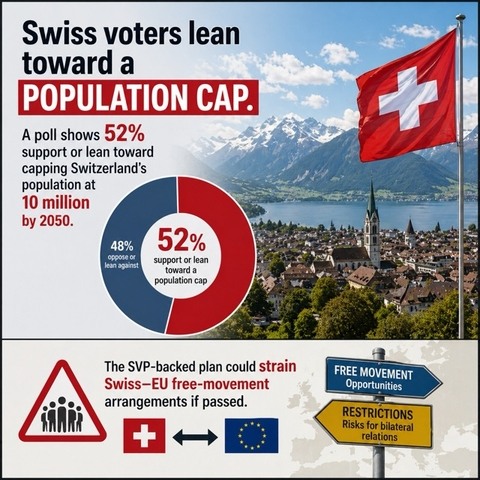
Switzerland’s most consequential vote of the spring is beginning to look less like a protest ballot and more like a live referendum on the country’s growth model. A poll published this week showed 52 percent of respondents supporting, or leaning toward supporting, a proposal to cap the permanent resident population at 10 million by 2050. For a country of just over 9 million people, built on open labor markets, cross-border commuting and deep economic integration with the European Union, that narrow majority has landed with force.
The initiative, backed by the right-wing Swiss People’s Party, or SVP, is framed as a safeguard against what its sponsors call uncontrolled population growth. Politically, it has a sharper edge. It asks voters whether the pressures of immigration – on housing, railways, roads, schools and social cohesion – have become serious enough to justify a hard ceiling on Switzerland’s population. Economically, it asks whether one of Europe’s richest countries can afford to restrict the labor flows that have helped make it rich.
The latest Tamedia, 20 Minuten and LeeWas survey, conducted on April 22 and 23 among more than 16,000 respondents, marked a notable shift from March, when support stood at 45 percent and opposition was slightly ahead. Swiss referendum campaigns often move in the opposite direction, with early protest support fading as government, business and civil-society groups intensify warnings about consequences. This time, support has grown as the vote approaches.
That is why the June 14 referendum is unnerving both Bern and Brussels. The Swiss government has rejected the proposal, warning that it would damage cooperation with the European Union and restrict the labor market. Business groups have echoed that concern, arguing that hospitals, construction firms, hotels, farms, universities and technology companies depend on foreign workers. The SVP counters that this dependency is itself evidence of a system that has spun out of control.
At the heart of the plan is a two-stage trigger. The government would have to ensure that the permanent resident population does not pass 10 million before 2050. If it reaches 9.5 million earlier, parliament and the cabinet would be required to act. In asylum policy, that could mean tighter rules on permanent residence and family reunification. In regular migration, it would push Switzerland to renegotiate international agreements that contribute to population growth.
The last point gives the campaign its European dimension. Switzerland is not an EU member, but its prosperity rests on a dense network of bilateral accords with the bloc. Free movement is one of the central pillars of that architecture, allowing EU citizens to work in Switzerland and Swiss citizens to live and work across the EU. A unilateral population cap would collide with the logic of that arrangement and could reopen years of difficult diplomacy.
Opponents have tried to make the risk tangible by calling the proposal a termination initiative. Their argument is that a cap would not merely slow immigration; it would place Switzerland on a collision course with the EU, its largest trading partner. If the free-movement agreement were terminated, other bilateral agreements could be endangered as well. The SVP rejects that framing, saying Switzerland must be able to set limits before population growth overwhelms infrastructure and erodes quality of life.
The supporters’ case resonates because it is rooted in daily pressure. Zurich rents are high, commuter trains are crowded, road congestion is familiar and the pace of construction has changed the feel of many communities. The SVP has turned those concerns into a simple political message: Switzerland should remain Switzerland, not become a country of 10 million residents by default. Its slogans cast the proposal as a sustainability initiative, tying migration to landscape protection, public services and social trust.
The government’s counterargument is more technocratic, but no less urgent. Switzerland is aging. Its pension system depends on contributions from the working population. Companies say they cannot fill all skilled jobs domestically. The health sector relies heavily on staff from abroad. Even critics of rapid growth acknowledge that immigration has helped cushion demographic decline and maintain competitiveness. The question is whether voters see that as a benefit or as proof that the model cannot manage without continuous inflows.
The vote also sits inside a longer political pattern. Swiss voters backed an SVP mass-immigration initiative in 2014, but its implementation was softened to avoid a rupture with the EU. They rejected another restriction in 2020. The new initiative is both a rerun and an escalation: it revives a familiar demand, but with a numerical ceiling and a long deadline that make it appear more concrete and, to supporters, more orderly.
The poll does not decide the outcome. Swiss campaigns can turn sharply in the final weeks, and the coalition against the initiative is broad, spanning the government, parliament, most major parties, unions and business associations. Yet the 52 percent figure has changed the psychology of the race. A population cap once treated by many opponents as a hard-sell proposition now looks plausible.
If the measure passes, Switzerland would enter years of legal and diplomatic negotiation. If it fails, the pressure behind it will not disappear. The referendum has already shown that the country’s prosperity bargain – growth, labor mobility, high wages and high infrastructure demands – is facing a more skeptical electorate. For Europe, it is a reminder that free movement remains politically fragile even where it has delivered economic gains. For Switzerland, it is a question of size, sovereignty and the price of remaining open.