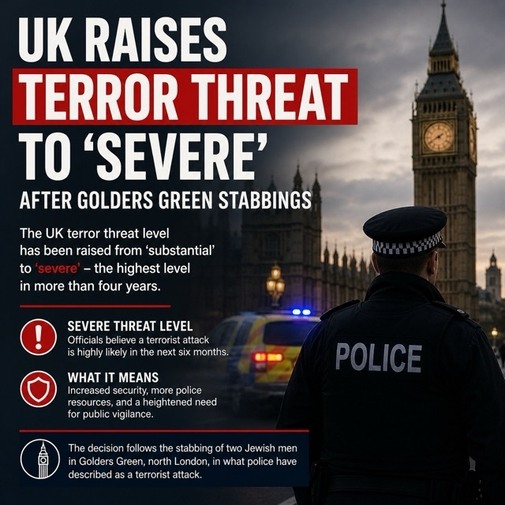
Britain entered May under a sharpened national security warning after the Joint Terrorism Analysis Centre raised the UK’s terrorism threat level from “substantial” to “severe”, meaning officials now judge a terrorist attack to be highly likely within the next six months.

The move followed the stabbing of two Jewish men in Golders Green, north London, but the government stressed that the decision reflected a broader and deteriorating threat picture, not one attack alone.
The elevation to “severe” marks the first time the UK has been at that level since November 2021, when the country was responding to the Liverpool Women’s Hospital bombing and the murder of MP Sir David Amess. The level was lowered to “substantial” in February 2022.
The attack in Golders Green, an area with a large Jewish population, has become the focal point of a national debate over antisemitism, policing, foreign-linked threats and the government’s counter-terrorism posture. Police said a 45-year-old man, Essa Suleiman, had been charged with two counts of attempted murder and possession of a bladed article in connection with the Golders Green attack. He was also charged with attempted murder over a separate incident in south London earlier the same day.
One of the victims, aged 34, has been discharged from hospital, while the second, aged 76, remains in stable condition, according to police details reported by Reuters. Suleiman has been remanded in custody and was due to appear at Westminster Magistrates’ Court on Friday.
Home Secretary Shabana Mahmood described the stabbing as an “abhorrent, antisemitic attack” and a “vile act of terrorism”, saying the rise in the threat level would be especially alarming for Jewish communities already living with heightened fear. The Home Office said the threat had been rising over time, driven by Islamist and extreme right-wing terrorism from individuals and small groups based in the UK.
Counter Terrorism Policing echoed that assessment. Assistant Commissioner Laurence Taylor said the UK had seen a gradual increase in terrorist threats, with casework rising across ideologies and a particular elevation in threats to Jewish and Israeli individuals and institutions. He urged the public to be “alert and not alarmed”, while confirming that police forces across the country were reviewing their protective posture.
For Britain’s Jewish community, the announcement landed less as an abstraction than as confirmation of a lived reality. The Golders Green attack followed what officials described as a spate of antisemitic arson attacks in London. In response, the government announced an additional £25 million for security around Jewish institutions, bringing total funding this year to £58 million. The money is intended to support policing, patrols and protective security at synagogues, schools and community centres.
The shift also carries consequences beyond Jewish communal security. A “severe” threat level typically prompts police, transport operators, local authorities and event organisers to review protective measures. MI5 says the threat level is designed to guide security professionals and police in determining what protective response may be needed, while members of the public are advised to remain vigilant and report suspicious activity.
The government has been careful to say that the Golders Green attack did not, by itself, trigger the higher alert. Officials pointed to a wider matrix of risk: domestic radicalisation, extreme right-wing threats, Islamist plots, the impact of overseas conflict and what the Home Office called state-linked physical threats encouraging violence, including against Jewish communities.
Prime Minister Keir Starmer has promised stronger measures against antisemitism and extremism, including action against charities promoting extremism and “hate preachers”. The government also said it would fast-track legislation aimed at people acting as proxies for state-sponsored groups, so they could be handled in a manner similar to spies working for hostile foreign intelligence services.
The political atmosphere is already charged. Since the Hamas attacks of October 2023 and the war in Gaza, pro-Palestinian demonstrations have become a regular feature of British public life. Critics within the Jewish community and beyond say some protests have become a platform for intimidation and antisemitic rhetoric; civil liberties advocates warn that security measures and restrictions on demonstrations must not erode lawful protest.
That tension now sits at the heart of the government’s challenge. A higher threat level demands visible reassurance without panic, stronger protection without collective blame, and sharper intelligence work without allowing fear to dominate public life. The Golders Green attack has given the crisis a human face: two men stabbed in a London street, a community shaken, and a country forced to confront the possibility that threats once treated as diffuse are becoming more immediate.
For now, “severe” is both a warning and a test. It signals that the security services believe the risk of another attack is no longer merely likely, but highly likely. It also asks whether Britain can protect vulnerable communities while preserving the civic habits that terrorism seeks to corrode: trust, restraint and the right to live openly without fear.