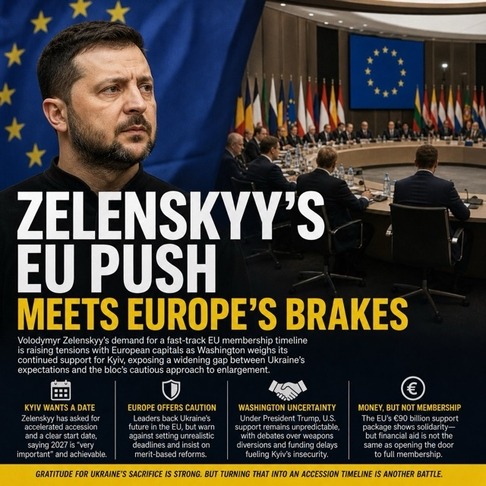
Volodymyr Zelenskyy has spent much of the war telling Europe that Ukraine is not merely defending its own territory, but the continent’s political future.
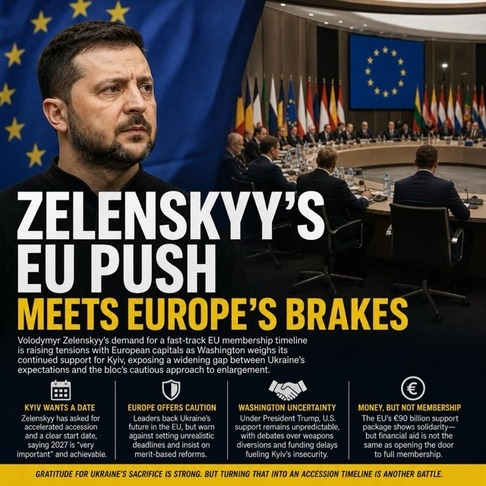
Now, as Kyiv presses for a hard date to join the European Union, that argument is running into a harder reality: many European capitals still support Ukraine’s accession in principle, but they are increasingly unwilling to promise the speed, certainty and political shortcuts that the Ukrainian president is demanding.
The tension has sharpened after the apparent removal of one of Kyiv’s most visible obstacles: Hungary’s long-running veto under Viktor Orbán. For nearly two years, Budapest’s obstruction allowed other EU governments to avoid the most difficult questions about Ukraine’s bid. With Orbán’s defeat in April elections raising hopes that the deadlock can be broken, the debate has shifted from whether Ukraine’s accession process can move to how far, how fast, and under what conditions.
Zelenskyy’s message is blunt. Ukraine wants full EU membership, not a halfway house, not symbolic integration, and not a vague promise deferred into the next decade. At an informal summit in Cyprus last week, he told EU leaders that Ukraine seeks “the same full membership” as existing member states and asked for accelerated accession with a clear start date for membership. The request follows his earlier insistence that 2027 is “very important” and, in Kyiv’s view, still achievable.
European leaders have answered with sympathy — and brakes. Dutch Prime Minister Rob Jetten said accession talks could proceed quickly, but warned that did not mean a near-term accession date could be named. Luxembourg’s Luc Frieden said Ukraine belonged to the European family but stressed that every candidate must meet the same conditions. Belgian Prime Minister Bart De Wever cautioned against “too much euphoria” after Orbán’s exit. European Commission President Ursula von der Leyen framed accession as a “two-way contract”: Ukraine must reform, and member states must reward progress, but the merits-based process must be respected.
The sharpest public warning came from Berlin. German Chancellor Friedrich Merz said on April 27 that a January 1, 2027 accession date “will not work” and that even January 1, 2028 is unrealistic. Merz also argued that Ukraine cannot join the bloc while still at war and must first meet strict rule-of-law and anti-corruption requirements. His suggestion that Kyiv may eventually have to accept that some territory remains outside its control in a future peace settlement linked the EU question directly to the war’s most painful political choices.
For Kyiv, the EU deadline is more than institutional choreography. It is a security guarantee, a political anchor and a signal to Moscow that Ukraine’s western trajectory cannot be vetoed by war. The official EU track has already advanced: Ukraine applied for membership days after Russia’s full-scale invasion in February 2022, received candidate status in June 2022, saw accession negotiations formally launched in June 2024, and completed its screening process in September 2025. But opening the actual negotiation clusters — the structured chapters that determine whether a candidate is ready — has remained politically blocked.
Kyiv believes the window is now open. On April 30, Ihor Zhovkva, a deputy head of the Ukrainian president’s office, said Ukraine’s path to EU membership was “clear of political obstacles,” with negotiation clusters expected to open in the coming months and a political decision on accession possible in 2027, provided membership requirements are met. A joint statement by Zelenskyy, European Council President António Costa and von der Leyen on April 23 also called for negotiation clusters to be opened “without delay.”
Yet the caution in Europe is not only procedural. Ukraine would be the EU’s most consequential enlargement in decades: a large, agricultural, heavily armed country with vast reconstruction needs, part of its territory under Russian occupation, and a war economy still dependent on external support. Its entry would reshape the EU budget, especially agriculture and cohesion funds, and could alter internal voting dynamics in a bloc already struggling with veto politics. European officials also know that enlargement will collide with domestic politics, including elections in several major member states where Eurosceptic parties may turn Ukraine’s accession into a campaign weapon.
That explains the search for alternatives. Some ideas would bring Ukraine deeper into the single market, give it observer roles in EU institutions, or integrate it in stages before full voting rights. Earlier proposals for a “reversed” accession process — membership in name first, benefits later — were rejected by capitals as too risky. Zelenskyy has signaled willingness to discuss formats, but he has drawn a line against anything that looks like symbolic membership. His argument is that Ukraine’s sacrifice is not symbolic: Ukrainians are dying in a war they say protects Europe itself.
Washington’s uncertainty has made the EU debate more urgent. Under President Donald Trump, U.S. support for Ukraine has become less predictable, with Kyiv increasingly reliant on European money and procurement mechanisms to access U.S.-made weapons. The Washington Post reported in March that the Pentagon had considered diverting weapons intended for Ukraine to the Middle East as the Iran war strained critical U.S. munitions supplies. Even where arms continued to flow, the debate highlighted how vulnerable Ukraine remains to shifting U.S. priorities.
The same ambiguity surrounds U.S. funding. Congress authorized $400 million for the Ukraine Security Assistance Initiative in the 2026 defense bill, but analysts noted that authorization alone did not guarantee the money would be spent. After criticism over delays, Defense Secretary Pete Hegseth told lawmakers that the funds had been released. The episode reinforced Kyiv’s fear that American support can still be slowed, conditioned or redirected by domestic politics in Washington.
Europe has tried to fill the gap with money. On April 23, the Council of the EU finalized a €90 billion support loan for Ukraine covering 2026 and 2027. The package includes €30 billion for macroeconomic support and €60 billion for defense-industrial capacity, with disbursements tied to conditions including rule of law and anti-corruption commitments. It is a major act of solidarity — but also a reminder that financial support is not the same thing as political admission.
That distinction is now the fault line. Zelenskyy is asking Europe to turn wartime gratitude into an accession timetable. European leaders are asking Kyiv to accept that enlargement is not only a moral question but an institutional transformation of the Union itself. The result is an increasingly visible gap between Ukrainian expectations and European caution: Kyiv sees delay as a strategic vulnerability; many EU capitals see haste as a risk to the bloc’s cohesion.
For now, both sides are still moving in the same direction. Ukraine’s future, EU leaders continue to say, lies in the Union. But the argument is no longer about destiny. It is about dates, voting rights, budgets, borders, corruption benchmarks and the political cost of absorbing a country still fighting Russia. Zelenskyy wants Europe to decide now. Europe, even while arming and financing Ukraine, is still deciding how much of that future it is ready to guarantee — and how soon.