A rout in the north has turned Russia’s Sahel showcase into a test of survival for Bamako’s junta

BAMAKO/MOSCOW — May 4, 2026
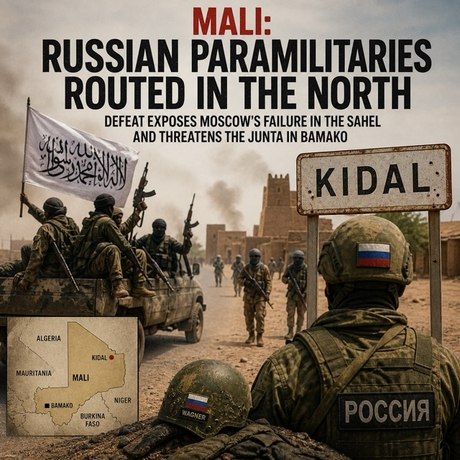
The war that Mali’s military rulers promised to win with Russian help has moved from the country’s remote desert tracks to the political heart of Bamako. After a wave of coordinated attacks on April 25, Russian-backed Malian forces were driven from Kidal, Defence Minister Sadio Camara was killed, and al-Qaeda-linked militants set up checkpoints on roads around the capital, according to Reuters and AP reporting. The result is more than a battlefield embarrassment. It is a direct challenge to the central bargain that has sustained Mali’s pro-Russian junta: sovereignty in exchange for security.
The immediate shock came in Kidal, the northern city that Russian mercenaries helped Mali’s army retake in 2023 and that had become a symbol of Bamako’s restored authority. Its loss after the April offensive punctured that narrative. Reuters reported that the Azawad Liberation Front seized Kidal on April 25, driving out Russian forces; AP said Russian and Malian troops withdrew after separatists and al-Qaeda-linked militants launched near-simultaneous attacks on Bamako’s airport, Kati, Kidal and other towns.
The rout did not come from nowhere. In July 2024, at Tinzaouaten near the Algerian border, Tuareg rebels ambushed a Russian-Malian convoy after days of fighting, inflicting heavy losses on Russian paramilitaries and Malian troops. The Polish Institute of International Affairs described the battle as a major defeat that undermined Russia’s image as an effective force in Africa; Wagner acknowledged significant losses, while jihadist and separatist claims put the toll far higher than Moscow or Bamako would confirm.
Mali’s generals had sold the Russian partnership as the hard alternative to failed Western counterinsurgency. After coups in 2020 and 2021, they expelled French troops and U.N. peacekeepers and turned first to Wagner, then to Moscow’s Defence Ministry-controlled Africa Corps. Camara, buried in Bamako on April 30, was one of the central architects of that pivot, according to AP; he had trained in Russia, helped bring in Russian mercenaries in 2021 and pushed for the end of the U.N. mission.
His death has therefore become a political event as much as a military loss. AP reported that analysts believe Camara’s killing, combined with the setback suffered by the Malian army and its Russian allies, could deepen divisions inside the junta and force a reconsideration of the Moscow partnership. Reuters quoted analysts saying the junta’s future is now in jeopardy and that Russia’s wider military presence in Mali is tied to whether Bamako can recover.
Russia’s problem is that Mali was supposed to be the proof of concept. Across the Sahel, Moscow has presented itself as a more reliable security patron than France, the U.N. or the United States: less constrained, less moralising, and more willing to defend military regimes facing insurgencies. But in Mali, that model is colliding with the same reality that humbled earlier interventions: vast terrain, weak state legitimacy, fragmented armed groups, and insurgents who can retreat, regroup and strike where the army is thin.
The Africa Corps is not merely “Wagner with a new badge.” It is more directly controlled by the Russian Defence Ministry and is estimated by Reuters and AP at about 2,000 troops in Mali. But the transition from Wagner’s semi-deniable mercenary brand to a state-managed expeditionary tool has not solved the central problem: Russian forces can help Bamako take towns, but they have not shown they can hold territory, protect supply lines or produce durable political order.
That weakness is now visible around Bamako itself. On May 1, Reuters reported that JNIM had called on Malians to rise up against the military government, urged a transition to Sharia law, and established checkpoints on several major roads leading into the capital. The same report said the Azawad Liberation Front had seized Tessalit, while Le Monde reported that at least five northern towns had fallen to attackers and that JNIM declared a blockade of Bamako, though the extent of that encirclement could not be independently verified.
For now, Assimi Goïta remains in power. He appeared publicly after days of rumours, met Russia’s ambassador and promised to continue operations until the armed groups were neutralised. Russia’s Defence Ministry called the offensive a coup attempt and claimed Africa Corps fighters had helped foil it, while AP noted that the Russian account could not be independently verified and that Mali’s government had not provided a detailed account of the attacks.
The junta’s difficulty is that reassurance is no longer enough. Its legitimacy rests on the claim that military rule, freed from civilian politics and Western tutelage, can restore national security. Yet the latest attacks suggest the opposite: insurgents can coordinate across ideological lines, force Russian withdrawals, kill a key minister and bring fear to the capital’s perimeter. Malian authorities are now investigating current and former soldiers suspected of involvement in the attacks, a sign that the crisis is also being read in Bamako as an internal breach, not just an external assault.
The rebel-jihadist alignment may not last. Tuareg separatists and JNIM have different endgames, and Mali’s history is full of tactical coalitions that collapse once territory is taken. But even a temporary convergence is dangerous. It allows separatists to pressure northern garrisons while jihadists threaten roads, towns and the political centre. In 2012, a Tuareg rebellion helped open the way for jihadist control of northern cities before France intervened; today, France is gone, the U.N. mission is gone, and Russia is the outside patron on the line.
For Moscow, the stakes extend beyond Mali. Reuters described Mali as one of Russia’s centres of power in West Africa, part of a chain of military partnerships stretching through Burkina Faso, Niger and the Central African Republic, where security support is traded for influence and access to mineral wealth. If Russian forces cannot rapidly restore the perception of control in Mali, their value proposition to other embattled regimes weakens.
That does not mean Russia will simply leave. The Kremlin has reasons to absorb losses: prestige, resources, anti-Western leverage and the need to prove that Ukraine has not exhausted its global reach. Mali’s junta also has few immediate alternatives. But the balance has shifted. Moscow is no longer merely backing a client; it is exposed as co-owner of a deteriorating war.
The defeat in northern Mali has stripped away the theatre from Russia’s African adventure. The message once projected from Bamako was that Moscow brought order where the West brought lectures and failure. The message now rising from Kidal, Tessalit and the roads into Bamako is harsher: Russia can help a junta survive, but it has not shown it can stabilise a country. And if Bamako’s rulers cannot reverse the tide quickly, the desert may yet decide not only the future of Mali’s war, but the credibility of Russia’s entire Sahel strategy.