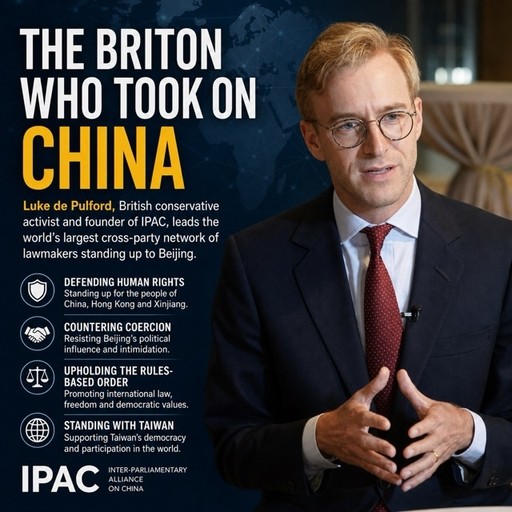
Conservative campaigner Luke de Pulford has turned China criticism into a cross-party, transnational parliamentary operation. His aim is not merely to denounce Beijing, but to make democratic silence harder to sustain.

The latest example of the world Luke de Pulford has chosen to fight in came not from Westminster, but from the international conference circuit. When human-rights gatherings, Taiwanese civil-society representatives, Hong Kong activists or Uyghur witnesses become the object of diplomatic pressure, de Pulford sees the same mechanism at work: Beijing does not merely object. It leans on governments, institutions and companies until the inconvenient subject disappears from the room.
De Pulford is not an elected politician. That is part of his utility. Officially, he is the founder and executive director of the Inter-Parliamentary Alliance on China, better known as IPAC. Before that, he co-founded the anti-slavery charity Arise and built a reputation in conservative human-rights circles as a campaigner with unusual access to legislators. He has advised Uyghur organisations, worked with faith and rights groups, and served on the Conservative Party Human Rights Commission.
His instrument is not a party, but a network. IPAC was launched in 2020 by a small group of lawmakers from democracies including the United States, Britain, Germany, Japan, Canada, Australia, Sweden and Norway, as well as members of the European Parliament. The premise was simple: China policy had become too important to be left to isolated national committees, and too vulnerable to bilateral pressure from Beijing.
Since then, the alliance has grown into what is arguably the most visible international caucus of China critics in elected politics. It links legislators across continents and political families: conservatives, liberals, social democrats, Christian democrats, Greens, Republicans, Democrats and security hawks. Many of them disagree bitterly on taxation, migration, climate or culture. On one question they converge: the Chinese Communist Party is not just another difficult trading partner, but a systemic challenge to democratic institutions, open markets, international law and basic political freedoms.
This political range is de Pulford’s central achievement. The British conservative has helped create a platform in which a senator in Washington, an MEP in Brussels, a lawmaker in Tokyo, a parliamentarian in Manila and a backbencher in London can speak with a shared vocabulary and, crucially, with a shared timetable. IPAC provides statements, hearings, draft amendments, witness networks and coordinated public pressure. It turns scattered outrage into parliamentary procedure.
Beijing regards that as hostile. Chinese officials and state media routinely describe IPAC as anti-China, a label the network rejects. De Pulford’s answer is that IPAC is not opposed to China or Chinese people, but to coercion by the party-state. In his framing, the issue is not cultural antagonism; it is power. Who gets to decide whether Taiwan may be represented at an international forum? Who pays the price when a legislature debates forced labour in Xinjiang? Who protects a Hong Kong publisher, a dissident student, or an exiled activist when pressure crosses borders?
Those questions explain why Taiwan has become central to IPAC’s work. For the alliance, Taiwan is not only a security flashpoint in the Indo-Pacific. It is a test case for whether democracies can resist the incremental normalisation of coercion. IPAC lawmakers have argued for stronger support for Taiwan’s international participation, clearer deterrence against any attempt to change the status quo by force, and tighter scrutiny of economic dependencies that could be weaponised in a crisis.
Hong Kong and Xinjiang supply the moral core of the campaign. The dismantling of Hong Kong’s promised autonomy convinced many Western parliamentarians that engagement had failed to moderate Beijing’s behaviour. The mass detention, surveillance and forced-labour allegations surrounding Uyghurs in Xinjiang gave IPAC a legislative target: supply-chain laws, import bans, sanctions and due-diligence rules. De Pulford’s method is to convert human-rights testimony into bills, amendments and votes.
The alliance has also made transnational repression one of its signature themes. Chinese pressure, in IPAC’s telling, is not confined within China’s borders. It appears in threats to diaspora communities, intimidation of activists abroad, pressure on universities, surveillance of critics and diplomatic efforts to prevent foreign lawmakers from attending Taiwan-related events. The intended effect is deterrence: make people calculate that speaking up is not worth the trouble.
De Pulford’s counter-strategy is collective exposure. If one legislator is targeted, others publicise it. If one government is pressured, foreign parliamentarians ask why. If a Chinese embassy warns against attendance at a summit, IPAC turns the warning itself into evidence of coercion. The tactic is simple but effective: make intimidation public, then make public intimidation politically costly.
In Britain, this places de Pulford in permanent tension with the instincts of economic pragmatism. Successive governments have oscillated between security concern and the temptation to stabilise relations with Beijing. The argument for caution is familiar: China is too large a market, too important a diplomatic actor and too central to global supply chains to be treated only as an adversary. De Pulford’s answer is equally direct: dependency is not neutrality. It is leverage waiting to be used.
That is why he has opposed projects and decisions he believes would deepen vulnerability, including controversial Chinese state-linked infrastructure or diplomatic projects in sensitive locations. For him, the issue is not symbolic hostility toward China, but the cumulative effect of concessions that appear technical when taken individually and strategic when added together.
IPAC’s real power is not executive authority. It has no trade mandate, no army, no intelligence service and no diplomatic corps. Its influence lies in agenda-setting. It gives legislators language, confidence and international cover. A lone MP raising Hong Kong or Taiwan can be dismissed as a crank or a partisan. A coordinated group of lawmakers from dozens of democracies is harder to ignore.
The risks are obvious. Critics argue that parliamentary activism can reduce diplomatic room for manoeuvre, feed escalation and flatten the complexity of relations with China. Businesses fear retaliation. Some diplomats worry that networks like IPAC reward confrontation over quiet negotiation. Beijing, for its part, portrays the alliance as proof that Western politicians are trying to contain China’s rise.
But de Pulford’s case rests on a harsher reading of the last two decades. Trade did not liberalise China. Silence did not save Hong Kong’s freedoms. Ambiguity has not ended pressure on Taiwan. And economic caution has not prevented forced-labour concerns, cyber intrusions or intimidation of critics abroad. In that reading, restraint has too often meant acquiescence.
His goal, therefore, is not regime change in Beijing. It is to deny Beijing a veto over democratic politics elsewhere. He wants governments and parliaments to treat coercion as a collective problem, not a bilateral inconvenience. He wants supply chains cleaned of forced-labour risk, dissidents protected, Taiwan included where possible, Hong Kong remembered, and strategic dependency reduced before crisis makes reduction impossible.
That ambition explains why a British conservative has ended up convening lawmakers of almost every political colour. De Pulford has found a cause that allows the right to talk about sovereignty, the left to talk about labour and human rights, liberals to talk about rules and institutions, and security hawks to talk about deterrence. IPAC’s genius is to let each faction keep its own language while moving in the same direction.
The result is a new kind of pressure group: part caucus, part campaign, part diplomatic early-warning system. It operates below the level of governments but above the level of NGOs. It does not negotiate with Beijing; it changes the domestic politics of negotiating with Beijing.
For Luke de Pulford, the endgame is a democratic China policy with a spine: not anti-Chinese, but anti-coercion; not a cold-war reflex, but a refusal to let economic dependence write foreign policy. His target is not only Beijing’s conduct. It is the Western habit of pretending that threats can be managed quietly, one concession at a time.
That is why IPAC matters. It may not be the largest institution in China policy, but it has discovered something Beijing dislikes: elected politicians become harder to isolate when they act together. De Pulford’s project is to make that solidarity durable enough to survive the next trade threat, the next diplomatic warning and the next attempt to make a politically inconvenient truth disappear.