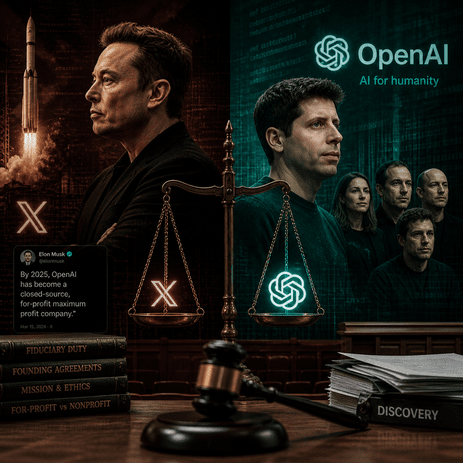
Elon Musk’s Lawsuit Against Sam Altman and OpenAI Threatens to Upend the AI Giant’s Trajectory

In a federal courtroom in Oakland, California, a legal showdown is unfolding that could reshape the future of one of the world’s most influential technology companies. Elon Musk, the billionaire CEO of Tesla and SpaceX, has taken the stand in his high-profile lawsuit against OpenAI, its CEO Sam Altman, and its president Greg Brockman. At the heart of the case is a fundamental question: did OpenAI betray its founding promise to develop artificial intelligence for the benefit of humanity as a nonprofit, or was the creation of a for-profit entity a necessary evolution to achieve its mission?
Musk, a co-founder of OpenAI in 2015, testified that he provided $38 million in funding and was instrumental in recruiting key talent, including top researcher Ilya Sutskever, under the explicit understanding that the company would remain a nonprofit “charity.” He alleges that Altman and Brockman abandoned this mission, enriching themselves and converting OpenAI into a profit-seeking “juggernaut” valued at over $850 billion. “I came up with the idea, the name, recruited the key people, taught them everything I know, provided all of the initial funding,” Musk declared, arguing that the for-profit subsidiary has become “the tail wagging the dog.”
OpenAI and its legal team, led by William Savitt of Wachtell, Lipton, Rosen & Katz, have mounted a vigorous defense. They argue that Musk was fully aware of and supportive of plans to create a for-profit arm as early as 2015 to secure the massive investments needed for cutting-edge AI research. They contend that Musk’s lawsuit is driven by “jealousy” and regret after he failed to take unilateral control of the company and subsequently left the board in 2018. Savitt pressed Musk on why he didn’t create a new nonprofit after founding his own AI company, xAI, to which Musk retorted, “Why would I start another nonprofit when I already started a nonprofit?”
The trial has been marked by dramatic and tense exchanges. Musk clashed repeatedly with Savitt during cross-examination, accusing him of asking “tricky” questions designed to “trick me.” The judge, Yvonne Gonzalez Rogers, has had to intervene multiple times, admonishing both sides and striking Musk’s repeated refrain of “you can’t steal a charity” from the record. She also firmly shut down attempts to center the trial on existential AI risks, stating, “We are not going to talk much about extinction in this case,” a notable irony given Musk’s own warnings about AI and his leadership of xAI.
The stakes could not be higher. Musk is seeking sweeping remedies, including the removal of Altman and Brockman from the company, a reversal of the for-profit conversion, and up to $150 billion in damages to be redirected to OpenAI’s nonprofit arm. A favorable outcome for Musk could derail OpenAI’s planned initial public offering, which is expected to value the company at around $1 trillion. As the trial continues with testimony from other key figures, the world is watching to see whether this courtroom battle will redefine the governance and future of the AI industry.