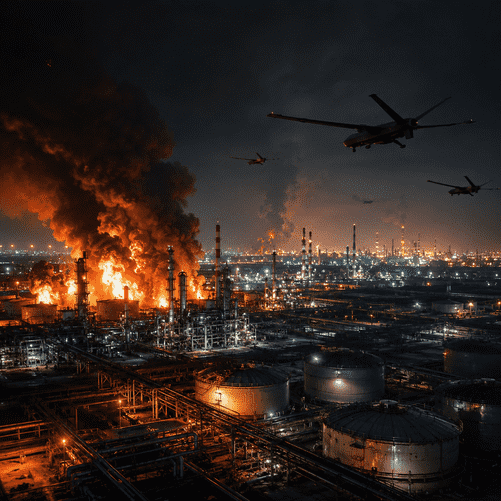
Abu Dhabi has finally stepped outside the Saudi-led quota system. But until the Strait of Hormuz fully reopens, traders cannot know whether the move will reshape supply or remain a deferred shock.

LONDON/DUBAI
The United Arab Emirates has chosen the most turbulent moment in the oil market in years to make its most consequential energy-policy break in decades: leaving OPEC and OPEC+. Yet for now, the market cannot fully price what Abu Dhabi has done. The barrels that matter are still trapped behind geopolitics.
The UAE announced its withdrawal effective May 1, ending a nearly six-decade relationship with the producers’ group and widening a long-running rift with Saudi Arabia, OPEC’s de facto leader. Energy Minister Suhail al-Mazrouei framed the decision as strategic, tied to current and future production policy, and said it had not been negotiated with other producers. The exit could free the UAE to lift output once Gulf exports normalize, but officials have also played down the immediate effect while the Strait of Hormuz remains constrained.
That is the paradox at the center of the market. Abu Dhabi has left a quota system it has long considered too restrictive, but the infrastructure of physical supply is still being dictated by the Iran conflict. Hormuz, the narrow passage between Iran and Oman through which roughly a fifth of global crude oil and liquefied natural gas normally moves, remains the decisive variable. Traders are watching diplomatic headlines, military threats and tanker movements more closely than they are watching OPEC communiques.
The first test comes almost immediately. Seven OPEC+ producers — Saudi Arabia, Iraq, Kuwait, Algeria, Kazakhstan, Russia and Oman — are expected to proceed with a June output-target increase of about 188,000 barrels per day. But that increase is mostly symbolic while war-related disruption continues to throttle exports from Gulf producers. Industry executives and traders expect flows to take weeks, if not months, to normalize even after Hormuz reopens.
For Saudi Arabia, the UAE’s exit is more than a technical adjustment to a spreadsheet of quotas. It removes one of the few Gulf producers with both the capacity and the financial discipline to make OPEC+ policy credible. The UAE was often difficult inside the tent, but it was still inside the tent. Its departure leaves Riyadh with fewer reliable partners at precisely the moment when OPEC+ cohesion matters most.
Abu Dhabi’s frustration has been building for years. ADNOC, the national oil company, has set a target of raising production capacity to 5 million barrels per day by 2027. That ambition sat uneasily with an OPEC+ system built around restraint, negotiated baselines and the political premium of Saudi leadership.
The UAE’s calculation is straightforward: if the world is entering a volatile final investment cycle for oil, the countries with cheap, low-carbon-intensity barrels want to sell more of them while demand still holds. OPEC’s calculation is the opposite: if producers defend price by holding back supply, everyone earns more for longer. The clash between those views has now moved from private bargaining rooms to the open market.
Still, this is not yet a price war. It may not become one. The Strait of Hormuz has turned the near-term market into a physical-security story rather than a classic producer-discipline story. Recent output figures show the scale of the disruption: OPEC+ production has fallen sharply, with Saudi Arabia and Iraq making the biggest cuts because exports were constrained. That means the market is not yet seeing the supply behavior that would normally follow a major political split inside the producer bloc.
The result is a market that swings violently on news but cannot yet settle on a post-UAE equilibrium. Brent crude surged to its highest level since 2022 on Wednesday before swinging back down as traders reacted to reports of fresh diplomatic openings around Iran. Those moves show how little the market is trading on oil fundamentals alone. A missile threat, a ceasefire signal, a naval briefing or a tanker crossing can move prices faster than any OPEC quota adjustment.
Iraq’s position underscores the same point. Baghdad says it can restore output and exports to normal levels quickly once the Hormuz crisis ends, but current flows are being routed through limited alternatives and held hostage to security conditions in the strait. In a normal market, Iraq’s recovery plan and the UAE’s quota freedom would pressure prices. In this market, both are conditional on a shipping corridor.
That is why the UAE decision will matter most after the ships move freely again. Once Hormuz reopens, the market will face two simultaneous shocks: the return of constrained Gulf supply and the emergence of an unconstrained Emirati producer. If Abu Dhabi uses its freedom to raise output materially, OPEC+ will have to decide whether to accommodate the extra barrels, cut more deeply, or let prices absorb the pressure.
The danger for Riyadh is that the UAE’s departure weakens the psychology of the group. OPEC+ has held together through years of uneven compliance, pandemic-era demand collapse and the disruption caused by Russia’s war in Ukraine. But it has done so because Saudi Arabia could credibly threaten discipline, cuts or market-share pressure. A producer with major spare capacity now sits outside that framework.
For consumers, the long-term implication may be lower prices. For OPEC+, it is a loss of control. Without the UAE, the coalition’s share of the roughly 100 million-barrel-a-day oil market declines, and its ability to choreograph restraint becomes less convincing. A state holding meaningful spare capacity has more leverage outside the quota system than inside it.
Yet the market’s immediate fear remains scarcity, not abundance. Inventories are being drawn down. Jet fuel costs have surged in Asia. Inflation risks are rising again. The longer Hormuz remains disrupted, the more the UAE’s institutional break becomes a secondary story to a global supply crunch.
That does not make the Emirati move less historic. It makes it harder to interpret in real time. Abu Dhabi has signaled that it no longer wants Saudi-led quota politics to define its oil future. Riyadh has signaled, through OPEC+ continuity, that the remaining producers will try to preserve the architecture. Traders, meanwhile, are waiting for the only signal that truly matters: whether tankers can move again.
Until then, the UAE’s exit is both a rupture and a deferred verdict. The diplomatic story has already broken. The market story begins when Hormuz reopens.