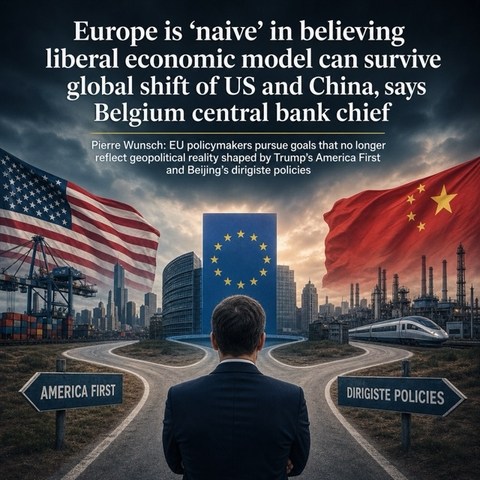
Belgium’s central bank governor warns that Brussels is still defending a liberal economic model while Washington and Beijing are rewriting the rules of global competition.

Europe’s belief that the liberal economic order can survive largely unchanged is becoming a strategic liability, Belgium’s central bank governor Pierre Wunsch has warned, arguing that EU leaders are still designing policy for a world that no longer exists.
Wunsch, who heads the National Bank of Belgium and sits on the European Central Bank’s policy-making circuit, said Europe was “naive” to think that its traditional model of open markets, rules-based trade and technocratic adjustment could endure the new pressure from Donald Trump’s America First trade policy and China’s state-directed industrial strategy.
His warning lands at a particularly exposed moment. In Washington, the Trump administration has made reciprocal trade, enforcement and strategic supply chains central to its trade agenda. In Beijing, industrial policy continues to channel capacity into electric vehicles, batteries, solar technology, chemicals and other sectors that Europe wants to protect or rebuild at home.
The immediate trigger is trade. Fresh U.S. tariff pressure on European cars and trucks has intensified the sense that Europe can no longer assume the United States will act as the ultimate guardian of the open trading system from which the continent benefited for decades. China, meanwhile, is not converging toward a liberal market model; it is using state power, subsidies and scale to dominate the industries of the future.
For Wunsch, the issue is larger than one dispute. Europe, caught between the two largest economic powers, still often behaves as if legal process, competition rules and incremental reform can substitute for strategy. The bloc has become adept at diagnosing its weaknesses. It has been slower to convert that diagnosis into power.
That is the heart of the governor’s charge. Europe is not short of plans. The European Commission’s competitiveness agenda promises to close the innovation gap, decarbonise industry and reduce dangerous dependencies. Mario Draghi’s competitiveness report gave the EU a sweeping reform blueprint. Yet the central question is whether Brussels can move at the speed now required by the geopolitical economy.
The economic backdrop reinforces the urgency. The euro area is facing softer external demand, persistent energy-cost disadvantages and a trade environment shaped less by multilateral confidence than by bargaining power. Cheap imports from China may help dampen some price pressures in the short term, but they also expose the depth of Europe’s industrial vulnerability.
Europe’s dilemma is that its virtues are also its constraints. The single market, independent regulators, competition law and fiscal rules helped build one of the world’s most prosperous regions. But in a world of subsidy races, tariff threats, export controls and industrial blocs, those same procedures can look slow, fragmented and underpowered.
European leaders increasingly speak the language of strategic autonomy. But capital markets remain shallow, defence procurement is fragmented, energy costs are structurally high, and many critical supply chains still run through China or depend on U.S. technology. The result is a continent that talks like a geopolitical actor while too often budgeting, regulating and investing like a market administrator.
The political risk is that Europe ends up with the worst of both worlds: too open to withstand coercion, too regulated to move at American or Chinese speed, and too divided to deploy industrial policy at scale. If the EU cannot finance strategic sectors, deepen its capital markets and coordinate defence, energy and technology policy more decisively, its openness may become a vulnerability rather than a strength.
Wunsch’s intervention is therefore less a rejection of liberal economics than a warning against nostalgia. The rules-based order has not disappeared, but it is no longer self-enforcing. The United States is using market access as leverage. China is using industrial capacity as geopolitical weight. Europe must decide whether openness remains a principle backed by power, or merely a habit from a more comfortable era.
The coming test will be whether Brussels can act before the next shock arrives. That means faster common financing for strategic sectors, a more integrated capital market, coordinated procurement in defence, a credible energy-cost strategy and a trade policy that can protect European industry without sliding into indiscriminate protectionism.
It also means accepting that competitiveness is no longer a narrow productivity file. It is now a security question. Wunsch’s word — “naive” — will sting because it captures a fear already spreading through European capitals. The continent knows the world has changed. It has commissioned the reports, written the strategies and named the dependencies. What it has not yet proven is that it can move with the urgency of a power that understands the age of benign globalisation is over.