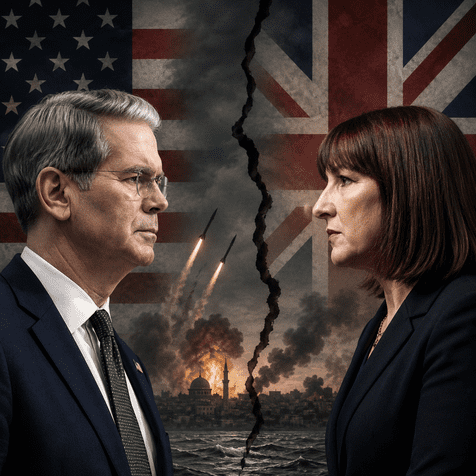
A private Washington confrontation has laid bare the limits of allied diplomacy as Britain challenges the economic and strategic logic of the US campaign.

US Treasury secretary Scott Bessent had a fierce private confrontation with Rachel Reeves in Washington last month after the UK chancellor publicly criticised Donald Trump’s war in Iran, according to people familiar with the exchange, in a sign that the transatlantic dispute over the conflict has moved from diplomatic unease to open friction.
The row took place during the International Monetary Fund’s spring meetings in April, where Reeves arrived with a blunt message: the conflict was damaging living standards, disrupting energy markets and lacking a clear strategic end point. People briefed on the meeting said Bessent challenged Reeves directly over those remarks, including by invoking the risk of an Iranian nuclear attack on Britain. Reeves, according to the same accounts, pushed back sharply, making clear she did not answer to the US Treasury secretary and objected to his tone.
The confrontation comes amid the sharpest public disagreement between London and Washington in years. Reeves and prime minister Keir Starmer have both questioned the rationale and conduct of the US-led campaign, while Donald Trump has responded with threats over trade, tariffs and the Falklands.
Reeves had been among the most outspoken figures in the British government before travelling to Washington. In mid-April, she told a US audience that Trump’s decision to abandon talks with Tehran and enter the conflict had been a mistake, arguing that the war had not made the world safer and had added to economic strain. She also said the objectives of the campaign were unclear and called for urgent de-escalation, particularly to restore safe passage through the Strait of Hormuz.
Those comments infuriated some in the Trump administration. Bessent, who has defended the economic cost of the war as justified by long-term security aims, confronted Reeves on the sidelines of the IMF gathering. His argument, according to people briefed on the meeting, echoed remarks he had made publicly about the danger of a nuclear strike on London. Reeves responded by restating her criticism that Washington had entered the war without a clear exit plan or defined objectives.
Downing Street has declined to deny that the clash took place. The prime minister’s official spokesperson said the government would not discuss private conversations, while insisting that Reeves and Bessent had a good relationship and had held constructive talks since the Washington visit. British officials also pointed to a US Treasury readout issued after the meeting, which described the discussion in formal terms and said the two had discussed financial markets, rare earths and critical minerals.
That official readout gave no hint of the tension. It said Bessent had underscored the Treasury’s commitment to using financial tools against entities supporting Iranian terrorist activity and noted continued work on the US-UK Transatlantic Taskforce for Markets of the Future.
But the diplomatic language has not obscured the widening policy gap. Reeves has framed her criticism in economic as well as strategic terms, arguing that the war has raised costs for households and businesses in Britain and beyond. The conflict has disrupted energy flows, intensified inflationary pressure and forced policymakers to revisit assumptions that the shock would be short-lived.
The IMF has warned that the war’s impact is becoming more severe. Managing director Kristalina Georgieva said in early May that the fund’s earlier baseline, built around a short conflict, was now receding, with an adverse scenario already taking hold as oil prices and inflationary pressures rise. She warned that if the war continues into 2027 and oil prices approach $125 a barrel, the world economy could face a significantly worse outcome.
For Reeves, that economic backdrop has sharpened the political case for speaking out. Britain is especially exposed to energy price shocks as a net importer of gas, and the chancellor has argued that growth would be stronger and inflation lower if the conflict ended through de-escalation. She has also said diplomacy remains the best route to preventing Iran from developing a nuclear weapon.
For Bessent and the White House, however, Reeves’s comments crossed a line. The Trump administration has treated criticism from London not as a private allied disagreement but as a challenge to the legitimacy of its Iran strategy. That has put economic policy, security policy and trade negotiations into the same combustible arena.
The result is an unusually public breakdown in the tone of the US-UK relationship. Starmer initially sought to preserve working ties with Trump, particularly on trade, but relations have soured since Britain refused to join offensive action against Iran. Trump has threatened to reopen a bilateral trade deal, impose fresh tariffs in response to Britain’s digital services tax and recognise Argentine claims over the Falkland Islands.
There have been moments of attempted repair. Trump struck a more conciliatory note during King Charles and Queen Camilla’s recent visit to the United States, including announcing an end to tariffs on Scotch whisky. Yet the private clash between Bessent and Reeves suggests that the underlying dispute over Iran remains unresolved.
For now, both governments are trying to preserve the appearance of functional cooperation. Treasury officials emphasise continued work on financial markets and supply chains. Downing Street insists the chancellor’s relationship with Bessent remains constructive. But the Washington row has exposed the limits of that diplomacy: on Iran, Britain’s chancellor is no longer speaking in careful hints, and America’s Treasury secretary is no longer pretending not to hear her.