A deadly wave of Russian attacks killed at least 27 people across Ukraine just hours before a proposed open-ended truce took effect, while the Venice Biennale suspends the Russian pavilion following a jury resignation over participation controversies.

The death toll from a coordinated series of Russian strikes across eastern and southern Ukraine has risen to at least 27, marking one of the deadliest bombing campaigns of the year. The attacks occurred mere hours before midnight on Wednesday, the deadline for the implementation of a Ukrainian proposal for an open-ended ceasefire.
In the south-eastern city of Zaporizhzhia, aerial bombs and drone strikes claimed at least 12 lives, according to regional governor Ivan Fedorov. Violence also intensified in the frontline city of Kramatorsk, where three aerial bombs killed six people in the Donetsk region. Further strikes in Dnipro resulted in four deaths, while an overnight attack on gas production facilities in the Poltava region killed five, including one casualty in the neighboring Kharkiv region.
Ukrainian Foreign Minister Andrii Sybiha condemned the timing of the assaults on the social media platform X, stating, “With mere hours until Ukraine’s ceasefire proposal comes into force, Russia shows no signs of preparing to end hostilities. On the contrary, Moscow intensifies terror.”
The escalation contrasts sharply with a recent announcement from Moscow. Russia had declared a unilateral ceasefire for May 8–9 to coincide with Victory Day commemorations and a military parade in Red Square. In response, Kyiv proposed an immediate, open-ended truce starting at midnight on Wednesday, urging Moscow to reciprocate.
Retaliatory action was also reported in Russian-occupied Crimea, where a Ukrainian drone attack in Dzhankoi killed five civilians, according to Sergey Aksyonov, the Moscow-installed head of the region.
Diplomatic and Cultural Fallout
In the diplomatic sphere, US Secretary of State Marco Rubio held a telephone conversation with Russian Foreign Minister Sergei Lavrov at Lavrov’s request. The discussion covered US-Russia relations, the war in Ukraine, and Iran. Separately, the US State Department approved a potential $373.6 million sale of Joint Direct Attack Munitions (Extended Range) and related equipment to Ukraine, with Boeing serving as the principal contractor.
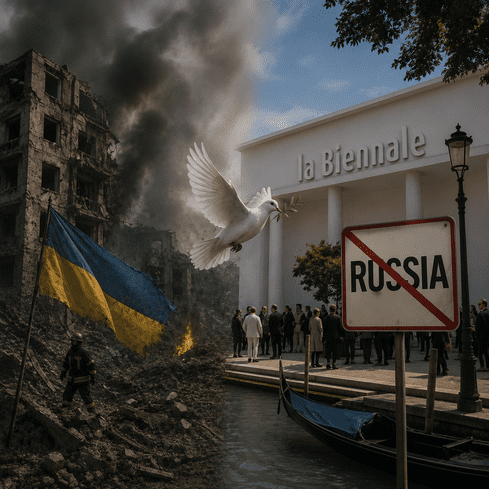
Tensions also spilled over into the cultural sector at the 61st Venice Biennale. The event began its preview period just days after the exhibition’s jury resigned in protest over the participation of Israel and Russia. Consequently, the Russian pavilion is restricted to preview access only and will not open to the general public when the six-month run begins on Saturday.
The controversy has already cost the Biennale 2 million euros ($2.3 million) in EU funding over a three-year period. While organizers defended the decision by citing Italy’s diplomatic relations with all nations, the move has drawn sharp criticism from Rome and Ukrainian representatives. Ksenia Malykh, co-curator of the Ukrainian pavilion, described the inclusion of Russia as a “false attempt to stay neutral,” emphasizing that neutrality is impossible while civilians continue to die.
Meanwhile, the Ukrainian pavilion featured “The Origami Deer,” a sculpture by artist Zhanna Kadryova. The piece replaced a nuclear-capable Soviet fighter jet that stood in Pokrovsk, a city in the Donbas region where the frontline was just 5km away when the statue was evacuated in 2024.
Border Incidents
Neighboring Finland reported that two drones suspected of violating its airspace over the weekend likely originated from Ukraine. The Nordic nation’s border guard stated the drones entered from the south in the Gulf of Finland and flew toward Russian territory, though their final destination remains unknown. This incident highlights the widening geographic footprint of the conflict, even as diplomatic efforts to secure a truce remain fragile.