Luxury houses, tech giants, and mass-market brands converged on fashion’s biggest stage, revealing how economic pressure and cultural change are reshaping the global style industry.

The 2026 Met Gala was more than a celebration of couture and celebrity spectacle. Beneath the dramatic silhouettes, avant-garde gowns, and multimillion-dollar jewelry, this year’s event revealed a profound transformation underway inside the global fashion industry. Major luxury houses, fast-fashion retailers, technology firms, and sustainability advocates all competed for visibility on what has become fashion’s most influential cultural platform.
Held under the theme Fashion Is Art, the annual gala at New York’s Metropolitan Museum of Art showcased increasingly theatrical designs that blurred the line between clothing, performance, and technology. One of the night’s most discussed appearances came from Olympian Eileen Gu, whose futuristic Iris van Herpen gown incorporated microprocessors and air systems capable of releasing real bubbles as she walked the carpet — a striking example of fashion’s growing fusion with engineering and digital innovation.
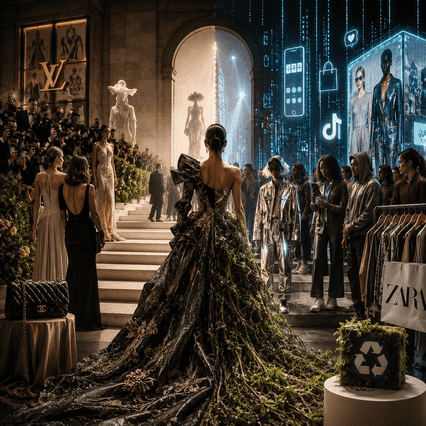
Yet the most significant development may have occurred behind the scenes. Traditionally dominated by European luxury houses, the Met Gala this year saw growing influence from nontraditional players, including technology companies, social-media platforms, and mass-market fashion brands. Zara and Gap drew major attention after dressing high-profile celebrities, signaling a shift in prestige marketing as economic uncertainty pressures luxury labels to reconsider spending.
Industry analysts say the change reflects broader tensions reshaping global fashion. While ultra-luxury brands continue to command cultural influence, consumers are increasingly gravitating toward accessibility, sustainability, and digital engagement. Social media platforms now drive fashion trends faster than runway cycles, while younger consumers demand transparency regarding environmental impact and labor practices.
That pressure is accelerating investment in sustainable materials and circular production systems. Recent multimillion-dollar environmental grants aimed at developing biodegradable alternatives to synthetic fabrics have highlighted growing concern over the industry’s environmental footprint. Fashion remains one of the world’s largest industrial polluters, responsible for substantial carbon emissions, textile waste, and water consumption.
At the same time, designers are increasingly treating sustainability not simply as ethical branding, but as a source of creative identity. Labels associated with upcycling, recycled textiles, and experimental craftsmanship are gaining stronger influence across both luxury and mainstream markets. Designers such as Marine Serre and Stella McCartney continue to push environmentally conscious design into the center of high fashion rather than its margins.
The industry is also entering a period of generational transition. The recent death of legendary Italian designer Valentino marked the symbolic end of an era defined by classic European glamour and traditional couture authority. Meanwhile, younger creative directors and digitally driven brands are redefining what luxury means for a generation raised on social media, artificial intelligence, and instant global visibility.
For fashion executives, the message from this year’s Met Gala was unmistakable: the future of style will no longer be shaped solely by heritage maisons and elite runways. Technology companies, celebrity culture, sustainability movements, and mass-market retailers are increasingly competing for the same cultural territory.
As the global fashion business confronts slowing luxury growth, rising production costs, and mounting environmental scrutiny, the industry’s next chapter may depend less on exclusivity — and more on adaptability.