President Félix Tshisekedi’s suggestion of a third term and possible 2028 vote delay has turned the war in the east into a national constitutional crisis

The Democratic Republic of Congo has entered a dangerous new political phase after President Félix Tshisekedi signaled that the country’s next presidential election could be delayed and left open the possibility of seeking a third term.
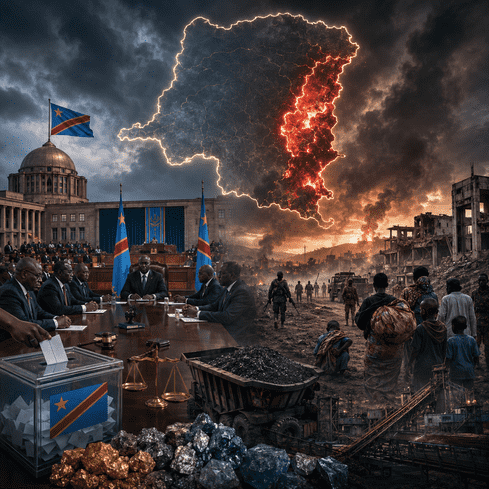
In a televised address from Kinshasa, Tshisekedi warned that elections scheduled for 2028 may not be possible unless the conflict in eastern Congo is resolved. The remarks immediately triggered criticism from opposition figures, who accused the president of using the security crisis as a pretext to weaken constitutional limits and extend his time in power. Congo’s constitution currently restricts presidents to two terms.
The timing is politically explosive. Tshisekedi is serving his second and constitutionally final term, which is due to end in 2028. His comments suggested that a third mandate could be considered if approved by the public through a referendum, a scenario that would place the country on a collision course with its own post-conflict democratic framework.
At the heart of the dispute is the war in eastern Congo, where fighting involving the M23 rebel movement has destabilized North Kivu and South Kivu. The conflict escalated sharply in 2025, when M23 rebels captured the strategic cities of Goma and Bukavu. The violence has killed thousands and displaced millions, creating one of the world’s most severe humanitarian crises.
For Tshisekedi, the argument is security first. He has said the country cannot organize a credible national vote while large parts of the east remain under threat. The political problem is that Congo has lived through this scenario before. Under former President Joseph Kabila, delayed elections after 2016 produced a prolonged legitimacy crisis, mass protests and intense international pressure before the eventual 2018 vote.
The current crisis also has a regional dimension. Rwanda has long been accused by Congo and international observers of supporting M23, an allegation Kigali denies. The United States has recently increased pressure around the conflict, including sanctions against former Congolese President Joseph Kabila over accusations that he supported rebel-linked destabilization efforts in eastern Congo. Kabila has denied wrongdoing.
Opposition leaders now fear that the government is preparing the ground for a constitutional referendum that could reset or remove presidential limits. Supporters of reform argue that the state needs stronger institutions and flexibility during wartime. Critics see a familiar pattern in African politics: insecurity used to justify postponed elections, followed by constitutional changes that concentrate power in the presidency.
The stakes extend beyond Congo’s borders. The DRC is central to global supply chains because of its vast mineral wealth, including cobalt and copper, both critical to batteries, energy infrastructure and advanced technologies. Political instability in Kinshasa could therefore reverberate through international markets, regional security arrangements and Western efforts to reduce dependence on strategic minerals controlled by rival powers.
For international partners, the challenge will be balancing two priorities that are increasingly difficult to separate: helping Congo defeat armed groups in the east while defending constitutional order in Kinshasa. Pressure on Rwanda, support for peace talks and humanitarian assistance may not be enough if the political calendar itself becomes contested.
Tshisekedi’s warning has transformed Congo’s security crisis into a democratic test. If the 2028 election remains on track, the country may preserve a fragile but essential constitutional rhythm. If it is delayed, or if the presidency moves toward a third-term referendum, Congo could face a new period of domestic confrontation at the very moment it can least afford another political rupture.