Breakthroughs in quantum hardware and encryption research are pushing the once-experimental technology closer to commercial reality — and raising new questions about cybersecurity and global competition.

Quantum computing, long considered one of the most ambitious frontiers in modern science, is rapidly evolving from a theoretical pursuit into a strategic global industry. Over the past several months, major technology companies and governments have significantly increased investment in quantum research, signaling growing confidence that the technology may soon reshape sectors ranging from cybersecurity and finance to medicine and defense.
Unlike traditional computers, which process information using binary bits represented as zeros or ones, quantum computers rely on quantum bits — or qubits — capable of existing in multiple states simultaneously. This phenomenon, known as superposition, allows quantum systems to perform highly complex calculations at speeds impossible for conventional machines.
The race to commercialize the technology has intensified sharply. IBM recently unveiled a new generation of quantum processors designed to reduce computational errors and improve system stability, one of the primary technical challenges preventing large-scale adoption. Google, Microsoft, and several Chinese technology firms are also accelerating research into fault-tolerant quantum systems capable of handling real-world industrial tasks.
Industry analysts believe the next major breakthrough may come in pharmaceutical research, where quantum computing could dramatically shorten the time required to simulate molecular interactions and develop new drugs. Financial institutions are also exploring the technology’s ability to optimize trading strategies, manage risk analysis, and process vast datasets in real time.
Yet alongside the excitement, quantum computing is generating growing concern within the cybersecurity community. Experts warn that sufficiently advanced quantum systems could eventually break many of today’s encryption standards, potentially exposing sensitive government, military, and financial communications. As a result, Western governments and technology companies are now investing heavily in so-called “post-quantum cryptography” — new encryption methods designed to resist quantum attacks.
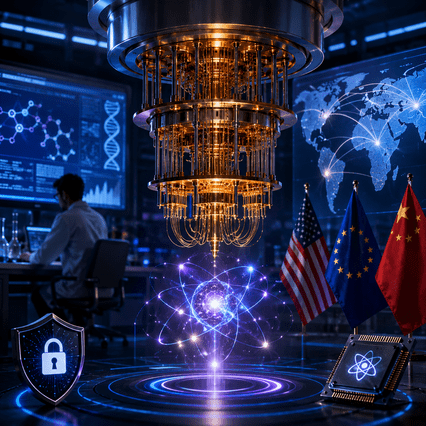
The geopolitical implications are equally significant. The United States, China, and the European Union increasingly view quantum technology not only as a scientific milestone, but as a matter of national strategic importance. Governments are pouring billions into research programs amid fears that whichever nation achieves practical quantum superiority first could gain major advantages in intelligence gathering, cybersecurity, and economic competitiveness.
Private investment is also accelerating. Venture capital funding for quantum startups reached record levels this year as investors seek exposure to what many believe could become the next major technological revolution after artificial intelligence. Startups specializing in quantum networking, quantum cloud services, and advanced cooling systems are attracting increasing attention from both institutional investors and large technology firms.
Despite the momentum, significant obstacles remain. Quantum systems are extraordinarily sensitive to temperature fluctuations, electromagnetic interference, and environmental noise. Most current machines still require highly controlled laboratory conditions and consume enormous amounts of energy.
Nevertheless, experts say the industry is approaching a critical turning point. While fully practical quantum computers may still be years away, the pace of progress has accelerated dramatically, transforming the field from an experimental niche into one of the world’s most closely watched technological races.
For governments, corporations, and cybersecurity agencies alike, the message is becoming increasingly clear: the quantum era is no longer a distant scientific possibility. It is beginning to emerge as a defining strategic challenge of the twenty-first century.