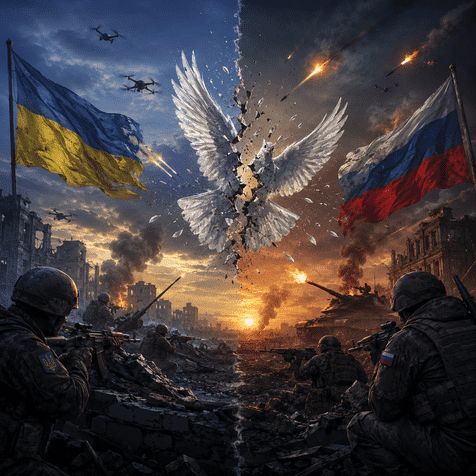
Moscow’s symbolic wartime pause fails to halt drone, missile and artillery attacks, underscoring the distance between battlefield gestures and a real peace process

Russia and Ukraine continued fighting on Friday despite Moscow’s declared ceasefire for Victory Day commemorations, with both sides accusing the other of violating the temporary pause.
Russian President Vladimir Putin had announced a unilateral ceasefire from May 8 to May 10 to mark the anniversary of the Soviet Union’s victory over Nazi Germany, one of Russia’s most politically significant national holidays. Kyiv rejected the limited proposal, arguing that a ceasefire tied to a symbolic celebration was insufficient, and instead called for an open-ended truce. Moscow did not accept that broader offer.
The result was not de-escalation, but another day of accusations and attacks. Russia said it had intercepted large numbers of Ukrainian drones, while Ukraine said Russian forces continued strikes and artillery fire along the front. The fighting highlighted how little trust remains between the two countries after more than four years of full-scale war.
For Moscow, the timing carried deep political symbolism. Victory Day is traditionally used by the Kremlin to project military strength, national unity and historical legitimacy. This year, however, the celebration unfolded under heightened security concerns, with reports of drone threats and a more restrained military display than in previous years.
For Kyiv, the ceasefire proposal looked less like a genuine opening for peace than a tactical gesture designed around Russia’s domestic calendar. President Volodymyr Zelenskyy has criticized Moscow’s approach, arguing that peace in Europe would be the most meaningful way to honor the memory of World War II rather than a brief pause that leaves the wider war intact.
The battlefield context remains severe. The war has settled into a grinding contest of drones, missiles, artillery and long-range strikes, with both countries seeking to pressure the other far beyond the front line. Ukraine has increasingly relied on drone operations against Russian military and energy targets, while Russia continues large-scale strikes against Ukrainian cities, infrastructure and military positions.
The failed ceasefire also exposes the weakness of current diplomacy. Ukraine’s negotiator Rustem Umerov has been in contact with U.S. officials as part of efforts to explore a path toward a peace agreement, but the gap between ceasefire rhetoric and battlefield reality remains wide.
European governments are watching closely. The continued fighting has reinforced concerns that any negotiation over Ukraine must include Kyiv directly and that a settlement imposed without Ukrainian consent would be unstable. EU officials are also preparing for the possibility of future talks with Russia, while stressing that Ukraine cannot be sidelined in decisions about its own territory and security.
The collapse of the Victory Day ceasefire is therefore more than a short-term military episode. It is a measure of the war’s political depth. A pause declared for symbolism could not overcome the strategic reality on the ground: both sides still believe they must keep fighting, and neither sees the other’s ceasefire language as credible.
As Russia marks its most important military holiday and Ukraine continues to defend against invasion, the failed truce sends a clear message. The war is not waiting for ceremonies, and peace will require far more than a temporary silence announced from Moscow.